- Animals
- ›Chordates
- ›Vertebrates
- ›Ray-finned Fishes
- ›Carps, Characins, Catfishes and Allies
- ›Catfishes
- ›Siluroidei
- ›North American Freshwater Catfishes
- ›Ameiurus
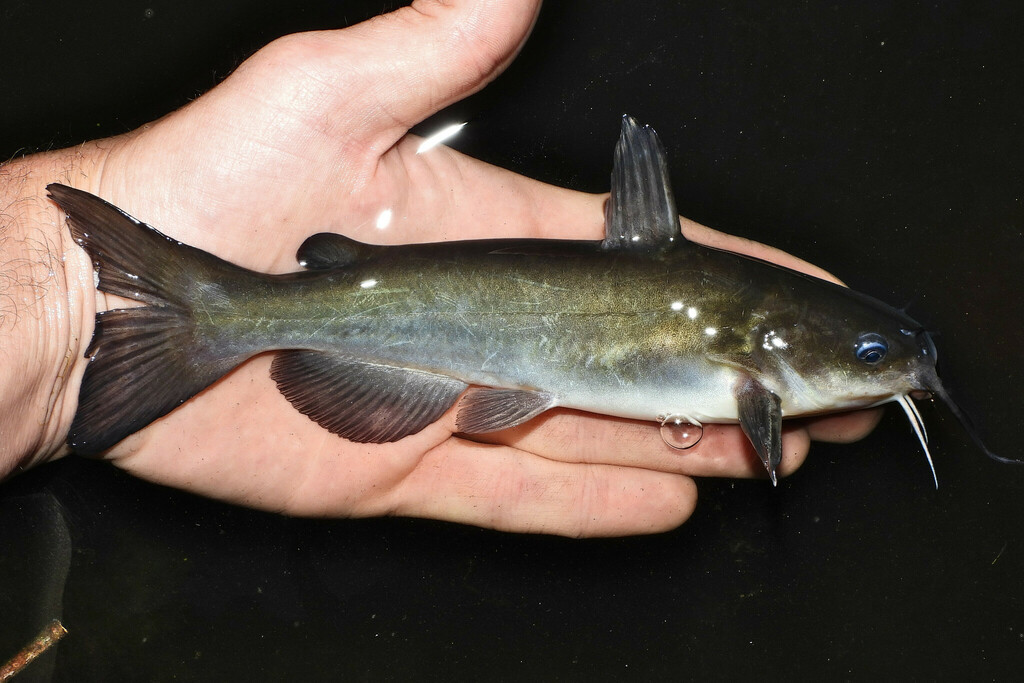
White Catfish
Ameiurus catus
The white bullhead, also known as the white catfish (Ameiurus catus), is a member of the family Ictaluridae of the order Siluriformes.
From the article White bullhead on Wikipedia (CC BY-SA), quoted section by section
Description
Ameiurus catus has a head with eight barbels, two nasal, two maxillary and four chin. It is scaleless. It has a spine on the anterior edge of its dorsal and pectoral fins. It usually has six dorsal soft rays. It does not have palatine teeth. It typically weighs between 0.5 and 2.0 pounds (0.23 and 0.91 kg), however, it can attain weights upwards of 10 pounds (4.5 kg). Like the yellow bullhead (Ameiurus natalis), white catfish have light-colored chin barbels. In A. catus the tail is forked, while it is rounded or truncate in A. natalis. In comparison to channel catfish (Ictalurus punctatus), A. catus typically has a larger head relative to its body width at maturity and a shorter anal fin relative to its body length bearing 22 to 24 rays.
Range & habitat
The white bullhead is native to river systems of the Eastern United States from the Hudson River in New York to the Peace River in Florida and west to the Apalachicola River, Florida. White bullheads may have migrated naturally into Connecticut rivers as a result of the white bullhead's salt tolerance. Elsewhere, the white bullhead has been widely introduced as a food and game fish, notably into California waters as a result of intentional stocking near Stockton in 1874. It has additionally become established in the Columbia River basin and in Puerto Rico as an introduced species. It was reportedly introduced to the Philippines but did not become established there. Escapees from fee-fishing ponds and stocked lakes have led to the establishment of white bullhead in Missouri.
Wikipedia: “Distribution”
What it does
White catfish feed mostly on the bottom, where they eat other fish and aquatic insects. They feed most actively at dusk and through the night mostly on bottom-dwelling insects, worms, amphipods, and other small invertebrates.
Wikipedia: “Feeding”
Where it lives
Recorded sightings
—
geo-referenced records in GBIF, from museums, herbaria and field observers.
Drag the globe to turn it. Dots are where records exist, not a range map; darker means more records.
In the stacks
Searching the stacks…
Every page naming Ameiurus catus in the Biodiversity Heritage Library →
This page is assembled live from iNaturalist, GBIF, Wikipedia, the Source Library and the Internet Archive. It is not yet part of the hand-edited codex. iNaturalist taxon 93844.