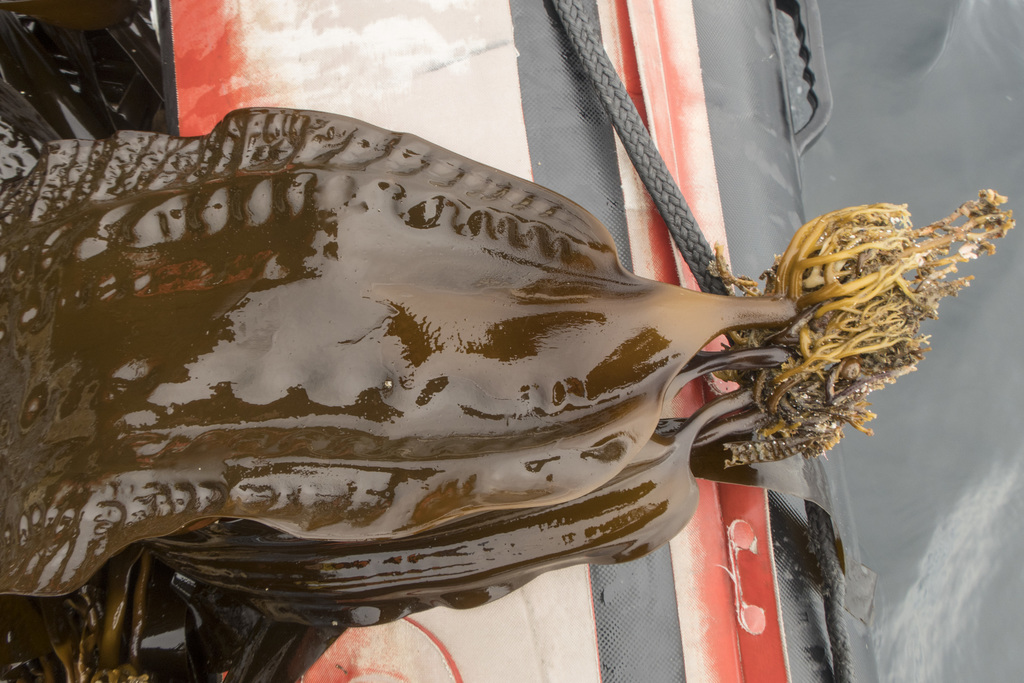
Kjellmaniella crassifolia
Kjellmaniella is a monotypic genus of kelp (large brown algae) comprising the species Kjellmaniella crassifolia, known as kagome (カゴメ/籠目) in Japanese. The species has received attention in recent years for fucoidan content and its multilateral profile of fucoidan chemicals compared to other seaweeds. It is now used in dietary supplements, cosmetics, and various processed foods (Cf. § Uses for the particulars).
It is characterized by textures appearing on the frond, described as dekoboko (凸凹; paraphrasable as 'bumps and dimples') or "gyrations".
From the article Kjellmaniella on Wikipedia (CC BY-SA), quoted section by section
Range & habitat
Kjellmaniella is found growing in the waters of Japan, Korea and Russian Far East (and Sakhalin). In the waters around Japan, the seaweed grows from southern Hokkaido down to the northern coasts of Shimokita Peninsula in Aomori Prefecture. They also grow in south Sakhalin, the vicinity of Strait of Tartary and the northern east coasts of the Korean Peninsula. It occupies subtidal or sublittoral habitats similar to kombu but in deeper waters, found anchored to rocky substrates by its holdfast connected to the stipe. The latter bears undivided blades, as typical for kelp species.
Wikipedia: “Distribution and habitat”
At the table
The seaweed is edible. Among its use as processed foods include tororo kombu or oboro kombu (machine- or hand-shaved shavings), Matsumae-zuke, and shio kombu (simmered in soy sauce). A rice dish called kagome meshi (かごめ飯) was developed in a collaborative effort for Hakodate city, as a new signature food item. As the name may suggest, this is rice mixed with chopped gagome seaweed, topped with various seafood. The gagome (개다지마[?], gaedajima[?]) is also amongst the seaweed harvested as "foodstuff" in parts of Korea also.
Wikipedia: “Culinary”
Where it lives
Recorded sightings
—
geo-referenced records in GBIF, from museums, herbaria and field observers.
Drag the globe to turn it. Dots are where records exist, not a range map; darker means more records.
In the stacks
Searching the stacks…
Every page naming Kjellmaniella crassifolia in the Biodiversity Heritage Library →
This page is assembled live from iNaturalist, GBIF, Wikipedia, the Source Library and the Internet Archive. It is not yet part of the hand-edited codex. iNaturalist taxon 941066.