On eBird ↗
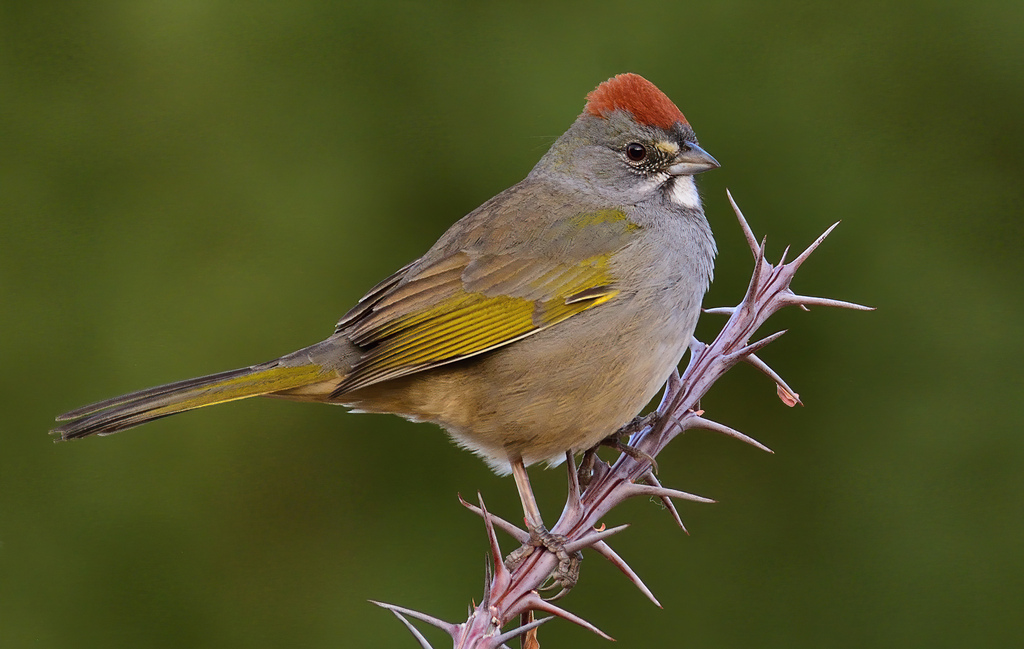
Green-tailed Towhee
Live sightings near you, the range map, bar charts of when it is seen, and Macaulay Library photos and recordings.
Green-tailed Towhee
Pipilo chlorurus
The green-tailed towhee (Pipilo chlorurus) is a species of bird in the family Passerellidae, the New World sparrows. It is found in the western United States and much of Mexico.
From the article Green-tailed towhee on Wikipedia (CC BY-SA), quoted section by section
Description
The green-tailed towhee is about 18 cm (7.1 in) long and weighs on average about 29 g (1.0 oz). Though the sexes have essentially the same plumage, females tend to be slightly duller than males. Adults have a reddish brown crown, a white spot above the lores, and a white "moustache" and throat on an otherwise gray head. Their hindneck, back, and scapulars are yellowish olive with grayish olive edges on the feathers. Their rump and uppertail coverts are grayish olive. Their tail is mostly greenish to yellow-green with olive brown edges on most feathers. Their wings are light fuscous with yellow-green edges on most flight feathers. Their breast and belly are grayish white, their sides and flanks pale gray with a creamy buff tinge, and their crissum creamy buff. Juveniles are comparatively drab with brownish gray upperparts and white underparts, both of which are heavily streaked with black.
Range & habitat
The green-tailed towhee has a large contiguous breeding range in the western U. S. and a few small populations outside it. It breeds from southeastern Washington, southern and southeastern Idaho, and southwestern Montana south through eastern Oregon and eastern California approximately to Kern County, in all but southernmost Nevada, in all of Utah, in all but northeastern Wyoming, in the western two-thirds of Colorado, most of the northern half of Arizona, and most of the northwestern half of New Mexico. There are isolated breeding areas in northwestern Oregon, north-central Montana, and the area where northeastern Wyoming and western South Dakota meet. It is found year-round in coastal southern California, in a band across central Arizona into west-central New Mexico, and in northern Baja California. It migrates through eastern Colorado, eastern New Mexico, and northwestern Texas. It winters coastally in California from approximately the San Francisco Bay area south and south from a line approximately across southern Nevada, central Arizona, central New Mexico, and central Texas south through Mexico to a line approximately from Jalisco to northern Oaxaca and in the east somewhat inland from central Tamaulipas to Oaxaca. Individuals have wandered as far north as northern Manitoba and east to Nova Scotia in Canada; in the U. S. …
Wikipedia: “Distribution and habitat”
What it does
The green-tailed towhee feeds on a wide variety of seeds and insects and includes smaller amounts of small fruits in its diet. It forages primarily on the ground, usually in dense vegetation, kicking backwards with both feet during a forward hop. It also simply picks food from the ground without the kick. In human-inhabited areas it visits feeders, especially during winter. During the breeding season it forages in pairs and in the non-breeding season is sometimes in small flocks of sparrows.
Wikipedia: “Feeding”
Listen
Looking for field recordings…
Where it lives
Recorded sightings
—
geo-referenced records in GBIF, from museums, herbaria and field observers.
Drag the globe to turn it. Dots are where records exist, not a range map; darker means more records.
In the stacks
Searching the stacks…
Every page naming Pipilo chlorurus in the Biodiversity Heritage Library →
This page is assembled live from iNaturalist, GBIF, Wikipedia, the Source Library and the Internet Archive. It is not yet part of the hand-edited codex. iNaturalist taxon 9419.