On eBird ↗
Eastern Towhee
Live sightings near you, the range map, bar charts of when it is seen, and Macaulay Library photos and recordings.
Eastern Towhee
Pipilo erythrophthalmus
The eastern towhee (Pipilo erythrophthalmus), also known as chewink, joree, or joree bird, is a large New World sparrow. The taxonomy of the towhees has been under debate in recent decades, and formerly this bird and the spotted towhee were considered a single species, the rufous-sided towhee.
Their breeding habitat is brushy areas across eastern North America. They nest either low in bushes or on the ground under shrubs. Northern birds migrate to the southern United States. One individual of this species was recorded as a vagrant to western Europe, a single bird in Great Britain in 1966.
From the article Eastern towhee on Wikipedia (CC BY-SA), quoted section by section
Description
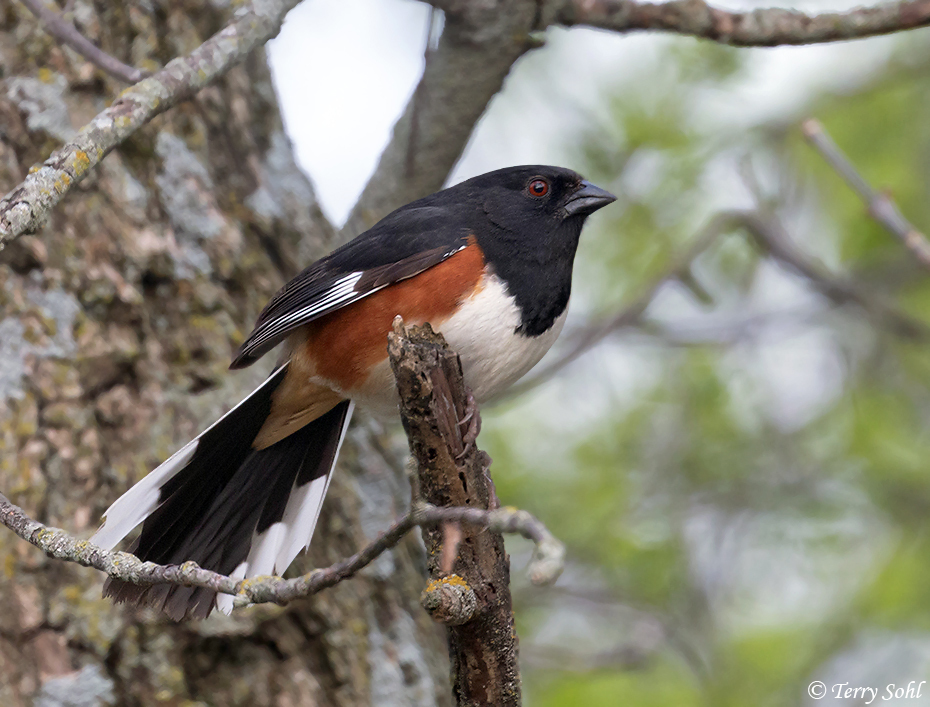
The eastern towhee is a large and striking species of sparrow. Their total lengths range from 17.3 to 23 cm (6.8 to 9.1 in) and their wingspans are 20–30 cm (7.9–11.8 in). The body of mass of this species ranges from 32 to 53 g (1.1 to 1.9 oz), with an average of 40 g (1.4 oz). Adults have rufous sides, a white belly, and a long, dark tail with white edges. The eyes are red for most populations, though populations in the southeastern U.S. have yellow eyes – often referred to as the "white-eye morph". Males have a black head, upper body, and tail; these parts are brown in the female. Juveniles are brown overall. Eastern towhees of all ages and both sexes generally are unmistakable. In the Great Plains, eastern towhees occasionally overlap in range with their sister species, the spotted towhee, which has resulted in rare hybrids between the two species.
Range & habitat
The eastern towhee occurs throughout the Eastern United States and southeast Canada. Occurrences from southern Saskatchewan, southwest Ontario, and Quebec south to Florida, and west to eastern Texas are noted in a literature review. Populations north of southern New England through northern Indiana and Illinois to southern Iowa primarily are summer residents. P. e. erythrophthalmus occurs in the most northerly part of the eastern towhee's distribution in the summer, and in winter migrates to the southern and eastern portion of the range of the species. The other subspecies are largely residents. P. e. canaster occurs from south-central Louisiana, north to northeastern Louisiana east through Mississippi, extreme southwestern Tennessee, northern Alabama and Georgia, central South Carolina to western North Carolina, and south to northwestern Florida and east along the Gulf Coast. The range of P. e. rileyi extends from northern Florida through southern Georgia and coastal South Carolina to east-central North Carolina. P. e. alleni occurs in peninsular Florida. The eastern towhee occurs in vegetation of disturbed areas, such as old-field successional vegetation and shrubby areas of power line rights-of-way. …
Wikipedia: “Distribution”
At the table
Eastern towhees primarily eat on the ground, although they also glean from vegetation. In a southeastern Massachusetts pitch pine barren, 73.5% of male and 80.4% of female foraging observations were on the ground. When foraging on the ground eastern towhees use a scratching technique where both feet kick back simultaneously. In a laboratory study four eastern towhees used this method to successfully obtain seed buried almost 1 inch (2.5 cm) deep. When foraging above ground the majority of time is spent gleaning foliage. In Massachusetts, 22.5% of male and 16.3% of female foraging observations were of food being gleaned from foliage. Eastern towhees were also observed gleaning from twigs, branches, and trunks. When gleaning, eastern towhees occurred significantly (p<0.01) more often on the distal half of tree branches compared to using distal and proximal portions equally. In 0.5% of male and 0.3% of female foraging observations, eastern towhees hovered. Eastern towhees were never observed catching food out of the air. Eastern towhees eat a variety of plant and animal matter. In literature reviews, eastern towhees are reported to eat seeds and fruits, several invertebrates, and occasionally small amphibians, snakes, and lizards. Reviews report eastern towhees foraging at feeders. Reviews show that animal matter makes up a larger proportion of the diet in the breeding season. …
Wikipedia: “Food habits”
Listen
Looking for field recordings…
Where it lives
Recorded sightings
—
geo-referenced records in GBIF, from museums, herbaria and field observers.
Drag the globe to turn it. Dots are where records exist, not a range map; darker means more records.
In the old herbals & bestiaries

In the stacks
Searching the stacks…
Every page naming Pipilo erythrophthalmus in the Biodiversity Heritage Library →
This page is assembled live from iNaturalist, GBIF, Wikipedia, the Source Library and the Internet Archive. It is not yet part of the hand-edited codex. iNaturalist taxon 9424.