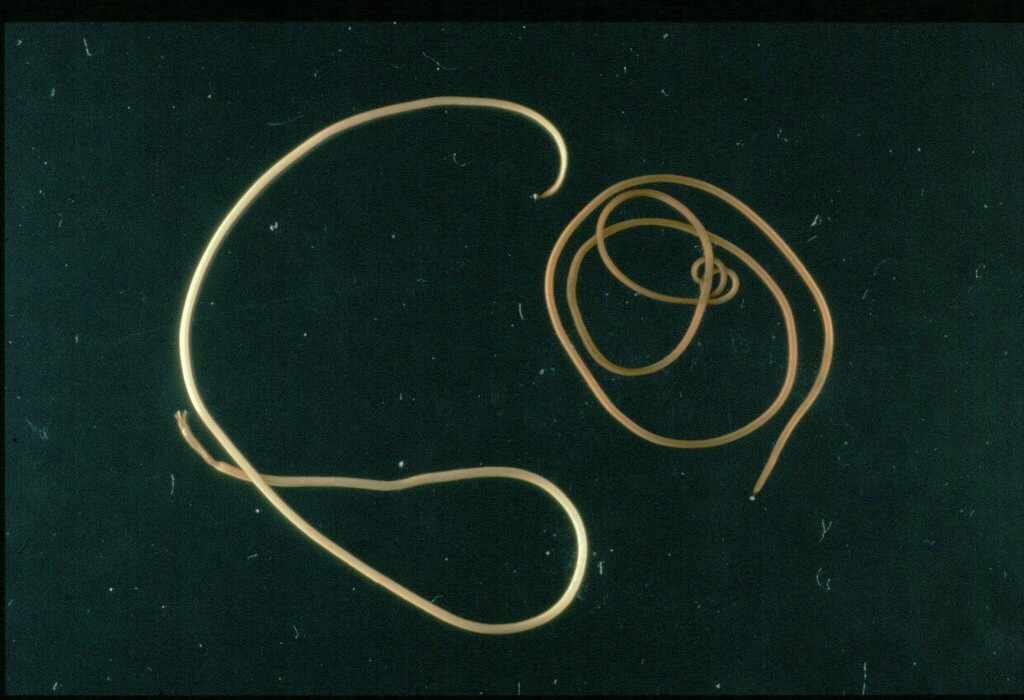
Paragordius tricuspidatus
Paragordius tricuspidatus belongs to the phylum Nematomorpha, and is known for manipulating the behavior of its host, the cricket Nemobius sylvestris. In its larval stage, the worm is microscopic, but grows into a large worm (10–15 cm or 3.9–5.9 in) inside its host after accidental ingestion since their eggs are laid at the edge of the water by rivers where crickets frequently reside. Upon ingestion, the worm nourishes upon its host and fills the entire body cavity of...
From the article Paragordius tricuspidatus on Wikipedia (CC BY-SA), quoted section by section
What it does
In its larval stage, the worm is microscopic, but grows into a large worm (10–15 cm or 3.9–5.9 in) inside its host after accidental ingestion. Eggs are laid at the edge of the water by rivers where crickets frequently reside. Upon ingestion, the worm nourishes upon its host and fills the entire body cavity of the cricket, until maturation, when the parasitic worm is ready to exit into water to complete its life cycle.
Hijacking of host behavior. The worm induces a peculiar behavior in its cricket host which causes the cricket to leap into water whereby the parasitic worm can slither out and find its mate, while the cricket often perishes. Studies of this parasitic worm have shown that the manipulative tactics of Paragordius tricuspidatus may be chemically based. In the related Spinochordodes tellinii, another parasitic and brain-manipulative nematomorph, the parasitic worm produces certain effector molecules to manipulate the cricket's central nervous system to behave in ways that are out of the norm for the insect, as in jumping into water. In addition, S.tellinii produces a group of proteins in the Wnt family that are similar to insect proteins, which suggests molecular mimicry as a possible source for behavioral manipulation.
Defense from predation. …
Wikipedia: “Life cycle”
Where it lives
Recorded sightings
—
geo-referenced records in GBIF, from museums, herbaria and field observers.
Drag the globe to turn it. Dots are where records exist, not a range map; darker means more records.
In the stacks
Searching the stacks…
Every page naming Paragordius tricuspidatus in the Biodiversity Heritage Library →
This page is assembled live from iNaturalist, GBIF, Wikipedia, the Source Library and the Internet Archive. It is not yet part of the hand-edited codex. iNaturalist taxon 944820.