- Animals
- ›Chordates
- ›Vertebrates
- ›Ray-finned Fishes
- ›Spiny-rayed fishes
- ›Freshwater Sunfishes, Grunters, and Allies
- ›Freshwater Sunfishes and relatives
- ›Freshwater Sunfishes
- ›Centrarchinae
- ›Archoplites
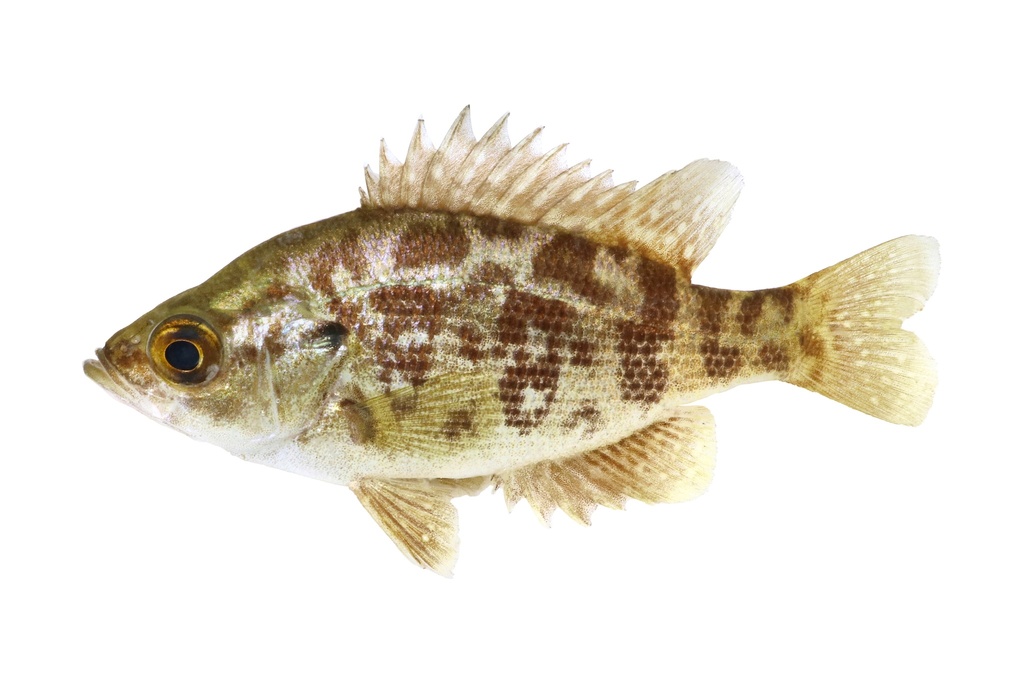
Sacramento Perch
Archoplites interruptus
The Sacramento perch (Archoplites interruptus) is a species of freshwater sunfish endemic to California, and transplanted to other parts of the western United States. It is the only extant species within the genus Archoplites. It is the only species of freshwater sunfish whose native habitat resides west of the Rocky Mountains, while all the other species are native to the east. Due its small range and the impact of introduced species on it, it is considered Endangered on the IUCN Red List.
They are indigenous to the Sacramento–San Joaquin River Delta, Pajaro, and Salinas River areas but have been widely introduced outside their native range throughout California. They have also been introduced outside of the state, in Nebraska, Nevada, Oregon, Utah, Colorado, Arizona, New Mexico, South Dakota, North Dakota, and Texas, to revive their populations. While there is no updated analysis of their populations in these states, it is certain that they still exist throughout California. However, there is speculation of viable populations in Utah, Nevada, and Colorado. The Sacramento perch's native habitat is in sluggish, heavily vegetated waters of sloughs and lakes. It can reach a maximum overall length of 73 cm (29 in) and a maximum weight of 1.4 kg (3.1 lb), and it has been reported to live as long as nine years. Its adaptability to different habitats is variable, and it can survive on various food sources, from insects, bottom-dwelling snails, phytoplankton, and small fishes.
From the article Sacramento perch on Wikipedia (CC BY-SA), quoted section by section
Description
The body shape of this fish is laterally compressed, and it is considered to be deep-bodied for a Centrarchid species. Being deep-bodied refers to it being wide in length from its ventral to dorsal side. On average, its depth is 2.5 times greater than the average length of all other Centrarchids. This fish has a slightly angled mouth in the superior position, indicating that it feeds on insects near the middle of the water column. The mouth is large, with numerous small teeth found on its jaws, tongue, and roof of its mouth. The dorsal fin has a strictly spiny portion with about 12–14 spines that is continuous, with the soft-rayed portion that has 10–11 spines. It has fairly large cycloid scales numerously ranging from 38 to 48 along the lateral line in an adult. It has a combination of white, silver, and dark brown colored scales.
The Sacramento perch is most identifiable by its irregular dark brown vertical bars that almost resemble stripes, giving it great cryptic coloration in dark and vertically broken-up habitats provided by aquatic plants. The females, however, tend to have these bars less prominent and have more of an even coloration with the silver scales. There are about 25–30 gill rakers in its gills, and has black spots on the operculum. During the breeding season, there tends to be more sexual dimorphism. …
Range & habitat
Historically, the Sacramento perch was found throughout the Central Valley of California at elevations below 100 m. The Sacramento perch was very popular for recreational fishing. It was so abundant that this species was commonly used as a food fish eaten regularly. It inhabited sloughs, slow-moving rivers of the Pajaro and Salinas rivers, and lakes with emergent vegetation such as Clear Lake. This species has been eliminated from 90% of its natural habitat due to habitat destruction, egg predation by invasive fish species, and interspecific competition with other centrarchids, mainly bluegill. Sacramento perch are quite rare in their native range and are found primarily in warm, turbid, and alkaline farm ponds, reservoirs, and recreational lakes that it has been introduced into. Sacramento perch populations exist in six California watersheds, including Clear Lake Reservoir, Cedar Creek, Walker River, upper Owens River, Mono Lake, and Abbotts Lagoon. In Colorado, there were two successful introductions in private land, one in Abrams Lake and the other in Gilberts Pond. The growth rate of the fish here was very rapid, but spawning is yet to be determined. Sacramento perch populations in Nevada were transplanted in 1877 from the Sacramento River into Washoe Lake. Eventually, they were moved again into Pyramid and Walker Lake in 1880. …
Wikipedia: “Distribution”
What it does
Aquatic insects are critical to the Sacramento perch's diet. This fish mostly feeds on chironomid midge larvae and pupae found on the bottom or in aquatic plants during winter months. Triochopteran larvae and recently hatched boatmen are also common insect food sources. During the summer months, this fish will mostly feed on plankton and other surface organisms. The Sacramento perch is an opportunistic species and will generally prey upon whatever is in abundance. They have even been shown to eat mosquito larvae. However, eating mosquito larvae is rare because these fishes are mainly midwater swimmers and do not usually feed on terrestrial or flying insects. The younger and smaller adult perches mostly feed on small benthic crustaceans. As they grow, they move on to chironomid larvae and other fish, including their own species on rare occasions. Sacramento perch of Pyramid Lake have been found feeding on Tui chubs and Tahoe suckers. Based on experimental designs in aquariums, they usually hunt alone and will slowly stalk their prey for a period of time. Once their prey becomes comfortable and loses focus, it is unprecedentedly snatched by the perch's sudden burst toward the prey. This behavior differs from the bluegill, its main competitive species, which usually hunts in schools and is much more aggressive towards its prey. …
Wikipedia: “Diet”
Where it lives
Recorded sightings
—
geo-referenced records in GBIF, from museums, herbaria and field observers.
Drag the globe to turn it. Dots are where records exist, not a range map; darker means more records.
In the stacks
Searching the stacks…
Every page naming Archoplites interruptus in the Biodiversity Heritage Library →
This page is assembled live from iNaturalist, GBIF, Wikipedia, the Source Library and the Internet Archive. It is not yet part of the hand-edited codex. iNaturalist taxon 94516.