On eBird ↗
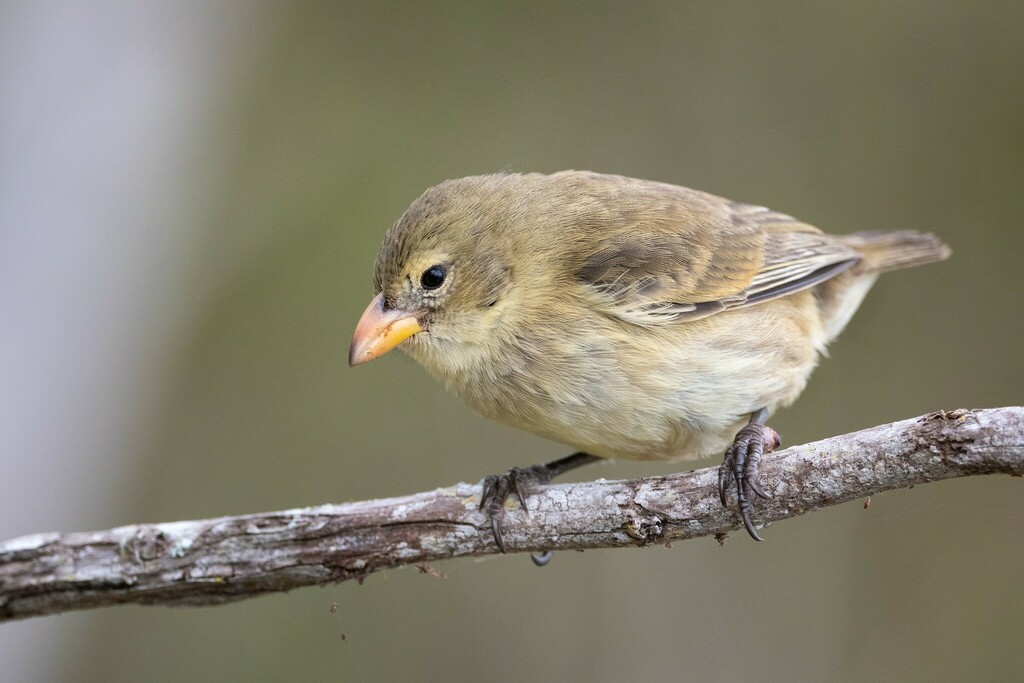
Woodpecker Finch
Live sightings near you, the range map, bar charts of when it is seen, and Macaulay Library photos and recordings.
Woodpecker Finch
Camarhynchus pallidus
The woodpecker finch (Camarhynchus pallidus) is a monomorphic species of bird in the Darwin's finch group of the tanager family Thraupidae, endemic to the Galapagos Islands. The diet of a woodpecker finch revolves mostly around invertebrates, but also encompasses a variety of seeds. Woodpecker finches, like many other species of birds, form breeding pairs and care for young until they have fledged. The most distinctive characteristic of woodpecker finches is their ability to use tools for foraging. This behaviour indicates that they have highly specialized cognitive abilities. Woodpecker finches have also shown the ability to learn new behaviours regarding tool use via social learning. Not all populations of woodpecker finches use tools equally often, as this is influenced by the environment in which they live.
From the article Woodpecker finch on Wikipedia (CC BY-SA), quoted section by section
Description
Woodpecker finches range in weight from 23 to 29 g (0.81 to 1.02 oz) and are about 15 cm (5.9 in) long. Although their tongues are quite short, they have a relatively long bill compared to other species of Darwin's finches.
Range & habitat
Woodpecker finches are native to the Galapagos Islands. They are commonly found on the islands of Isabela, Santa Cruz, San Cristobal, Fernandina, Santiago, and Penzón. They occupy all areas of the islands, from the most arid zones to more humid zones. However, the density of woodpecker finches is greater in the more humid zones than in the drier ones. Woodpecker finches are also found at a variety of altitudes, from sea level to higher inland elevations. They are not a migratory species and when they do fly, they only fly short distances.
Wikipedia: “Distribution”
What it does
Woodpecker finch diets mainly consist of arthropods found under dead logs and rocks. They also eat larvae, which are often located inside dead logs. Their habit of pecking at fallen logs is similar to a woodpecker's drumming on a tree trunk. Wood-boring beetle larvae are a staple of their diet. They also often feed on moths, caterpillars, and crickets. Another significant part of their diet includes meat from the small animals it kills, making woodpecker finches important hunters.
Wikipedia: “Diet”
Listen
Looking for field recordings…
Where it lives
Recorded sightings
—
geo-referenced records in GBIF, from museums, herbaria and field observers.
Drag the globe to turn it. Dots are where records exist, not a range map; darker means more records.
In the stacks
Searching the stacks…
Every page naming Camarhynchus pallidus in the Biodiversity Heritage Library →
This page is assembled live from iNaturalist, GBIF, Wikipedia, the Source Library and the Internet Archive. It is not yet part of the hand-edited codex. iNaturalist taxon 9473.