On eBird ↗
Ruddy-breasted Seedeater
Live sightings near you, the range map, bar charts of when it is seen, and Macaulay Library photos and recordings.
Ruddy-breasted Seedeater
Sporophila minuta
The ruddy-breasted seedeater (Sporophila minuta) is a species of bird in the family Thraupidae. It is found in Brazil, Colombia, Costa Rica, Ecuador, El Salvador, French Guiana, Guatemala, Guyana, Honduras, Mexico, Nicaragua, Panama, Suriname, Trinidad and Tobago, and Venezuela. Its natural habitats are dry savanna, subtropical or tropical seasonally wet or flooded lowland grassland, and heavily degraded former forest.
From the article Ruddy-breasted seedeater on Wikipedia (CC BY-SA), quoted section by section
Description
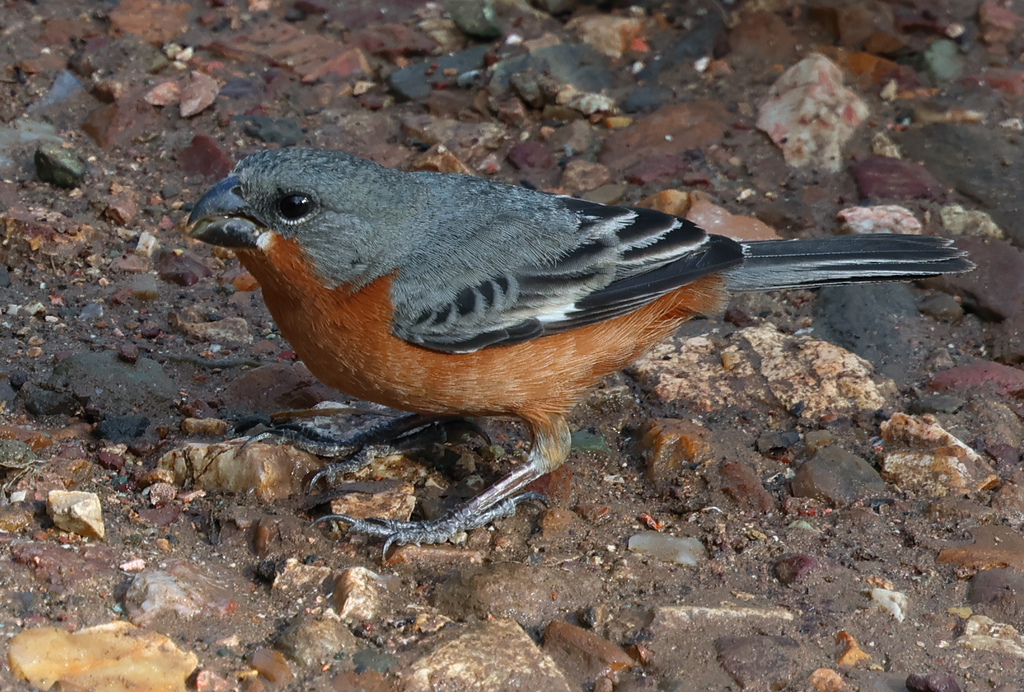
The ruddy-breasted seedeater is 8.6 to 9.6 cm (3.4 to 3.8 in) long and weighs 7 to 9 g (0.25 to 0.32 oz). It is one of the smallest of its genus. It has a short, thick bill with a rounded culmen. The species is sexually dimorphic. Adult males of the nominate subspecies S. m. minuta have a medium gray head with a tiny white spot behind the bill. Their upper back is medium gray with faint brownish streaks. Their lower back and rump are rufous, their longest uppertail coverts medium gray, and the rest rufous. Their tail is mostly blackish with olive feather edges. Their wings are blackish brown with wide grayish edges on the coverts and tertials. Their wing's primaries have white bases that show as a white rectangle on the folded wing. Their throat and underparts are rufous. Females have a warm buffy brown head and upperparts. Their wings and tail are a slightly darker buffy brown. Their throat and underparts are buffy brown that is paler buff on the throat and belly. Males of subspecies S. m. parva have more blue-gray, without brown, upperparts than the nominate. Females have warmer buff underparts. Males of S. m. centralis have a brownish wash on their upperparts and paler underparts than the nominate. Females are like the nominate. Both sexes of all subspecies have a dark brown iris and blackish legs. Males have a blackish bill and females a dark horn one.
Range & habitat
The ruddy-breasted seedeater has a disjunct distribution: Each subspecies is separate from the others. The subspecies are found thus:
S. m. parva: from Nayarit in western Mexico south on the Pacific lowlands through southern Guatemala, El Salvador, extreme southern Honduras, and Nicaragua slightly into northern Costa Rica's Alajuela Province S. m. centralis: from southern San José and southern Puntarenas provinces in southwestern Costa Rica south along most of the Pacific slope of Panama S. m. minuta: from west of the Andes in northwestern Venezuela south through all three ranges of the Colombian Andes into northwestern Ecuador at least to western Imbabura Province; from southwestern Colombia widening northeast to Venezuela, there across most of the northern half of the country, western Amazonas, and eastern Bolívar states, continuing across the northern parts of the Guianas into northeastern Brazil around the mouth of the Amazon River in Amapá and Pará states; Trinidad but not Tobago; and a few scattered records in far northwestern Brazil adjacent to Colombia and Venezuela The ruddy-breasted seedeater inhabits open landscapes including savanna, grassy areas with brambles (Rubus) and wild roses (Rubus), parks and lawns in settled areas, and clearings in forest. …
Wikipedia: “Distribution and habitat”
What it does
The ruddy-breasted seedeater feeds primarily on grass seeds, though it includes small amounts of other seeds, fruit, and arthropods in its diet. It feeds mostly while clinging to grass stems, sometimes becoming upside-down when stems bend. It often forages in groups that include other seed-eating species.
Wikipedia: “Feeding”
Listen
Looking for field recordings…
Where it lives
Recorded sightings
—
geo-referenced records in GBIF, from museums, herbaria and field observers.
Drag the globe to turn it. Dots are where records exist, not a range map; darker means more records.
In the stacks
Searching the stacks…
Every page naming Sporophila minuta in the Biodiversity Heritage Library →
This page is assembled live from iNaturalist, GBIF, Wikipedia, the Source Library and the Internet Archive. It is not yet part of the hand-edited codex. iNaturalist taxon 9492.