- Animals
- ›Chordates
- ›Vertebrates
- ›Ray-finned Fishes
- ›Carps, Characins, Catfishes and Allies
- ›Catfishes
- ›Siluroidei
- ›Bagrid Catfishes
- ›Bagrus
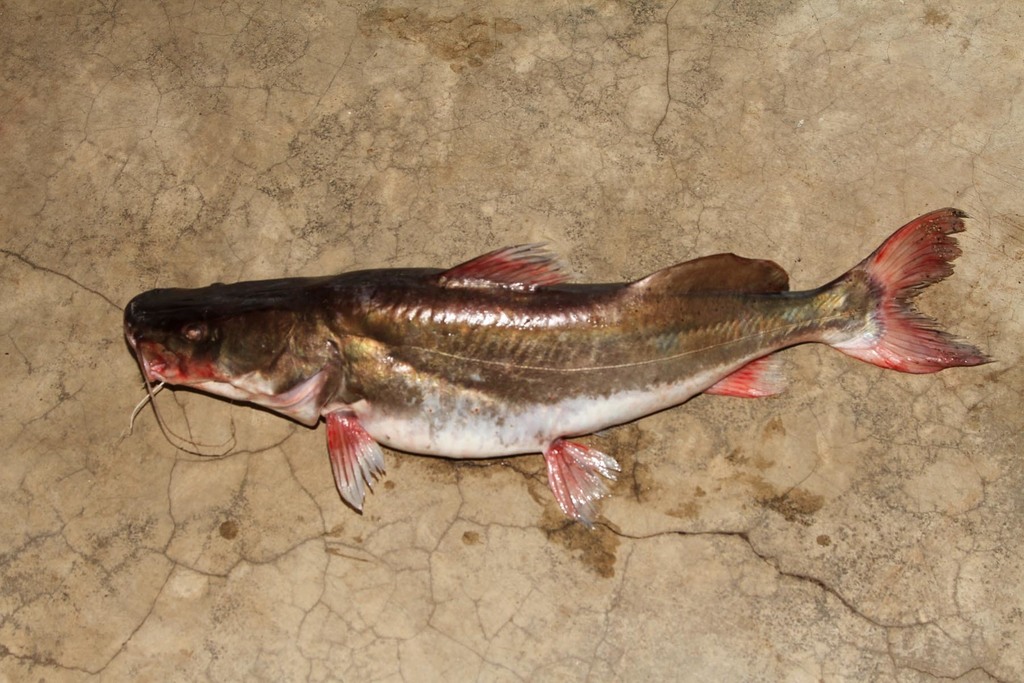
Kampoyo
Bagrus meridionalis
The kampango or kampoyo (Bagrus meridionalis) is a critically endangered species of large and predatory bagrid catfish that is endemic to Lake Malawi, Lake Malombe and the upper Shire River in Africa. It prefers areas near rocks in water shallower than 50 m (160 ft), but it also occurs deeper (not beyond the oxygen limit) and over a sandy or muddy bottom.
From the article Kampango on Wikipedia (CC BY-SA), quoted section by section
Description
The kampango is among the largest fish in the Lake Malawi basin, reaching up to about 1 m (3.3 ft) long, or possibly even 1.5 m (4.9 ft). A common length is around 42 cm (1.4 ft) and females are typically larger than males. Adults are overall blackish, while young are grey with dark spots. During the day kampangos hide in caves, but around dusk or dawn they hunt and eat their prey, primarily cichlids.
Breeding. The male digs a shallow nest in the sandy bottom, often near rocks, where the female lays several thousand eggs. After hatching, the young mostly eat trophic (unfertilized) egg that their mother lays, but they also take invertebrates that the father brings to them in his mouth. The eggs and young are fiercely guarded by the parents. The young kampango only leave the protection of their parents when around 12 cm (4.7 in) long, but before that most have typically already been eaten by egg- and fry-stealing cichlids like Mylochromis melanonotus and Pseudotropheus crabro. At other times Pseudotropheus crabro has a mutualistic relationship with the kampango, as it will clean it by feeding on parasites and dead tissue. Another catfish, Bathyclarias nyasensis, is a brood parasite of the kampango. Kampango parents have been observed taking care of entire broods of B. nyasensis young as if they were their own. As these broods almost exclusively contain B. …
Wikipedia: “Appearance and behavior”
Where it lives
Recorded sightings
—
geo-referenced records in GBIF, from museums, herbaria and field observers.
Drag the globe to turn it. Dots are where records exist, not a range map; darker means more records.
In the stacks
Searching the stacks…
Every page naming Bagrus meridionalis in the Biodiversity Heritage Library →
This page is assembled live from iNaturalist, GBIF, Wikipedia, the Source Library and the Internet Archive. It is not yet part of the hand-edited codex. iNaturalist taxon 95047.