On eBird ↗
White-throated Seedeater
Live sightings near you, the range map, bar charts of when it is seen, and Macaulay Library photos and recordings.
White-throated Seedeater
Sporophila albogularis
The white-throated seedeater (Sporophila albogularis) is a species of bird in the family Thraupidae, the tanagers and allies. It is endemic to northeastern Brazil.
From the article White-throated seedeater on Wikipedia (CC BY-SA), quoted section by section
Description
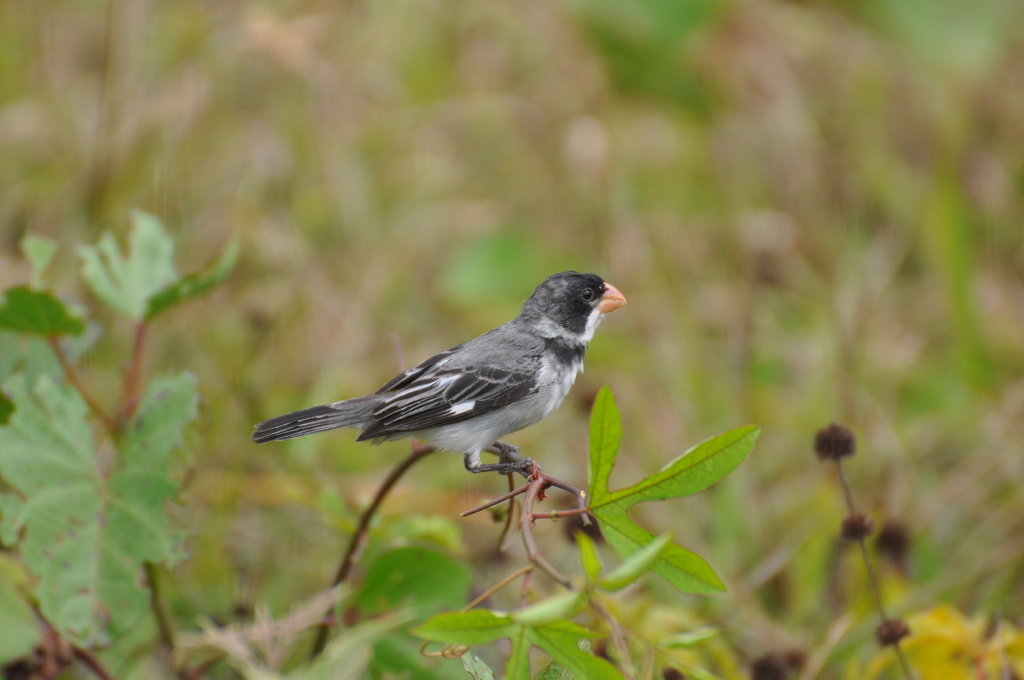
The white-throated seedeater is about 11 cm (4.3 in) long and weighs about 9.7 g (0.34 oz). It has a thick bill with a rounded culmen. The species is sexually dimorphic. Adult males have a blackish crown and face with a white spot above the lores, a white arc below the eye, and a white throat whose color extends rearward as a partial collar most of the way around the neck. The rest of their head, their nape, and their upperparts are dark grayish. Their tail is darker gray. Their wings are darker gray with white bases on the primaries that show as a patch on the closed wing. They have a narrow blackish band below the throat and the rest of their underparts are mostly whitish with grayish sides on the breast and a gray wash on the flanks. Females have a warm buffy brown head, upperparts, wings, and tail. Their throat is whitish, their breast and flanks warm buffy brown, and their belly and vent whitish. Both sexes have a dark brown iris. Males have an orange-yellow to orange-pink bill and blackish legs. Females have a dusky bill and legs.
Range & habitat
The white-throated seedeater is found in northeastern Brazil from the Atlantic west to a line that roughly traces from northeastern Maranhão south to western Bahia and then northeast to northeastern Bahia. There are also scattered records further north and west. It inhabits caatinga scrublands and the edges of shrubby woodland at elevations up to 1,200 m (3,900 ft).
Wikipedia: “Distribution and habitat”
What it does
The white-throated seedeater feeds primarily on grass seeds. It feeds mostly on the ground and sometimes while clinging to stems. In the non-breeding season it usually forages in small groups.
Wikipedia: “Feeding”
Listen
Looking for field recordings…
Where it lives
Recorded sightings
—
geo-referenced records in GBIF, from museums, herbaria and field observers.
Drag the globe to turn it. Dots are where records exist, not a range map; darker means more records.
In the stacks
Searching the stacks…
Every page naming Sporophila albogularis in the Biodiversity Heritage Library →
This page is assembled live from iNaturalist, GBIF, Wikipedia, the Source Library and the Internet Archive. It is not yet part of the hand-edited codex. iNaturalist taxon 9513.