On eBird ↗
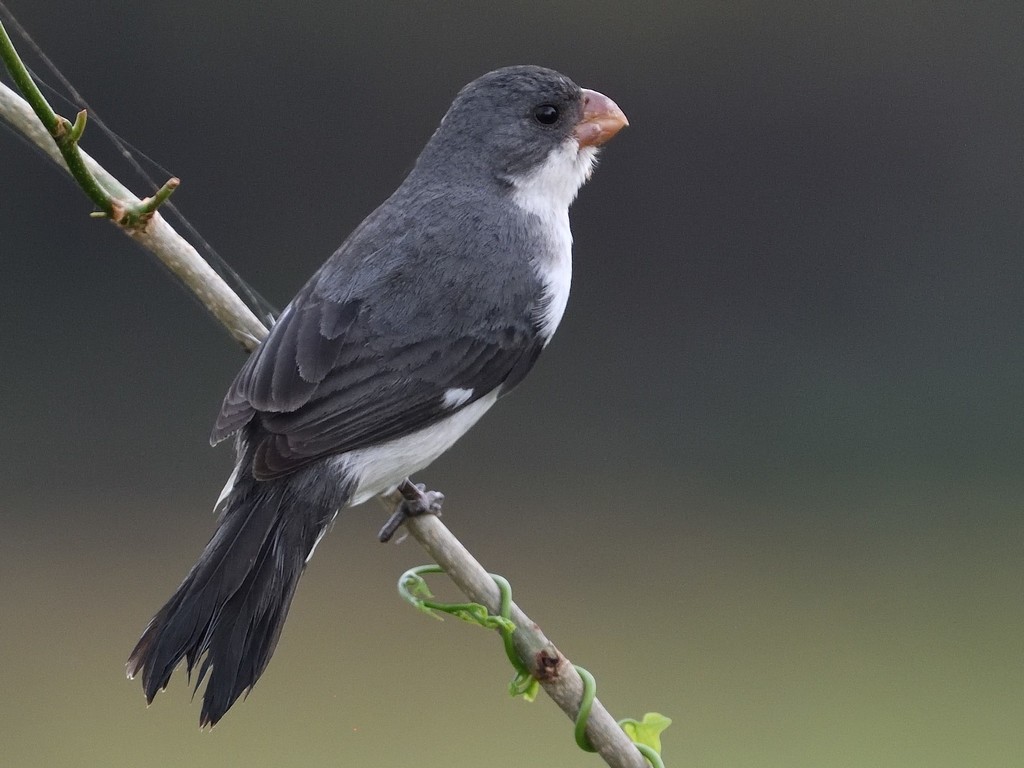
White-bellied Seedeater
Live sightings near you, the range map, bar charts of when it is seen, and Macaulay Library photos and recordings.
White-bellied Seedeater
Sporophila leucoptera
The white-bellied seedeater (Sporophila leucoptera) is a species of bird in the family Thraupidae. It is found mainly in Bolivia, Paraguay and eastern Brazil, with smaller numbers in Suriname, southeastern Peru and northern Argentina. Its natural habitats are subtropical or tropical moist shrubland, swamps, and heavily degraded former forest.
From the article White-bellied seedeater on Wikipedia (CC BY-SA), quoted section by section
Description
The white-bellied seedeater is 11 to 12.5 cm (4.3 to 4.9 in) long and weighs about 15 to 16 g (0.53 to 0.56 oz). It is a rather large seedeater with a longish tail. It has a very short, thick, bill with a rounded culmen. The species is sexually dimorphic. Adult males of the nominate subspecies S. l. leucoptera have a dark gray head that is slightly darker near the lores and a white throat and submoustachial area. Their upperparts are dark gray with a thin white band on the rump. Their tail is darker gray. Their wings are darker gray with white bases on the primaries that show as a patch on the closed wing. Their underparts are almost entirely white with slightly more grayish sides and flanks. Females have a warm tawny brown head, upperparts, wings, and tail. Their throat and belly are pale tawny brown and their breast and flanks intermediate between that and the upperparts' color. The other subspecies of the white-bellied seedeater differ from the nominate and each other thus:
S. l. mexianae: males have paler gray upperparts than nominate with no white rump band and entirely white (no gray) underparts S. l. cinereola: smaller than nominate; males have paler gray upperparts with no white rump band and more gray on the flanks S. l. …
Range & habitat
The white-bellied seedeater has a disjunct distribution. The subspecies are found thus:
S. l. mexianae: southern Suriname; separately in northern Brazil's southern Amapá state and Mexiana Island in northeastern Pará S. l. cinereola: eastern Brazil from central Maranhão east to Paraíba and south to Rio de Janeiro state S. l. leucoptera: central and southern Brazil from Goiás and Minas Gerais south to Mato Grosso and through Paraguay into northern Argentina as far as Santa Fe Province S. l. bicolor: northern and eastern Bolivia (but see below) Some sources also include far southeastern Peru in the range of S. l. bicolor. However, as of 2010 it was known in that country only from a single sight record. The South American Classification Committee lists it as a vagrant to Peru. The committee also lists the species as a vagrant in French Guiana and Uruguay. The white-bellied seedeater inhabits shrubby grasslands and adjacent forest edges, and always near water. In elevation it reaches 800 m (2,600 ft).
Wikipedia: “Distribution and habitat”
What it does
The white-bellied seedeater feeds on grass seeds and those of other plants with some insects also in its diet. It feeds mostly while clinging to plant stems. It typically forages singly or in pairs and seldom in flocks.
Wikipedia: “Feeding”
Listen
Looking for field recordings…
Where it lives
Recorded sightings
—
geo-referenced records in GBIF, from museums, herbaria and field observers.
Drag the globe to turn it. Dots are where records exist, not a range map; darker means more records.
In the stacks
Searching the stacks…
Every page naming Sporophila leucoptera in the Biodiversity Heritage Library →
This page is assembled live from iNaturalist, GBIF, Wikipedia, the Source Library and the Internet Archive. It is not yet part of the hand-edited codex. iNaturalist taxon 9514.