On eBird ↗
Yellow-bellied Seedeater
Live sightings near you, the range map, bar charts of when it is seen, and Macaulay Library photos and recordings.
Yellow-bellied Seedeater
Sporophila nigricollis
The yellow-bellied seedeater (Sporophila nigricollis) is a species of bird in the family Thraupidae, the tanagers and allies. It is found in Costa Rica, Panama, on Trinidad, in the Lesser Antilles, and in every South American country except Chile and Uruguay. However, it has been found in Argentina only as a vagrant and reports from Paraguay are unconfirmed.
From the article Yellow-bellied seedeater on Wikipedia (CC BY-SA), quoted section by section
Description
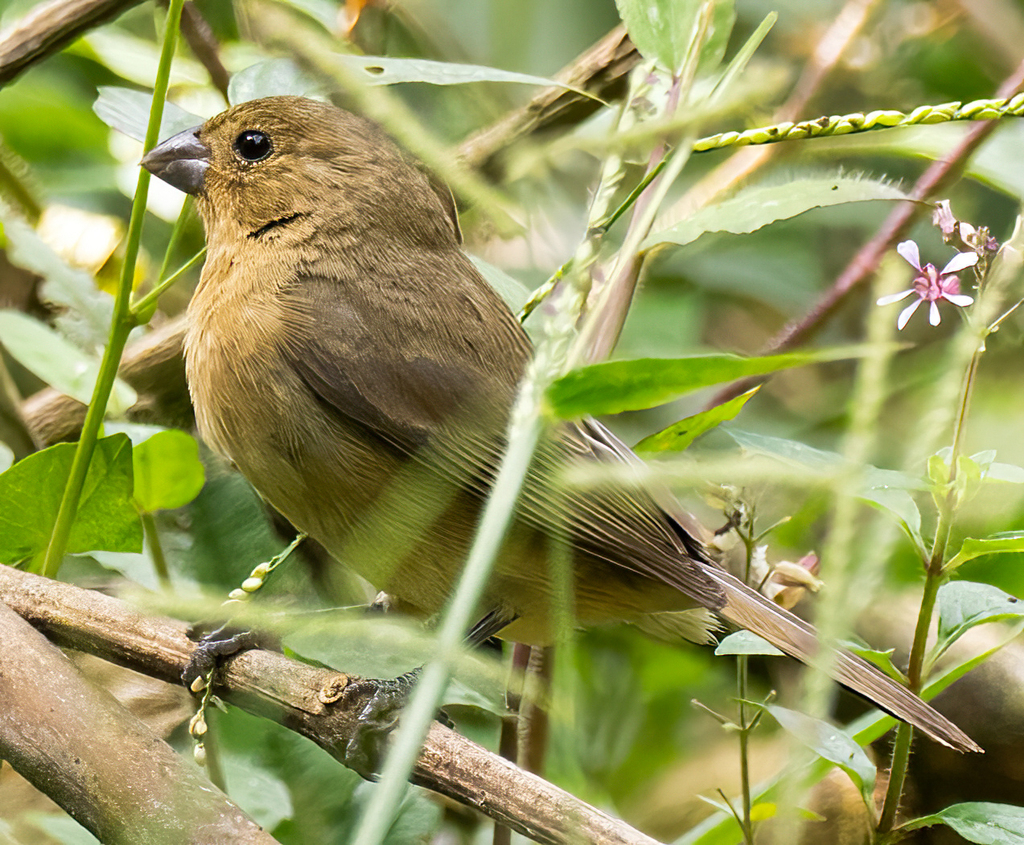
The yellow-bellied seedeater is 8.5 to 10.3 cm (3.3 to 4.1 in) long and weighs 8.5 to 11.2 g (0.30 to 0.40 oz). It has a short thick bill with a rounded culmen. The species is sexually dimorphic. Adult males of the nominate subspecies S. n. nigricollis usually have a black head and nape. Their upperparts are dull olive with some faint but darker streaks on the back. Their wings are mostly brownish with wide olive edges on the coverts and tertials. Their tail is also brownish with wide olive edges on the feathers. Their throat is black with a sharp demarcation from the pale yellowish underparts; the latter often have dark blurry spots on the flanks. Some individuals have gray instead of olive upperparts and feather edges and whitish underparts. Adult females have a warm buffy brown head, nape, upperparts, wings, and tail. Their throat, breast, and flanks are warm buffy brown, their belly and vent paler buff, and their crissum a darker buff. Juveniles resemble adult females with a warmer cinnamon wash on the underparts. Males of subspecies S. n. olivacea/vivida have greener upperparts and brighter yellow underparts than the nominate. S. n. inconspicua is black only on the front of its head and on its throat. Both sexes of all subspecies have a dark brown iris and blackish legs. Males have a blue-gray bill and females a blackish one.
Range & habitat
The nominate subspecies of the yellow-bellied seedeater is the most northerly of the three. It has by far the largest range with two major and several smaller disjunct populations. It is found in Costa Rica spottily in the central highlands and on the Pacific slope in southern San José and Puntarenas provinces. From there its range continues on the Pacific slope of Panama to Colón Province and from there on the Pacific and Caribbean slopes to Colombia. It is found in all three Colombian Andes ranges, in the northeast, and from Caquetá Department east and northeast to Venezuela. From the Colombian Andes it continues south on the eastern Andean slope of Ecuador almost to Peru. In Venezuela it is found on the Colombian border in western Zulia, on both slopes of the Andes, in the Venezuelan Coastal Range, and from southern Apure east into northwestern Amazonas, Bolívar except its center and far east, eastern Anzoátegui, and western Delta Amacuro states. From Colombia and Venezuela the subspecies' range continues into Brazil in extreme northwestern Amazonas and from eastern Venezuela east across the Guianas and northern Brazil's Roraima and extreme northern Pará. …
Wikipedia: “Distribution and habitat”
What it does
The yellow-bellied seedeater feeds almost entirely on grass seeds. It plucks them while sitting on the seed head or by bending the stalk to the ground. In the breeding season it usually forages in pairs but sometimes during it and often in winter forms flocks that can exceed 20 individuals.
Wikipedia: “Feeding”
Listen
Looking for field recordings…
Where it lives
Recorded sightings
—
geo-referenced records in GBIF, from museums, herbaria and field observers.
Drag the globe to turn it. Dots are where records exist, not a range map; darker means more records.
In the stacks
Searching the stacks…
Every page naming Sporophila nigricollis in the Biodiversity Heritage Library →
This page is assembled live from iNaturalist, GBIF, Wikipedia, the Source Library and the Internet Archive. It is not yet part of the hand-edited codex. iNaturalist taxon 9515.