- Animals
- ›Chordates
- ›Vertebrates
- ›Birds
- ›Swifts and Hummingbirds
- ›Hummingbirds
- ›Brilliants, Coquettes, and Allies
- ›Coquettes and Allies
- ›Oreotrochilus
On eBird ↗
Blue-throated Hillstar
Live sightings near you, the range map, bar charts of when it is seen, and Macaulay Library photos and recordings.
Blue-throated Hillstar
Oreotrochilus cyanolaemus
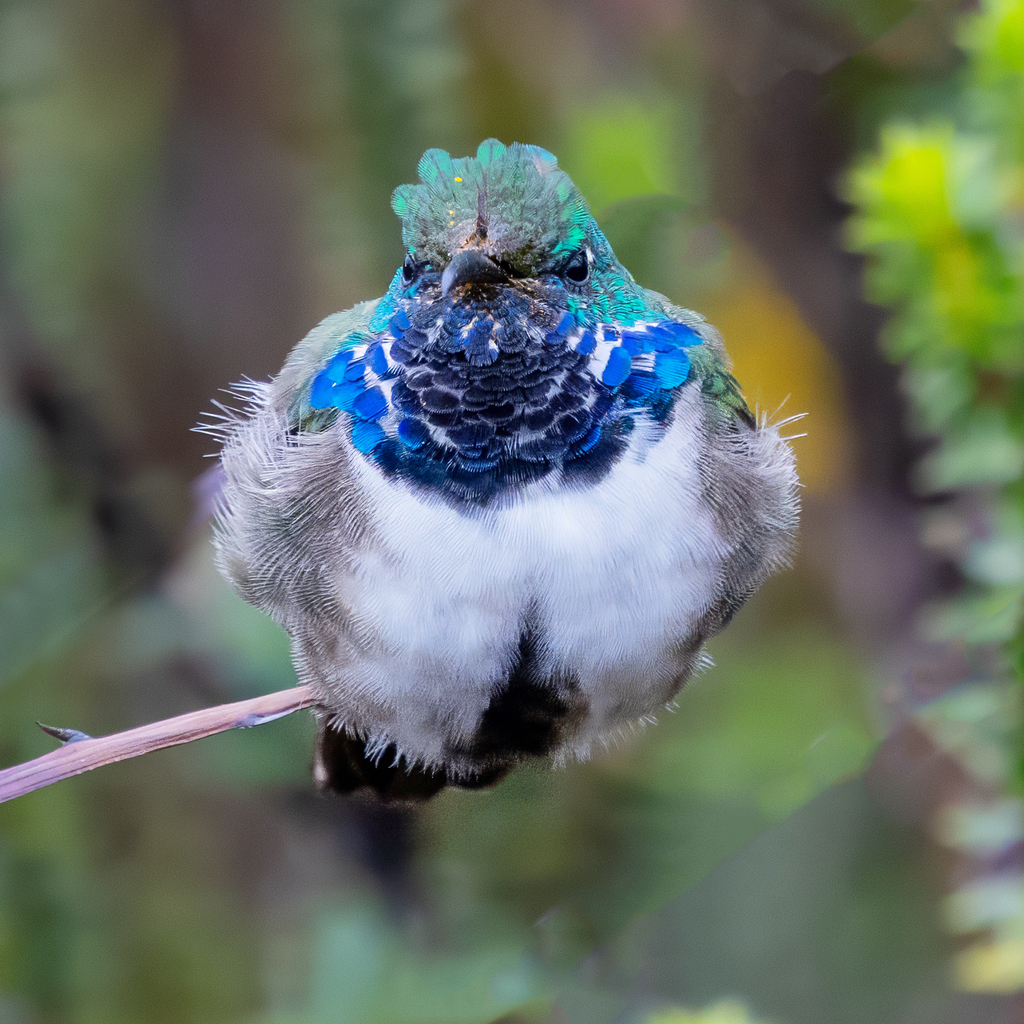
The blue-throated hillstar (Oreotrochilus cyanolaemus), also sometimes called the blue-throated star, is a highly endangered species of hummingbird found only in a very small portion of the southwestern Andes in Ecuador. Discovered in 2018, it can be clearly distinguished from other hillstars by the ultramarine color of its iridescent throat.
From the article Blue-throated hillstar on Wikipedia (CC BY-SA), quoted section by section
Description
The top of the head of the male blue-throated hillstar is iridescent emerald green, which extends from the forehead to the base of the crown. The iridescent highlights are blue-green. The nape of the neck, mantle, lower portion of the back, rump, and upperwing coverts are bright emerald green. Some feathers in these regions have blue-green edging, and some have bronze highlights. The uppertail coverts are emerald blue-green. The upper surface of the central flight feathers are blackish blue. The other flight feathers and the upperwing coverts are dull black to dusky greenish blue, with a blue sheen. The outermost primary feathers have a white edge. The feathers of the throat and chin are a glittering ultramarine blue, with white bases separated from the blue parts of the feather by a black line. The feathers of the throat have slightly green tips, and are longer on the sides of the throat than in the middle; the extent of these green tips varies between individuals. The bright blue throat patch was the basis for its name. The bird has a velvety black collar around its throat. The belly and the breast are a dull white color, and the feathers in these regions have black bases. There is a black longitudinal stripe in the middle of the belly. The sides and flanks of the bird are between green and greenish gray, with metallic green highlights. …
Range & habitat
The preferred habitat of the blue-throated hillstar is grassland with patches of shrubs in the Andean paramo. In the region that the type specimen was collected, the shrubs were dominated by Chuquiraga. The terrain in which it was found included hilly regions, steep terrain, rocky outcrops, and stream banks. O. cyanolaemus was observed to feed by clinging to branches sideways or upside down, or by perching next to flowers. It was observed feeding most frequently from Chuquiraga jussieui, and also from Macleania rupestris and Lleresia hypoleuca. Collected males were also found to have eaten flies. Some females were once observed making aerial sallies after swarming flies. Blue-throated hillstars were frequently observed being chased away from perches by Shining Sunbeams (Aglaeactis cupripenni). Aggressive interactions were also seen between it and the Viridian metaltail (Metallura williami).
Wikipedia: “Habitat and ecology”
Listen
Looking for field recordings…
Where it lives
Recorded sightings
—
geo-referenced records in GBIF, from museums, herbaria and field observers.
Drag the globe to turn it. Dots are where records exist, not a range map; darker means more records.
In the stacks
Searching the stacks…
Every page naming Oreotrochilus cyanolaemus in the Biodiversity Heritage Library →
This page is assembled live from iNaturalist, GBIF, Wikipedia, the Source Library and the Internet Archive. It is not yet part of the hand-edited codex. iNaturalist taxon 956112.