On eBird ↗
Flame-faced Tanager
Live sightings near you, the range map, bar charts of when it is seen, and Macaulay Library photos and recordings.
Flame-faced Tanager
Tangara parzudakii
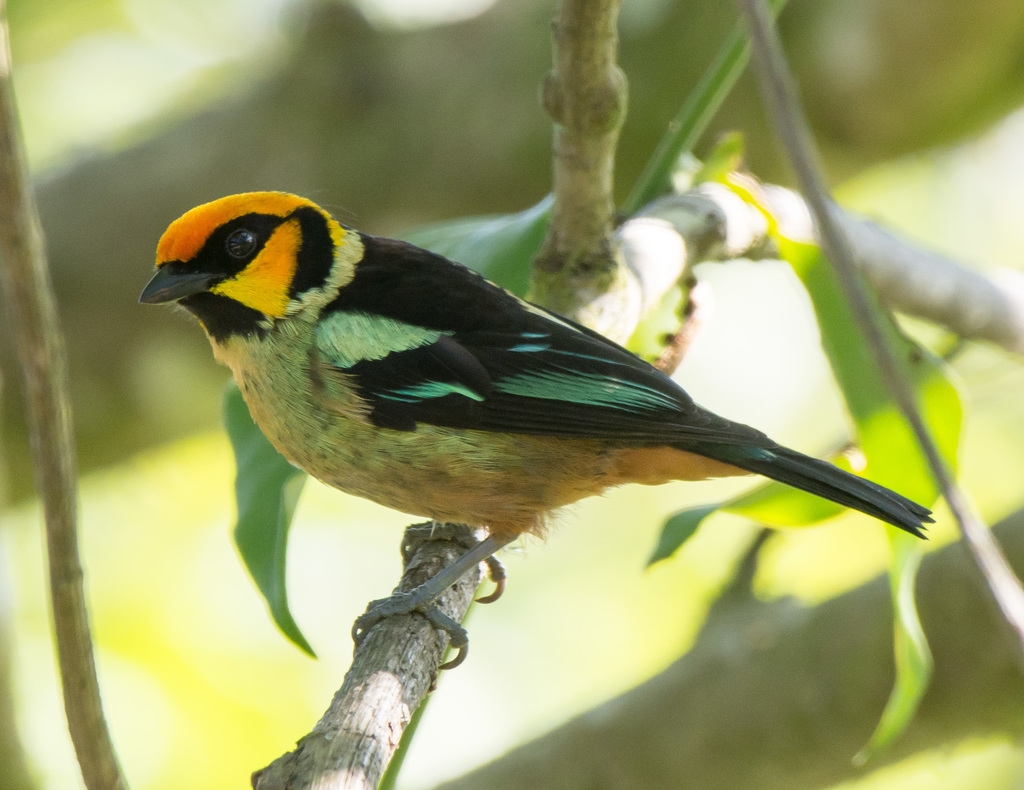
The flame-faced tanager (Tangara parzudakii) is a species of bird in the tanager family Thraupidae. It is endemic to South America and is found in the eastern Andes of Colombia, Ecuador, Peru and Venezuela. Its natural habitat is subtropical or tropical moist montane forests. It is a distinctive-looking species with black and opalescent green upperparts, opalescent green and buff underparts, and a deep red and yellow face. The subspecies lunigera lacks the deep red on the face, which is replaced with orangish-red.
It is omnivorous and feeds on fruit and arthropods. Foraging is conducted nearly exclusively on mossy branches. Breeding occurs in the rainy season. Eggs are laid in clutches of two, and are white with pale brown flecking concentrated on the larger end. Fledglings are fed by both parents. The flame-faced tanager is listed as being of least concern by the International Union for Conservation of Nature (IUCN) on the IUCN Red List. However, it is facing population declines due to habitat destruction.
From the article Flame-faced tanager on Wikipedia (CC BY-SA), quoted section by section
Description
The flame-faced tanager is a distinctive-looking medium-sized species of tanager, being on average 14–15 cm (5.5–5.9 in) in length and 28 g (0.99 oz) in mass. Both sexes of the species look similar. The body is mostly black and silvery green. The auricle, malar surface, and forecrown is deep red, while the crown and nape are yellow. The underparts are mostly opalescent green mixed with buff. The central belly is pale cinnamon buff, while the flanks and undertail coverts are darker. The lower back and rump are opalescent golden, frequently with a bluish tinge. The iris is dark brown, the bill is black, and the feet are dark gray. Immatures have a dull yellow instead of red on the head. The throat is pale buffy gray, while parts that are black in adults are dull dusky. Overall, the plumage is duller than in the adult. The nominate subspecies is unlikely to be mistaken for any other species due to the deep red facial plumage, but lunigera resembles the saffron-crowned tanager. However, it can be distinguished due to the latter's greenish breast, yellow crissum (area surrounding cloaca), and smaller size.
Range & habitat
Flame-faced tanagers are found in the Andes of Colombia, Ecuador, Venezuela, and Peru, at elevations of 1,000–2,600 m (3,300–8,500 ft). It inhabits montane and cloud forests, and is most frequent at elevations above 1,500 m (4,900 ft). It is also found in forest edges and tall secondary growth.
Wikipedia: “Distribution and habitat”
What it does
The flame-faced tanager is most often found either in pairs or groups of 3–7 birds. It is also often found in mixed-species flocks, which are composed mostly of other tanager species. On average, mixed-species flocks containing the flame-faced tanager have seven other species in them.
Diet. Like other tanagers in its genus, the flame-faced tanager is omnivorous, and feeds on fruit, arthropods, flower buds, and nectar. Foraging is mainly done in the canopy. Preferred types of fruit include species of Miconia and Cecropia. More than half of fruit is collected through gleaning, but can also be collected through probing or other techniques. Arthropods are collected almost entirely from fully and partially moss-covered branches, through a variety of methods such as gleaning and probing.
Breeding. In Colombia, adults were observed feeding each other berries as a part of courtship in February. In Ecuador, populations of the subspecies parzudakii were observed breeding January–July, during the rainy season. Nests were observed mainly in pastures, but some were also found in forests, forest edges, and on man-made structures. Nests are built entirely by the female, in locations that were concealed from all sides. The male waits beside the female while nest building is ongoing, but does not directly help her. …
Wikipedia: “Behavior and ecology”
Listen
Looking for field recordings…
Where it lives
Recorded sightings
—
geo-referenced records in GBIF, from museums, herbaria and field observers.
Drag the globe to turn it. Dots are where records exist, not a range map; darker means more records.
In the stacks
Searching the stacks…
Every page naming Tangara parzudakii in the Biodiversity Heritage Library →
This page is assembled live from iNaturalist, GBIF, Wikipedia, the Source Library and the Internet Archive. It is not yet part of the hand-edited codex. iNaturalist taxon 9573.