On eBird ↗
Emerald Tanager
Live sightings near you, the range map, bar charts of when it is seen, and Macaulay Library photos and recordings.
Emerald Tanager
Tangara florida
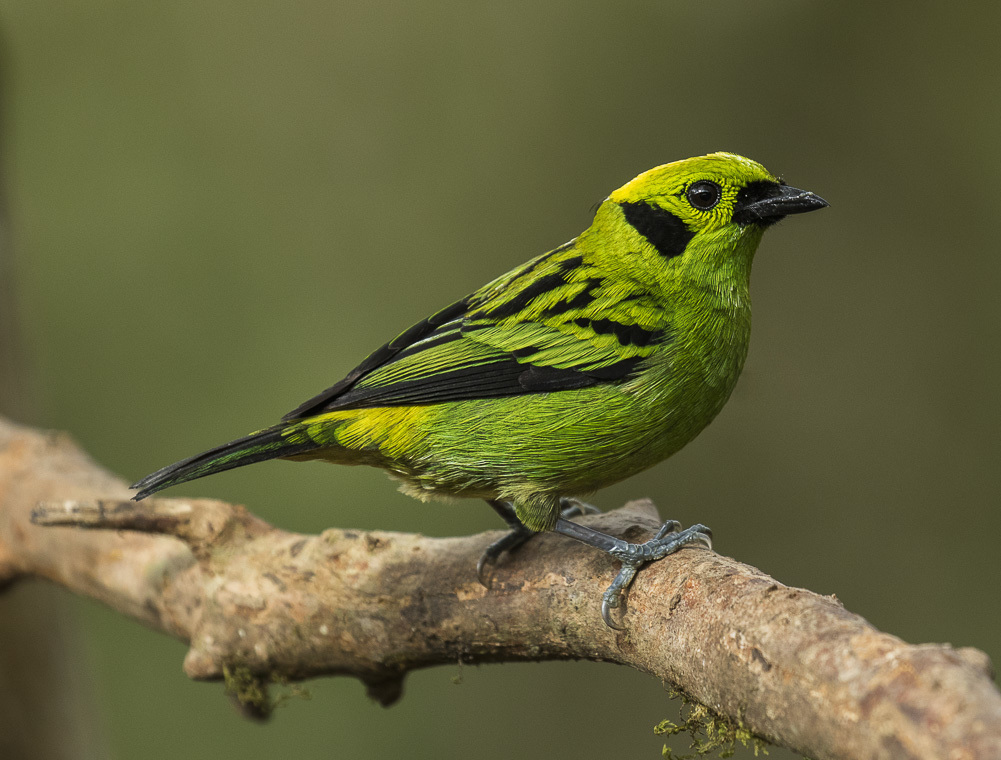
The emerald tanager (Tangara florida) is a species of bird in the tanager family Thraupidae. It is found in Colombia, Costa Rica, Ecuador, and Panama. Described by the English ornithologists PL Sclater and Osbert Salvin in 1869, it is a medium-sized species that has a length of 10.6–13 cm (4.2–5.1 in) and a mass of 18–20.5 g (0.63–0.72 oz). It can be identified by its bright green plumage, with black streaking on the back and wings, and a black auricular patch and beak. It also has yellow on the crown and rump. The species shows slight sexual dimorphism, with the females being duller and having yellow-green in place of yellow on the head.
The emerald tanager mainly inhabits humid lowland forest, montane evergreen forest, and secondary forest at elevations of 500–900 m (1,600–3,000 ft) but can be found from 100–1,200 m (330–3,940 ft). It is omnivorous and feeds mainly on fruit, flowers, and flower buds, supplementing its diet with arthropods. It breeds from March to May in Costa Rica and from January to April in Colombia. The emerald tanager makes cup nests out of moss, where eggs are laid in clutches of two.
From the article Emerald tanager on Wikipedia (CC BY-SA), quoted section by section
Description
The emerald tanager is a medium-sized tanager with a length of 10.6–13 cm (4.2–5.1 in) and a mass of 18–20.5 g (0.63–0.72 oz). Both sexes are similar in appearance, but the species shows slight sexual dimorphism, with females being duller and having yellow-green instead of yellow on the head. It may be confused with the glistening-green tanager but can be told apart by its less intense plumage. It is also similar to the blue-whiskered tanager but can be distinguished by the latter's black face and throat and turquoise cheeks. Adults males are mostly bright light green, with black streaking on the upperparts. The loral area, the base of the bill, and chin, along with the auricular patch, are also black. The center and rear of the crown are dark yellow, while the rest of the crown, the region around the eye, and the band across the back of the neck are yellowish-green. The upper back is black, while the lower back, rump, and uppertail coverts are dark yellow. The wings are black and green. The underparts are mostly light green, while the center of the belly and the undertail coverts are light yellow. The iris is brown, the bill is black and the feet are bluish-gray. Immatures resemble adult females, while juveniles are much duller. …
Range & habitat
The emerald tanager is found from southern Costa Rica to northern Ecuador; through Panama and Colombia. It may also be found in extreme southern Nicaragua. There are two disjunct populations, separated by an area between Panama and the San Juan River. Throughout its range, the emerald tanager is commonest at elevations of 500–900 m (1,600–3,000 ft) but is found at elevations of up to 1,200 m (3,900 ft) in Ecuador and as low as 100 m (330 ft) in Colombia. The average elevation inhabited is highest in the north of the range and is the lowest in the south. The emerald tanager inhabits humid lowland forest, montane evergreen forest, and secondary forest. It is usually found in the canopy and rarely strays to the forest floor. It has also been observed in lone fruiting trees or shrubs next to forests. It prefers forested habitats to semi-open ones.
Wikipedia: “Distribution and habitat”
What it does
The emerald tanager is omnivorous. It mainly feeds on fruit, supplementing its diet with arthropods, flowers, and flower buds. In Costa Rica, arthropods make up a greater proportion of the diet during the breeding season. The most commonly eaten fruits include those in the genera Miconia, Coussapoa, Cecropia, Ficus, Ilex, Tetrochidium, and Topobea. The emerald tanager forages singly, in pairs, or small flocks of 3–7 individuals within larger mixed-species flocks consisting of other tanager species, honeycreepers, and warblers. It is active, occasionally moving about excitedly when foraging. Fruits are typically gleaned, while insects are mainly foraged from moss in the crown of trees, with moss occasionally being torn apart during feeding to capture prey. The species has also been observed feeding on a swarm of army ants.
Wikipedia: “Feeding”
Listen
Looking for field recordings…
Where it lives
Recorded sightings
—
geo-referenced records in GBIF, from museums, herbaria and field observers.
Drag the globe to turn it. Dots are where records exist, not a range map; darker means more records.
In the stacks
Searching the stacks…
Every page naming Tangara florida in the Biodiversity Heritage Library →
This page is assembled live from iNaturalist, GBIF, Wikipedia, the Source Library and the Internet Archive. It is not yet part of the hand-edited codex. iNaturalist taxon 9578.