- Animals
- ›Chordates
- ›Vertebrates
- ›Ray-finned Fishes
- ›Spiny-rayed fishes
- ›Gobies, cardinalfishes and allies
- ›Gobies and allies
- ›Gudgeons
- ›Butis
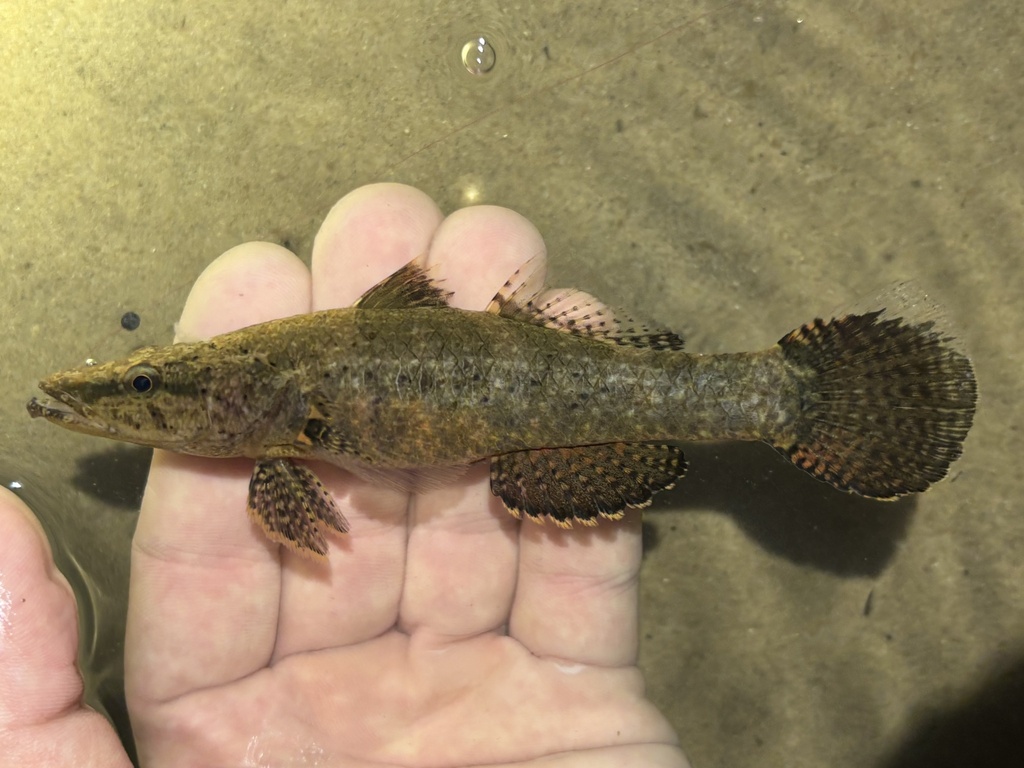
Crimsontip Gudgeon
Butis butis
Butis butis, the crazy fish, duckbill sleeper, or upside-down sleeper, Ikan Ubi is a species of sleeper goby that are native to brackish and freshwater coastal habitats of the Indian Ocean and the western Pacific Ocean from the African coast to the islands of Fiji. They prefer well-vegetated waters and can frequently be found in mangrove swamps. They are small, drably-colored fish, reaching a maximum length of only 15 cm (5.9 in). They are predatory and are known for their behavior of swimming vertically – or even upside down – while hunting.
From the article Crazy fish on Wikipedia (CC BY-SA), quoted section by section
Description
Crazy fish range in length from 69 to 155 mm (2.7 to 6.1 in) in length. The head is subcylindrical and flattened dorsoventrally, and slightly concave in the area between the tip of the snout to just behind the eyes. The mouth is very large, with a lower jaw extending past the upper jaw. Both contain multiple rows of tiny, bristle-like, sharp teeth. A pair of nostrils is present on each side of the snout (four in all) midway between the tip of the snout and the eyes. The front pair of nostrils is far smaller in size than the posterior pair. The relatively small eyes (about a sixth of the length of the head in diameter) are situated near the top of the head, but are oriented sidewise. They are gold and black in coloration. The body is strongly compressed laterally. The dorsal fins are situated approximately in the middle of the body. The first dorsal fin (with five to six rays) is arched and originates from the highest point of the back of the fish. It has thinner rays than the second dorsal fin (with seven to eight rays). The short triangular ventral fins (each with five rays) are located considerably farther forward than all the other fins. The anal fin (with seven to nine rays) is located approximately directly below the second dorsal fin, and are roughly the same size and shape as the latter. The pair of pectoral fins (each with eighteen to twenty rays) are large and rounded. …
Range & habitat
Crazy fish inhabit brackish and freshwater habitats near the coast, but they can sometimes be found upriver. They are demersal fish, usually found near the muddy bottoms of lagoons, estuaries, and mangrove forests with abundant vegetation. Crazy fish has a wide distribution range: west from East Africa to as far east as Fiji, north from the South China Sea and south to Australia and New Caledonia, including islands in the Indian and Pacific Oceans. Countries where it is found include Australia (New South Wales, Northern Territory, Queensland, and Western Australia); Brunei Darussalam; Cambodia, China (Guangdong, Guangxi, Hainan, Hong Kong, and Macau); Fiji; India (including the Andaman and Nicobar Islands); Indonesia; Japan; Kenya; Madagascar; Malaysia; Mauritius (including Rodrigues Island); Mozambique; Myanmar; Papua New Guinea; the Philippines; Seychelles; Singapore; Somalia; Sri Lanka; Taiwan; Tanzania; Thailand; and Vietnam.
Wikipedia: “Distribution and habitat”
What it does
Crazy fish are predatory, preying on crustaceans, small fishes, and worms. They are territorial and are most active at twilight and at night. They are known for their behavior of aligning their bodies against the nearest surface, appearing horizontal, vertical, and even upside down. They use this positioning to ambush prey. They also have the ability to change colors to a limited extent to blend in with their environments. During the monsoon seasons, the reddish margins of the fins can turn paler (to either orange or white), accompanied by the appearance of numerous reddish spots on the lower half of the body. The upper half of the caudal fin also turns white.
Wikipedia: “Ecology and behavior”
Where it lives
Recorded sightings
—
geo-referenced records in GBIF, from museums, herbaria and field observers.
Drag the globe to turn it. Dots are where records exist, not a range map; darker means more records.
In the stacks
Searching the stacks…
Every page naming Butis butis in the Biodiversity Heritage Library →
This page is assembled live from iNaturalist, GBIF, Wikipedia, the Source Library and the Internet Archive. It is not yet part of the hand-edited codex. iNaturalist taxon 96263.