- Animals
- ›Chordates
- ›Vertebrates
- ›Mammals
- ›Therians
- ›Placental Mammals
- ›Primates, Rodents, and Allies
- ›Primates
- ›Monkeys, Apes, and Tarsiers
- ›Monkeys and Apes
- ›Apes and Old World Monkeys
- ›Old World Monkeys
- ›Colobines
- ›Langurs, Surilis, and Lutungs
- ›Semnopithecus
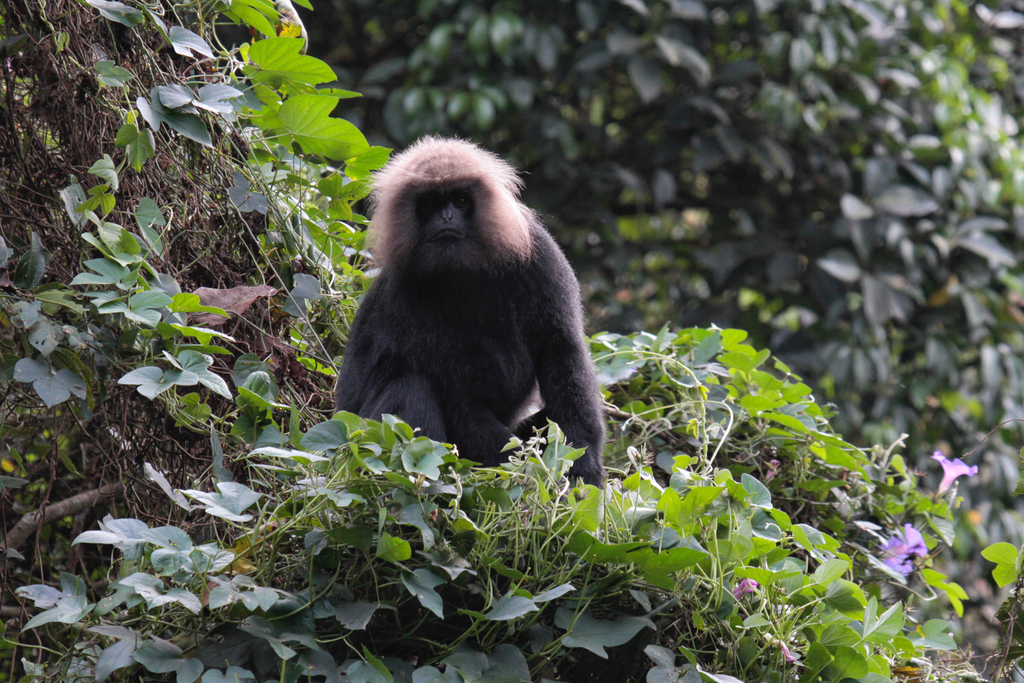
Nilgiri Langur
Semnopithecus johnii
The Nilgiri langur (Semnopithecus johnii) is an Asian langur of the Old World monkey. It has glossy, black fur and an orangey-golden brown, hair-like mane on its head. Females have a white patch of fur on the inner thigh. It typically lives in troops of nine to ten individuals, with or without offspring, depending on seasonality. Its diet consists of fruits, shoots and leaves. It is listed as vulnerable on the IUCN Red List and is threatened by habitat destruction and poaching for its body parts, thought to supposedly contain aphrodisiac properties.
From the article Nilgiri langur on Wikipedia (CC BY-SA), quoted section by section
Description
Adult males have a head-to-body length of 78–80 cm (31–31 in) and adult females of 58–60 cm (23–24 in); their tails are 68.5–96.5 cm (27.0–38.0 in) long. Males weigh 9.1–14.8 kg (20–33 lb) and females 10.9–12 kg (24–26 lb).
Range & habitat
The Nilgiri langur is native to the Nilgiri Hills of South India, where it occurs at elevations of 300–2,000 m (980–6,560 ft) in the states of Karnataka, Kerala and Tamil Nadu. It has been sighted in Agasthyamala Biosphere Reserve, Aliyar Forest Reserve, Anamalai Tiger Reserve, Bandipur National Park, Eravikulam National Park, Idamalayar Reserve Forest, Mudumalai National Park, Mukurthi National Park, Mundanthurai Tiger Reserve, Nelliampathi, Periyar National Park, Shendurney Wildlife Sanctuary and Silent Valley National Park.
Wikipedia: “Distribution”
Listen
Looking for field recordings…
Where it lives
Recorded sightings
—
geo-referenced records in GBIF, from museums, herbaria and field observers.
Drag the globe to turn it. Dots are where records exist, not a range map; darker means more records.
In the stacks
Searching the stacks…
Every page naming Semnopithecus johnii in the Biodiversity Heritage Library →
This page is assembled live from iNaturalist, GBIF, Wikipedia, the Source Library and the Internet Archive. It is not yet part of the hand-edited codex. iNaturalist taxon 963196.