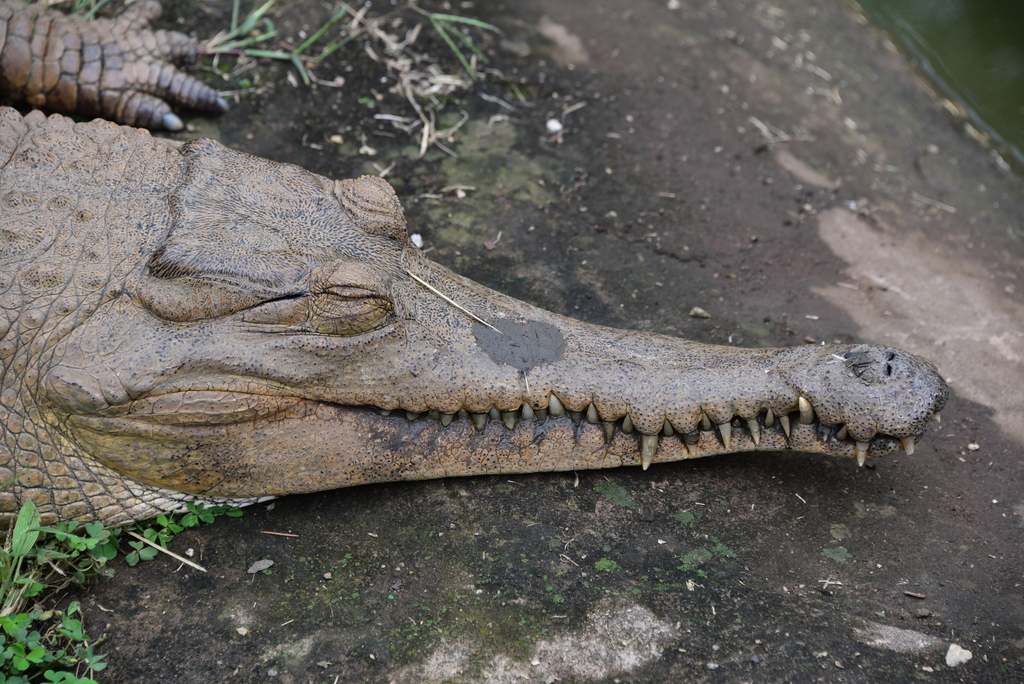
West African slender-snouted crocodile
Mecistops cataphractus
The West African slender-snouted crocodile (Mecistops cataphractus), or slender-snouted crocodile, is a critically endangered species of African crocodile. It is one of five species of crocodile in Africa, the other four being the Central African slender-snouted, Nile, West African and dwarf crocodiles.
The slender-snouted crocodile (M. cataphractus) was thought to be distributed across west Africa and into central Africa but the central African species has been separated as the Central African slender-snouted crocodile (M. leptorhynchus) based on studies in 2014 and 2018 that indicated that both were distinct species. The name cataphractus is retained for the West African species as that species was described first based on specimens from western Africa. The two species diverged about 6.5–7.5 mya, living in different river drainage zones that were geographically separated from each other by the Cameroon Line.
From the article West African slender-snouted crocodile on Wikipedia (CC BY-SA), quoted section by section
Description
As with its relative, the West African slender-snouted crocodile has a very long, slender snout that it uses to catch fish and small aquatic invertebrates. As with all crocodilians, larger animals may feed opportunistically on larger prey if it becomes available. They are relatively medium-sized, but large males can exceed several other species of crocodilians in size. Three individuals measuring 2.31 to 2.62 m (7 ft 7 in – 8 ft 7 in) and weighing 50–95 kg (110–209 lb) had a bite force in the range of 1,704–2,447 N (383–550 lbf). Adult males typically reach 3 to 4 m (9 ft 10 in – 13 ft 1 in) in length. Large males can reportedly grow up to 4.5 m (15 ft) in length. They generally weigh between 125 and 325 kg (276 and 717 lb). The body mass of the largest males have been estimated to reach up to 667 kg (1,470 lb).
Range & habitat
West African slender-snouted crocodile occurs widely in West Africa (Benin, Burkina Faso, southern Senegal, Gambia, Ghana, Guinea, Guinea-Bissau, Ivory Coast, Liberia, southern Mali, Nigeria, Sierra Leone, and Togo) and extends into Cameroon in Central Africa. They prefer to live in dense, vegetated bodies of water that are away from human settlements. Their distribution is currently being monitored by drone surveillance and prerecorded calls to attract them.
== References ==
Wikipedia: “Distribution”
In human culture
The genus name Mecistops is most probably derived from the Ancient Greek words μήκιστ (mēkist), meaning "longest", and ὄψ (óps) meaning "face". The specific epithet cataphractus is thought to be derived from the Greek word κατάφρακτος (katáphraktos) meaning "armoured" or "shielded".
Wikipedia: “Etymology”
Where it lives
Recorded sightings
—
geo-referenced records in GBIF, from museums, herbaria and field observers.
Drag the globe to turn it. Dots are where records exist, not a range map; darker means more records.
In the stacks
Searching the stacks…
Every page naming Mecistops cataphractus in the Biodiversity Heritage Library →
This page is assembled live from iNaturalist, GBIF, Wikipedia, the Source Library and the Internet Archive. It is not yet part of the hand-edited codex. iNaturalist taxon 964788.