- Animals
- ›Chordates
- ›Vertebrates
- ›Reptiles
- ›Snakes and Lizards
- ›Lizards
- ›Skinks and allies
- ›Skinks
- ›Eugongyline skinks
- ›Acritoscincus
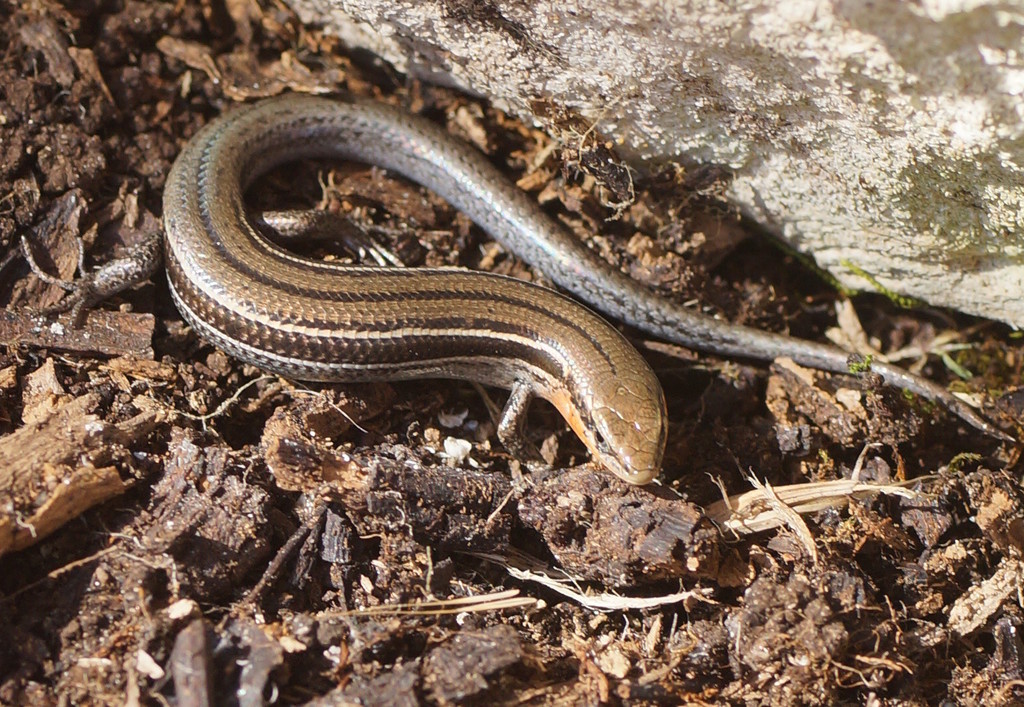
Eastern Three-lined Skink
Acritoscincus duperreyi
The eastern three-lined skink (Acritoscincus duperreyi), also known commonly as the bold-striped cool-skink, is a species of skink, a lizard in the family Scincidae. The species is endemic to Australia. A. duperreyi has been extensively studied in the context of understanding the evolution of learning, viviparity in lizards, and temperature- and genetic-sex determination. A. duperreyi is classified as a species of "Least Concern" by the IUCN.
From the article Eastern three-lined skink on Wikipedia (CC BY-SA), quoted section by section
Description
A. duperreyi is strongly striped and it has a characteristic pattern of stripes running down the length of its body. Black or grey stripes usually run along the sides of its body, with a black stripe running down the spine as well. A hatchling typically has bright red colouration on its throat, which fades to an orange-pink or disappears after a few weeks of life. The skink has a comparatively small body size, ranging up to 80 millimeters in snout-tail length. Hatchling Bassiana have relatively larger head sizes than adults. Unlike most skinks, A. duperreyi has greater than 22 maxillary teeth. However, like many other skinks, A. duperreyi has an autonomous tail that can easily break away from the rest of the body due to its unique musculature and caudal fracture plate. Pengilley (1972) distinguished three distinct populations of A. duperreyi based on appearance (Form A, B, and C). Form A can be distinguished from Form B based on its non-continuous dark vertebral stripe, and the rare occurrence of the upper light line in the middle of a scale row. The vertebral line of form C is also broken, however typically into spots as opposed to lines in form A. The lateral line in Form C is also typically absent. Form A has been associated with south-western Australia. …
Range & habitat
A. duperreyi is found in south-eastern Australia (New South Wales, South Australia, Tasmania, Victoria), and several islands. The eastern three-lined skink has been found on Babel Island, Big Dog Island, Flinders Island, Little Dog Island, and Maria Island. A. duperreyi habitats include grasslands, wet-dry sclerophyll forests, temperate forests, temperate shrublands, human-developed pasturelands, and Alpine regions. They are particularly abundant in cool climate regions of south-eastern Australia. Though they are abundant in high-elevation regions, A. duperreyi does not live at higher elevations than 1,650 meters.
Wikipedia: “Distribution and habitat”
What it does
A. duperreyi is oviparous, meaning that parents lay eggs from which young hatch. Females lay eggs once a year in the early summer, with clutch sizes ranging between 3 and 9 eggs. Additionally, gravid females typically lay eggs at communal sites. Typically, these communal sites are located in open areas, under logs, or under rocks. Females prefer to lay eggs in sunny areas. Nests are typically shallow compared to other reptile species. In one study that assessed A. duperreyi nests over the course of eleven years, 64% of nests were found to be communal. Nest-site availability varies significantly over time in the habitat of A. duperreyi; despite this, there is little temporal variation in communal nesting patterns. Also, there is no significant temperature difference between solitary and communal nests. Eggs raised in communal nests have lower water content than those raised in solitary nests, however hatchlings born from communal nests are larger in size. Communal hatchlings also had shorter tails and tended to run faster than solitary hatchlings.
Hatchling development. The temperature of incubation and the elevation of the clutch can affect the development of offspring before and after hatching, as well as behaviour throughout the skink's life. Females typically choose where to lay eggs based on the expected average temperature of incubation for their eggs. …
Wikipedia: “Reproduction”
In human culture
The specific name, duperreyi, was given by British zoologist John Edward Gray, in order to honour French naval officer Louis-Isidore Duperrey. Duperrey was known for his explorations of Australia and the New Guinea archipelago, where he collected various flora and fauna.
Wikipedia: “Etymology”
Where it lives
Recorded sightings
—
geo-referenced records in GBIF, from museums, herbaria and field observers.
Drag the globe to turn it. Dots are where records exist, not a range map; darker means more records.
In the stacks
Searching the stacks…
Every page naming Acritoscincus duperreyi in the Biodiversity Heritage Library →
This page is assembled live from iNaturalist, GBIF, Wikipedia, the Source Library and the Internet Archive. It is not yet part of the hand-edited codex. iNaturalist taxon 966815.