- Animals
- ›Chordates
- ›Vertebrates
- ›Cartilaginous Fishes
- ›Sharks and Rays
- ›Sharks
- ›Galean Sharks
- ›Ground Sharks
- ›Requiem Sharks
- ›Carcharhinus
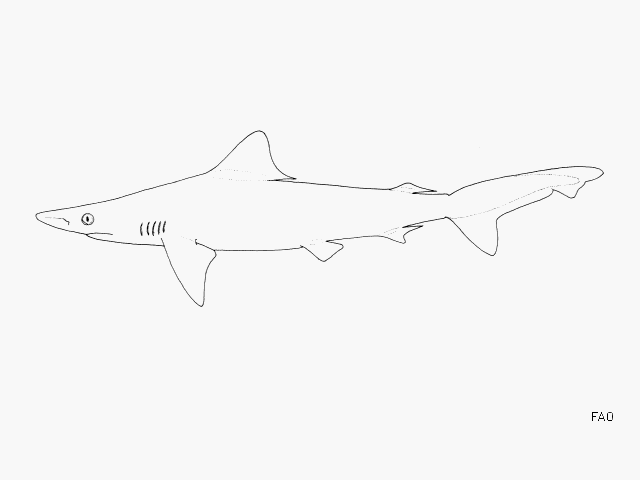
Borneo Shark
Carcharhinus borneensis
The Borneo shark (Carcharhinus borneensis) is a species of requiem shark, and part of the family Carcharhinidae. Extremely rare, it is known only from inshore waters around Mukah in northwestern Borneo, though it may once have been more widely distributed. A small, gray shark reaching 65 cm (26 in) in length, this species is the only member of its genus with a row of enlarged pores above the corners of its mouth. It has a slender body with a long, pointed snout and a low second dorsal fin placed posterior to the anal fin origin.
Almost nothing is known about the natural history of the Borneo shark. It is viviparous like other requiem sharks; the females bear litters of six pups, which are provisioned through gestation by a placental connection. The International Union for Conservation of Nature last assessed this species as Critically Endangered. While an extant population has since been found, the Borneo shark continues to merit conservation concern given its highly limited range within heavily fished waters.
From the article Borneo shark on Wikipedia (CC BY-SA), quoted section by section
Description
The Borneo shark is slim-bodied, with a long, pointed snout and oblique, slit-like nostrils preceded by narrow, nipple-shaped flaps of skin. The eyes are rather large and circular, and equipped with nictitating membranes. The corners of the sizable mouth bear short, indistinct furrows, and immediately above are a series of enlarged pores that are unique within the genus. There are 25–26 upper and 23–25 lower tooth rows. The upper teeth have a single, narrow, oblique cusp with strongly serrated edges, and large cusplets on the trailing side. The lower teeth are similar, but tend to be more slender and finely serrated. The five pairs of gill slits are short. The pectoral fins are short, pointed, and falcate (sickle-shaped), while the pelvic fins are small and triangular with a nearly straight trailing margin. The first dorsal fin is fairly large and triangular, with a blunt apex sloping down to a sinuous trailing margin; its origin lies over the free rear tips of the pectoral fins. The second dorsal fin is small and low, and originates over the middle of the anal fin base. There is no ridge between the dorsal fins. The caudal peduncle bears a deep, crescent-shaped pit at the origin of the upper caudal fin lobe. The asymmetrical caudal fin has a well-developed lower lobe and a longer, narrow upper lobe with a strong ventral notch near the tip. …
Range & habitat
All recent specimens of the Borneo shark have been collected solely from fishery landing sites at Mukah in Sarawak, despite thorough surveys across the rest of Borneo (including at the locality of the type specimen). Thus, its range may now be restricted to shallow, inshore waters in northwestern Borneo. Of the five earlier specimens, four came from Borneo and one from Zhoushan Island in China, hinting at a wider historical distribution. This species was also recorded from Borongan in the Philippines in 1895, and Java in 1933; these records cannot be substantiated and there have been no subsequent sightings from these areas.
Fossil record. Fossils of the Borneo shark are known from as early as the Late Miocene. At the site of Ambug Hill in Brunei, their remains have been found alongside those of blacktip sharks and members of the genera Paragaleus, Chiloscyllium, Rhinobatos, Scoliodon, and Lamiopsis.
Wikipedia: “Distribution and habitat”
What it does
Bony fishes are probably the main food of the Borneo shark. It is viviparous like other requiem sharks, with the developing embryos provisioned by the mother through a placental connection formed from the depleted yolk sac. The litter size is six, and the pups are born at close to 24–28 cm (9.4–11.0 in) long. From the available specimens, the length at sexual maturity can be surmised to be under 55–58 cm (22–23 in) in males and under 61–65 cm (24–26 in) in females.
Wikipedia: “Biology and ecology”
Where it lives
Recorded sightings
—
geo-referenced records in GBIF, from museums, herbaria and field observers.
Drag the globe to turn it. Dots are where records exist, not a range map; darker means more records.
In the stacks
Searching the stacks…
Every page naming Carcharhinus borneensis in the Biodiversity Heritage Library →
This page is assembled live from iNaturalist, GBIF, Wikipedia, the Source Library and the Internet Archive. It is not yet part of the hand-edited codex. iNaturalist taxon 96749.