- Animals
- ›Chordates
- ›Vertebrates
- ›Cartilaginous Fishes
- ›Sharks and Rays
- ›Sharks
- ›Galean Sharks
- ›Ground Sharks
- ›Requiem Sharks
- ›Carcharhinus
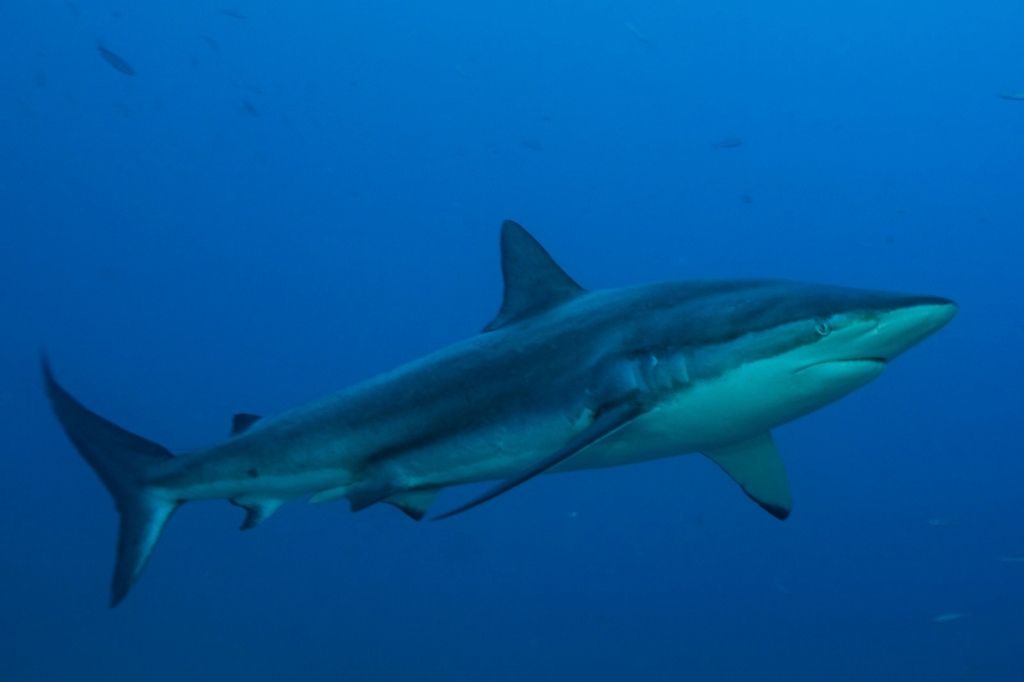
Bronze Whaler
Carcharhinus brachyurus
The copper shark (Carcharhinus brachyurus), bronze whaler, or narrowtooth shark is a species of requiem shark found mostly in temperate latitudes. It is distributed in a number of separate populations in the northeastern and southwestern Atlantic, off southern Africa, in the northwestern and eastern Pacific, and around Australia and New Zealand, with scattered reports from equatorial regions. The species can be found from brackish rivers and estuaries to shallow bays and harbors, to offshore waters 100 m (330 ft) deep or more. Females are found apart from males for most of the year, and conduct seasonal migrations. A large species reaching 3.3 m (11 ft) long, the copper shark is difficult to distinguish from other large requiem sharks. It is characterized by its narrow, hook-shaped upper teeth, lack of a prominent ridge between the dorsal fins, and plain bronze coloration.
Feeding mainly on cephalopods, bony fishes, and other cartilaginous fishes, the copper shark is a fast-swimming predator that has been known to hunt in large groups, using their numbers to their advantage; however, for most of the time they remain solitary. Off South Africa, this species associates closely with the annual sardine run, involving millions of southern African pilchard (Sardinops sagax). Like other requiem sharks, it is viviparous, with the developing embryos mainly nourished through a placental connection formed from the depleted yolk sac. Females bear litters of 7 to 24 pups every other year in coastal nursery areas, after a gestation period of 12 or perhaps as long as 21 months.
From the article Copper shark on Wikipedia (CC BY-SA), quoted section by section
Description
The copper shark has a slender, streamlined body with a slightly arched profile just behind the head. The snout is rather long and pointed, with the nostrils preceded by low flaps of skin. The round, moderately large eyes are equipped with nictitating membranes (protective third eyelids). The mouth has short, subtle furrows at the corners and contains 29–35 upper tooth rows and 29–33 lower tooth rows. The teeth are serrated with single narrow cusps; the upper teeth have a distinctive hooked shape and become more angled towards the corners of the jaw, while the lower teeth are upright. The upper teeth of adult males are longer, narrower, more curved, and more finely serrated than those of adult females and juveniles. The five pairs of gill slits are fairly long. The pectoral fins are large, pointed, and falcate (sickle-shaped). The first dorsal fin is tall, with a pointed apex and a concave trailing margin; its origin lies about even with the tips of the pectoral fins. The second dorsal fin is small and low, and positioned about opposite to the anal fin. There is usually no ridge between the dorsal fins. The caudal fin has a well-developed lower lobe and a deep ventral notch near the tip of the upper lobe. …
Range & habitat
The copper shark is the only member of its genus largely found in temperate rather than tropical waters, in temperatures above 12 °C (54 °F). It is widely distributed but as disjunct regional populations with little to no interchange between them. In the Atlantic, this shark occurs from the Mediterranean Sea to Morocco and the Canary Islands, off Argentina, and off Namibia and South Africa (where there may be two separate populations), with infrequent records from Mauritania, the Gulf of Guinea, and possibly the Gulf of Mexico. In the Indo-Pacific, it is found from the East China Sea to Japan (excluding Hokkaido) and southern Russia, off southern Australia (mostly between Sydney and Perth but occasionally further north), and around New Zealand but not as far as the Kermadec Islands; there are also unconfirmed reports from the Seychelles and the Gulf of Thailand. In the eastern Pacific, it occurs from northern Chile to Peru, and from Mexico to Point Conception, California, including the Gulf of California. The copper shark is common off parts of Argentina, South Africa, Australia, and New Zealand, and rare elsewhere; in many areas its range is ill-defined because of confusion with other species. …
Wikipedia: “Distribution and habitat”
What it does
Fast but active, the copper shark may be encountered alone, in pairs, or in loosely organized schools containing up to hundreds of individuals. Some aggregations seem to form for reproductive purposes, while others form to concentrations of food. This species may fall prey to larger sharks and killer whales. Known parasites of the copper shark include the tapeworms Cathetocephalus australis, Dasyrhynchus pacificus and D. talismani, Floriceps minacanthus, Phoreiobothrium robertsoni, and Pseudogrillotia spratti, the leech Stibarobdella macrothela, and the fluke Otodistomum veliporum.
Feeding. The copper shark feeds more towards the bottom of the water column than the top, consuming cephalopods, including squid (Loligo spp.), cuttlefishes, and octopus; bony fishes, including gurnards, flatfishes, hakes, catfishes, jacks, Australian salmon, Atlantic salmon, mullets, sea breams, smelts, tunas, sardines, Cape horse mackerel, and anchovies; and cartilaginous fishes, including dogfish sharks (Squalus spp.), stingrays, skates, electric rays, and sawfishes. Cephalopods and cartilaginous fishes become relatively more important food for sharks over 2 m (6.6 ft) long. Young sharks also consume scyphozoan jellyfish and crustaceans, including mud shrimps (Callianassa) and penaeid prawns. …
Wikipedia: “Biology and ecology”
Where it lives
Recorded sightings
—
geo-referenced records in GBIF, from museums, herbaria and field observers.
Drag the globe to turn it. Dots are where records exist, not a range map; darker means more records.
In the stacks
Searching the stacks…
Every page naming Carcharhinus brachyurus in the Biodiversity Heritage Library →
This page is assembled live from iNaturalist, GBIF, Wikipedia, the Source Library and the Internet Archive. It is not yet part of the hand-edited codex. iNaturalist taxon 96750.