- Animals
- ›Chordates
- ›Vertebrates
- ›Cartilaginous Fishes
- ›Sharks and Rays
- ›Sharks
- ›Galean Sharks
- ›Ground Sharks
- ›Requiem Sharks
- ›Carcharhinus
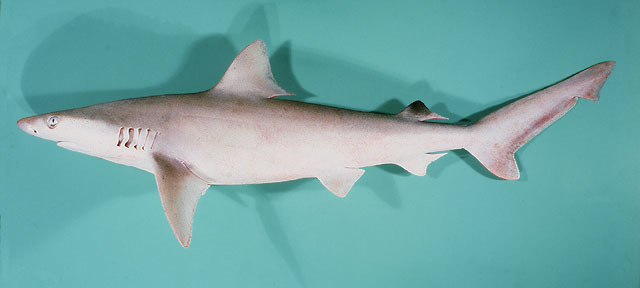
Whitecheek Shark
Carcharhinus dussumieri
The whitecheek shark or widemouth blackspot shark (Carcharhinus dussumieri) is a requiem shark of the family Carcharhinidae, found in the Indo-West Pacific Ocean between latitudes 34°N and 25°S. It can reach a length of 1 m (39 in). It feeds mainly on fish, cephalopods, and crustaceans. It is a viviparous species, with the female giving birth to up to four live young.
The specific name honours the French explorer and trader Jean-Jacques Dussumier (1792–1883).
From the article Whitecheek shark on Wikipedia (CC BY-SA), quoted section by section
Description
The whitecheek shark grows to a length around 100 cm (39 in). It has a slender body and long head with a rounded snout. The eyes are oval and both jaws have multiple rows of backward-pointing, serrated teeth. The pectoral fins are long, narrow, and curved and have narrow, pointed tips. The first dorsal fin is triangular, uncurved, and moderately sized, and the second dorsal fin is much smaller than the first and bears a large black patch at its apex. The whitecheek shark's dorsal (upper) surface is grey or brownish-grey, while its ventral (under) surface is pale.
Range & habitat
The whitecheek shark is native to the Indo-Pacific Ocean, where it is found on continental shelves and inshore slopes around islands down to about 170 m (560 ft). Its range extends from the Arabian Sea and Persian Gulf to Java, Indonesia, Japan, and Australia.
Wikipedia: “Distribution”
What it does
The whitecheek shark mostly feeds on fish, but also eats octopus, squid, and various crustaceans including crabs. It sometimes picks off molluscs and worms from the seabed. It is a common species, but not well known, and it is sometimes confused with the blackspot shark (Carcharhinus sealei). Both males and females mature when they are about 70 cm (28 in) long. Females are viviparous and breeding takes place throughout the year, with females normally being either pregnant or having recently given birth. One to four, but usually two, pups are retained in the uterus, where they feed from a yolk sac. They are about 38 cm (15 in) at the time of birth.
Wikipedia: “Behaviour”
Where it lives
Recorded sightings
—
geo-referenced records in GBIF, from museums, herbaria and field observers.
Drag the globe to turn it. Dots are where records exist, not a range map; darker means more records.
In the stacks
Searching the stacks…
Every page naming Carcharhinus dussumieri in the Biodiversity Heritage Library →
This page is assembled live from iNaturalist, GBIF, Wikipedia, the Source Library and the Internet Archive. It is not yet part of the hand-edited codex. iNaturalist taxon 96753.