- Animals
- ›Chordates
- ›Vertebrates
- ›Cartilaginous Fishes
- ›Sharks and Rays
- ›Sharks
- ›Galean Sharks
- ›Ground Sharks
- ›Requiem Sharks
- ›Carcharhinus
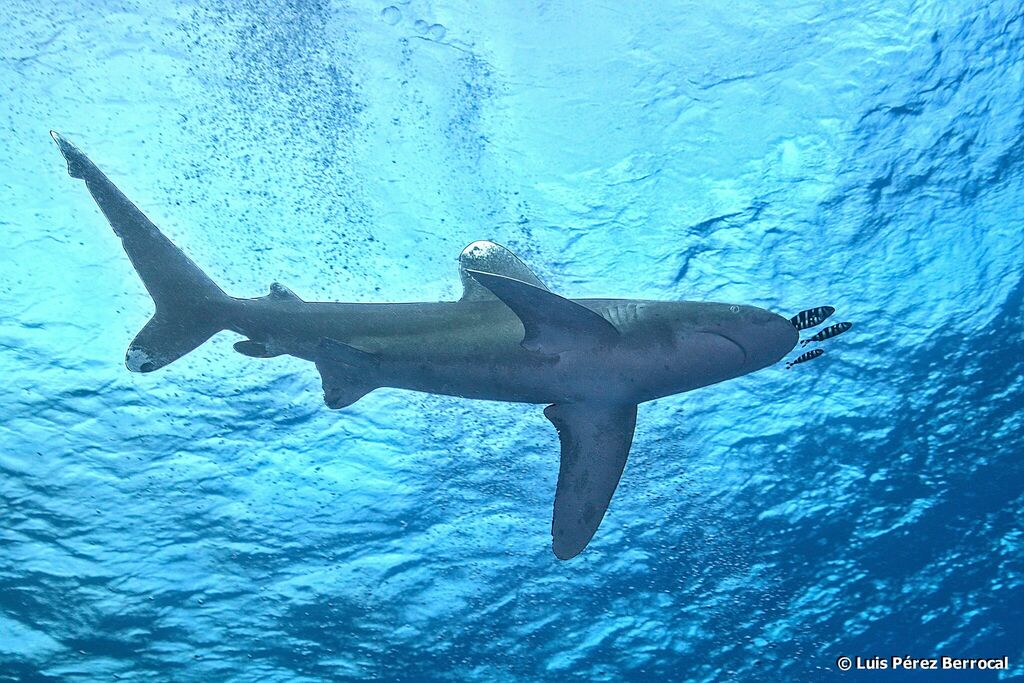
Oceanic Whitetip Shark
Carcharhinus longimanus
The oceanic whitetip shark (Carcharhinus longimanus) is a large requiem shark inhabiting the pelagic zone of tropical and warm temperate seas. It has a stocky body and iconic elongated rounded fins, with white tips. The species is typically solitary, though they may gather in large numbers at food concentrations. Bony fish and cephalopods are the main components of its diet and females give live birth.
Though slow-moving, the shark is opportunistic and aggressive, and is reputed to be dangerous to shipwreck survivors. The IUCN Red List considers the species to be critically endangered. As with other shark species, the whitetip faces mounting fishing pressure throughout its range, with recent studies show steeply declining populations as they are harvested for their fins and meat.
From the article Oceanic whitetip shark on Wikipedia (CC BY-SA), quoted section by section
Description
C. longimanus' most distinguishing characteristics are its long, wing-like pectoral and dorsal fins. The fins are significantly larger than most other shark species, and have conspicuously rounded tips. The shark's snout is rounded and its eyes are circular, with nictitating membranes. The species is grey-bronze dorsally and white ventrally, being countershaded. As its name suggests, most of its fins (dorsal, pectoral, pelvic and caudal) have white tips. Along with white tips, the fins may be mottled, and young specimens can have black marks. A saddle-shaped patch may be apparent between first and second dorsal fins. The shark has two morphs of teeth; those in the mandible (lower jaw) are thinner with a serrated tip, while the teeth in the upper jaw are triangular, but much larger and wider with entirely serrated edges. The lower jaw has between 13 and 15 teeth on either half of the jaw, while the upper has 14 or 15 on each half. The denticles are nearly flat and wide, typically have between five and seven ridges. There is little overlap between them, revealing some bare skin. The oceanic whitetip shark is a robust, large-bodied shark. The largest specimen ever caught measured at more than 4 m (13 ft) in length, though they usually grow up to 3 m (10 ft) in length and 150 kg (330 lb) in weight. …
Range & habitat
This shark is found worldwide between 45°N and 43°S latitude. It lives in deep, open oceans, with a temperature greater than 18 °C (64 °F), It prefers water temperatures above 20 °C (68 °F), and up to 28 °C (82 °F) but can also be found in waters as cool as 15 °C (59 °F) but avoids temperatures lower than this. It was once extremely common and widely distributed, and still inhabits a wide band around the globe; however, recent studies suggest that its numbers have drastically declined. The shark spends most of its time in the upper layer of the ocean—to a depth of 150 m (490 ft)—and prefers off-shore, deep-ocean areas. According to longline capture data, increasing distance from land correlates to a greater population of sharks. It is sometimes found close to land, in waters as shallow as only 37 m (120 ft) deep, mainly around oceanic islands and narrow continental shelves.
Wikipedia: “Distribution and habitat”
What it does
Mating and birthing seems to occur in early summer in the northwest Atlantic Ocean and southwest Indian Ocean, although females captured in the Pacific have been found with embryos year round, suggesting a longer mating season there. The shark is viviparous—embryos develop in utero and are fed by a placental sac. Its gestation period lasts nine months to one year. In the northwest Atlantic, shark pups are born 65–75 cm (26–30 in) long while off South Africa, birth length is 60–65 cm (24–26 in) long. In the Pacific Ocean, newborns average 45–55 cm (18–22 in) long, and number two to fourteen per litter. In one population off Brazil, sharks were recorded to grow an average of 25.2 cm (9.9 in) in one year, reducing to 13.6 cm (5.4 in) per year up to four years and then 9.7 cm (3.8 in) in their fifth year. Both sexes reached maturity at 180–190 cm (71–75 in) between the ages of six and seven and continued to grow at 9.10 cm (3.58 in) per year. The average length of maturity for sharks averages in the greater equatorial and southwestern Atlantic is 170 cm (67 in) for females and 170–190 cm (67–75 in) for males. In the Pacific, sharks appear to mature at four to five years. One oceanic whitetip shark was estimated to have lived 22 years.
Wikipedia: “Life cycle”
Where it lives
Recorded sightings
—
geo-referenced records in GBIF, from museums, herbaria and field observers.
Drag the globe to turn it. Dots are where records exist, not a range map; darker means more records.
In the stacks
Searching the stacks…
Every page naming Carcharhinus longimanus in the Biodiversity Heritage Library →
This page is assembled live from iNaturalist, GBIF, Wikipedia, the Source Library and the Internet Archive. It is not yet part of the hand-edited codex. iNaturalist taxon 96760.