- Animals
- ›Chordates
- ›Vertebrates
- ›Cartilaginous Fishes
- ›Sharks and Rays
- ›Sharks
- ›Galean Sharks
- ›Ground Sharks
- ›Requiem Sharks
- ›Carcharhinus
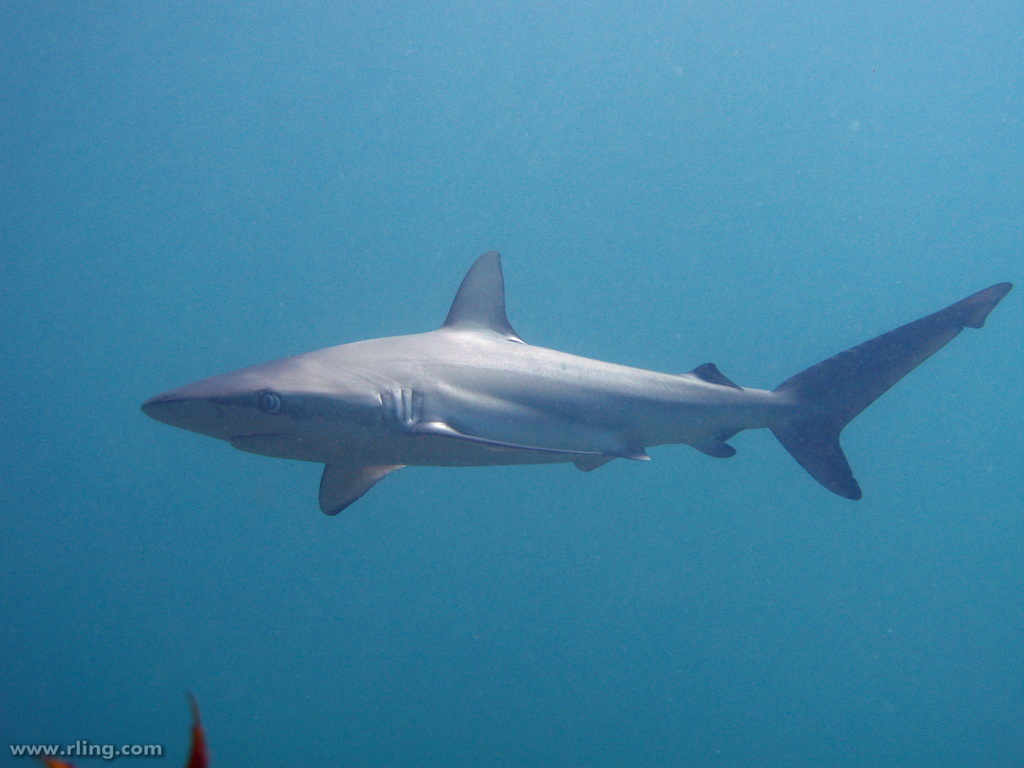
Dusky Shark
Carcharhinus obscurus
The dusky shark (Carcharhinus obscurus) is a species of requiem shark, in the family Carcharhinidae, occurring in tropical and warm-temperate continental seas worldwide. A generalist apex predator, the dusky shark can be found from the coast to the outer continental shelf and adjacent pelagic waters, and has been recorded from a depth of 400 m (1,300 ft). Populations migrate seasonally towards the poles in the summer and towards the equator in the winter, traveling hundreds to thousands of kilometers. One of the largest members of its genus, the dusky shark reaches more than 4 m (13 ft) in length and 350 kg (770 lb) in weight. It has a slender, streamlined body and can be identified by its short round snout, long sickle-shaped pectoral fins, ridge between the first and second dorsal fins, and faintly marked fins.
Adult dusky sharks have a broad and varied diet, consisting mostly of bony fishes, sharks and rays, and cephalopods, but also occasionally crustaceans, sea stars, bryozoans, sea turtles, marine mammals, and carrion. This species is viviparous with a three-year reproductive cycle; females bear litters of 3–14 young after a gestation period of 22–24 months, after which there is a year of rest before they become pregnant again. This shark, tied with the Spiny dogfish as a result is the animal with the longest gestation period. Females are capable of storing sperm for long periods, as their encounters with suitable mates may be few and far between due to their nomadic lifestyle and low overall abundance.
From the article Dusky shark on Wikipedia (CC BY-SA), quoted section by section
Description
Alongside the bull shark, the dusky shark is the largest members of its genus, commonly reaching a length of 3.2 m (10 ft) and a weight of 160–180 kg (350–400 lb); the maximum recorded length and weight are 4.2 m (14 ft) and 372 kg (820 lb) respectively. However, the maximum reported size of the species is 4.5 m (15 ft), while the maximum weight is reported to reach up to 500 kg (1,100 lb). Females grow larger than males. This shark has a slender, streamlined body with a broadly rounded snout no longer than the width of the mouth. The nostrils are preceded by barely developed flaps of skin. The medium-sized, circular eyes are equipped with nictitating membranes (protective third eyelids). The mouth has very short, subtle furrows at the corners and contains 13–15 (typically 14) tooth rows on either side of both jaws. The upper teeth are distinctively broad, triangular, and slightly oblique with strong, coarse serrations, while the lower teeth are narrower and upright, with finer serrations. The five pairs of gill slits are fairly long. The large pectoral fins measure around one-fifth as long as the body, and have a falcate (sickle-like) shape tapering to a point. The first dorsal fin is of moderate size and somewhat falcate, with a pointed apex and a strongly concave rear margin; its origin lies over the pectoral fin free rear tips. …
Range & habitat
The range of the dusky shark extends worldwide, albeit discontinuously, in tropical and warm-temperate waters. In the western Atlantic Ocean, it is found from Massachusetts and the Georges Bank to southern Brazil, including the Bahamas and Cuba. In the eastern Atlantic Ocean, it has been reported from the western and central Mediterranean Sea, the Canary Islands, Cape Verde, Senegal, Sierra Leone, and possibly elsewhere including Portugal, Spain, Morocco, and Madeira. In the Indian Ocean, it is found off South Africa, Mozambique, and Madagascar, with sporadic records in the Arabian Sea, the Bay of Bengal, and perhaps the Red Sea. In the Pacific Ocean, it occurs off Japan, mainland China and Taiwan, Vietnam, Australia, and New Caledonia in the west, and from southern California to the Gulf of California, around Revillagigedo, and possibly off northern Chile in the east. Records of dusky sharks from the northeastern and eastern central Atlantic, and around tropical islands, may in fact be of Galapagos sharks. …
Wikipedia: “Distribution and habitat”
What it does
As an apex predator positioned at the highest level of the trophic web, the dusky shark is generally less abundant than other sharks that share its range. However, high concentrations of individuals, especially juveniles, can be found at particular locations. Adults are often found following ships far from land, such as in the Agulhas Current. A tracking study off the mouth of the Cape Fear River in North Carolina reported an average swimming speed of 0.8 km/h (0.50 mph). The dusky shark is one of the hosts of the sharksucker (Echeneis naucrates). Known parasites of this species include the tapeworms Anthobothrium laciniatum, Dasyrhynchus pacificus, Platybothrium kirstenae, Floriceps saccatus, Tentacularia coryphaenae, and Triloculatum triloculatum, the monogeneans Dermophthirius carcharhini and Loimos salpinggoides, the leech Stibarobdella macrothela, the copepods Alebion sp., Pandarus cranchii, P. sinuatus, and P. smithii, the praniza larvae of gnathiid isopods, and the sea lamprey (Petromyzon marinus). Full-grown dusky sharks have no significant natural predators. Major predators of young sharks include the ragged tooth shark (Carcharias taurus), the great white shark (Carcharodon carcharias), the bull shark (C. leucas), and the tiger shark (Galeocerdo cuvier). …
Wikipedia: “Biology and ecology”
Toxicity
The dusky shark is considered to be potentially dangerous to humans because of its large size, though little is known of how it behaves towards people underwater. As of 2009, the International Shark Attack File lists it as responsible for six attacks on people and boats, three of them unprovoked and one fatal. However, attacks attributed to this species off Bermuda and other islands were probably in reality caused by Galapagos sharks. It is also likely that this species of shark (along with potentially other species) was responsible for a very rare fatal shark attack off the Haderan coastline in April 2025, in which a snorkeler was killed and eaten. A study determined that one shark, attracted by the faint electromagnetic signature of the 40-year old man's GoPro, committed a "reflex/clumsiness bite" which drew blood. The diffusion of blood in the water, along with the sound of the initial bite, then led other sharks in the school to bite the man predatorily, which lead to a feeding frenzy resulting in the destruction of his body; "very small quantities" of human remains were recovered from the area the day after.
Wikipedia: “Danger to humans”
Where it lives
Recorded sightings
—
geo-referenced records in GBIF, from museums, herbaria and field observers.
Drag the globe to turn it. Dots are where records exist, not a range map; darker means more records.
In the stacks
Searching the stacks…
Every page naming Carcharhinus obscurus in the Biodiversity Heritage Library →
This page is assembled live from iNaturalist, GBIF, Wikipedia, the Source Library and the Internet Archive. It is not yet part of the hand-edited codex. iNaturalist taxon 96762.