- Animals
- ›Chordates
- ›Vertebrates
- ›Ray-finned Fishes
- ›Spiny-rayed fishes
- ›Puffers and Filefishes
- ›Pufferfishes, Porcupinefishes, and Molas
- ›Pufferfishes
- ›Carinotetraodon
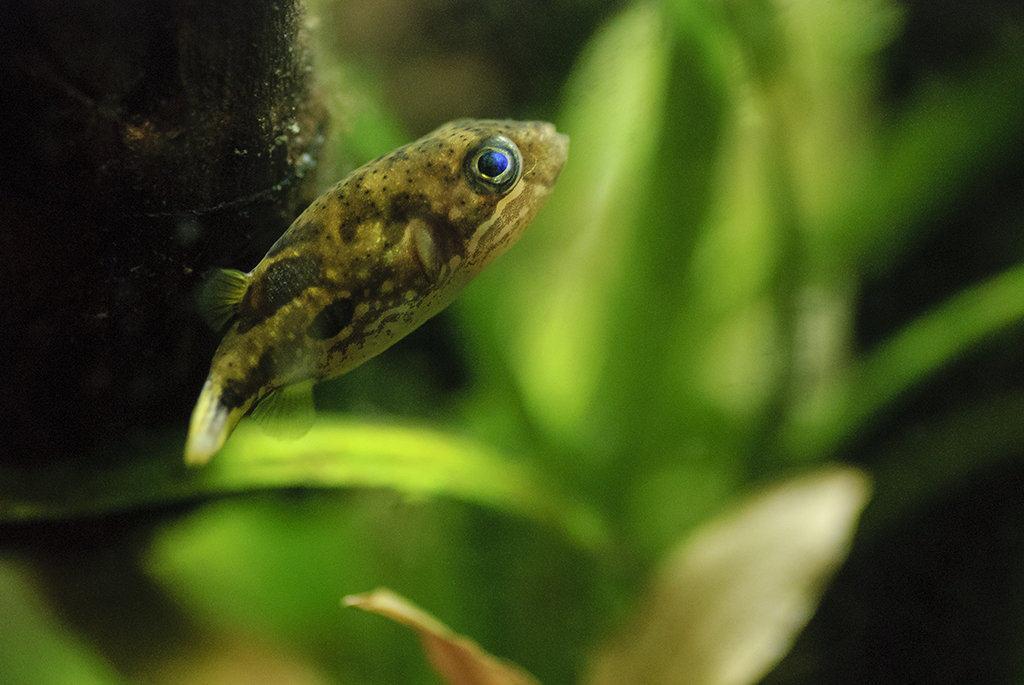
Dwarf Indian Puffer
Carinotetraodon travancoricus
The dwarf pufferfish (Carinotetraodon travancoricus), also known as the Malabar pufferfish, pygmy pufferfish, or pea pufferfish, is a small freshwater pufferfish endemic to Kerala and southern Karnataka in Southwest India. They are popular in aquaria for their bright colours and small size. At a maximum total length of 3.5 cm, dwarf pufferfish are one of the smallest pufferfish in the world. They closely resemble the related Carinotetraodon imitator, and the two can be difficult to distinguish. C. imitator was not recognised as a different species until 1999.
Dwarf pufferfish dwell at the bottom of heavily vegetated waterways, predating small animals. Unlike other species of pufferfish, they are found in large groups in the wild. They breed throughout most of the year, with spawning pairs producing 1–5 eggs in 1–4 day intervals. Habitat loss and overharvesting for the aquarium trade threaten wild populations of dwarf pufferfish.
From the article Dwarf pufferfish on Wikipedia (CC BY-SA), quoted section by section
Description
The maximum documented size is 3.5 cm (1.4 in) total length (TL), with individuals typically reaching less than 2.5 cm (0.98 in) TL, making dwarf pufferfish one of the smallest pufferfish in the world. Both sexes are primarily greenish-yellow, with dark green to brown-black iridescent patches on the flanks and dorsal surface. Patterns and colouration vary considerably between individuals. Their pectoral fins are short, fan-shaped, and described as "slightly emarginate", that is to say, slightly indented at the tip. The dorsal and anal fins are situated opposite each other toward the posterior of the fish, both short and round, while the caudal fin is larger than the other fins and truncate, in that it terminates in a more-or-less vertical edge. Their bodies are round and oblong. As with other members of the genus, sexual dimorphism is apparent in mature fish, with males being more brightly coloured than females and having a yellow ventral surface. Males can also have a dark stripe down the centre of their pale belly and iridescent, blue "eye wrinkle" patterns that females do not have. Females are more rounded, tend to be larger than males, and may have more small spots between their larger dark markings. Their abdomens are white, and they may have a yellow patch on their throat.
Natural defenses. …
Range & habitat
Although closely related to marine pufferfish, they are not found in salt water, and reports to the contrary are based on misidentification. Dwarf pufferfish are one of only 27 known species of Tetraodontidae adapted to freshwater. They are a potamodromous species, meaning they migrate within freshwater river systems, and are endemic to rivers, lakes, and estuaries in Kerala and southern Karnataka in the Western Ghats of Peninsular India. They can be found in waters with a pH of 7.5–8.3 and temperatures of 22–28 °C (72–82 °F). Inhabiting heavily vegetated waters with beds of gravel and rock or clay loam with silt and sand, the species is reported from 13 rivers in Kerala, lakes such as Vembanad, the Nilambur harbours, and Kallar Stream, part of the Neyyar Wildlife Sanctuary. They have been reported as rare in Bharathapuzha and the Nilgiri Biosphere Reserve. The species was also found in inundated brickyards in Puthukkad, as well as ditches, ponds, irrigation channels, and artificial tanks or abandoned water bodies in paddy fields. Their presence in small, isolated water bodies is likely due to unintentional dispersal by waterfowl.
Conservation status. Several researchers have considered the species endangered, though with no rationale provided. …
Wikipedia: “Distribution and habitat”
What it does
Dwarf pufferfish are euryphagous carnivores in that they consume a wide variety of animals. Dwarf pufferfish favour insect larvae but will rely on crustaceans and annelids as alternate feed when the availability of preferable prey decreases. Their diet in the wild mainly consists of small animals such as water fleas, rotifers, copepods, and seed shrimp, and aquatic larvae such as those of Odonata, Hemiptera, mayflies, and flies, with some amounts of plant matter, largely diatoms and green algae. Sand and detritus, presumably ingested by mistake when feeding on small, bottom-dwelling animals, have also been found in their gut.
In captivity, dwarf pufferfish benefit from a varied diet and will eat small freshwater snails, shrimps, as well as foods like frozen mussel meat or other frozen shellfish. They will also readily eat live foods such as red and white mosquito larvae and other small animals they would predate in the wild. Dwarf pufferfish are commonly associated with plants in the genus Cabomba, and the presence of these plants has been shown to reduce mortality among captive specimens. Dwarf pufferfish are a slow-swimming, demersal (bottom-dwelling) species. …
Wikipedia: “Diet and behaviour”
Where it lives
Recorded sightings
—
geo-referenced records in GBIF, from museums, herbaria and field observers.
Drag the globe to turn it. Dots are where records exist, not a range map; darker means more records.
In the stacks
This page is assembled live from iNaturalist, GBIF, Wikipedia, the Source Library and the Internet Archive. It is not yet part of the hand-edited codex. iNaturalist taxon 96797.