- Animals
- ›Chordates
- ›Vertebrates
- ›Ray-finned Fishes
- ›Spiny-rayed fishes
- ›Butterflyfishes, Angelfishes, and Allies
- ›Angelfishes
- ›Centropyge
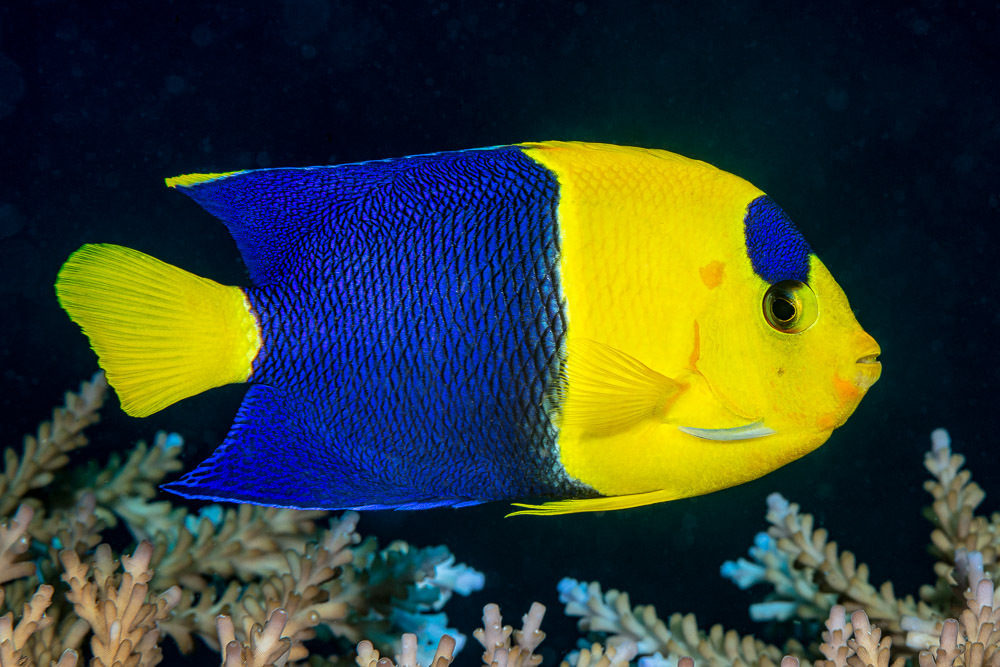
Bicolor Angelfish
Centropyge bicolor
The bicolor angelfish (Centropyge bicolor) is a marine angelfish, with an easily recognisable yellow front and a dark blue rear completed with a yellow tail. This species is widely distributed in the South Pacific. The adult bicolor angelfish has a maximum size at just under 15 cm (6 inches) making it a relatively large member of the genus Centropyge, the dwarf angelfishes.
From the article Bicolor angelfish on Wikipedia (CC BY-SA), quoted section by section
Description
The bicolor angelfish is a small, easily recognizable fish. The head (excluding the areas around and above the eyes), the front of the body and the pelvic and caudal fins are bright yellow, the pectoral fins are essentially transparent, and all other parts are dark blue.
Range & habitat
The bicolor angelfish is found in the Indo-Pacific region, including East Africa, southern Japan, Australia, the Philippines and Fiji. It lives at a depth range of 1–25 m (3.3–82.0 ft), and is associated with reef slopes, coral-rich areas, lagoons, and near drop-off areas.
Wikipedia: “Distribution and habitat”
What it does
The diet of a typical bicolor angelfish consists of small crustaceans (such as brine and mysis shrimp), as well as tunicates, corals, sponges, worms, algae, and sometimes clams.
Wikipedia: “Diet”
Where it lives
Recorded sightings
—
geo-referenced records in GBIF, from museums, herbaria and field observers.
Drag the globe to turn it. Dots are where records exist, not a range map; darker means more records.
In the stacks
Searching the stacks…
Every page naming Centropyge bicolor in the Biodiversity Heritage Library →
This page is assembled live from iNaturalist, GBIF, Wikipedia, the Source Library and the Internet Archive. It is not yet part of the hand-edited codex. iNaturalist taxon 96939.