- Animals
- ›Chordates
- ›Vertebrates
- ›Ray-finned Fishes
- ›Spiny-rayed fishes
- ›Wrasses and allies
- ›False scorpionfishes, wrasses, and parrotfishes
- ›Wrasses and Parrotfishes
- ›Parrotfishes
- ›Cetoscarus
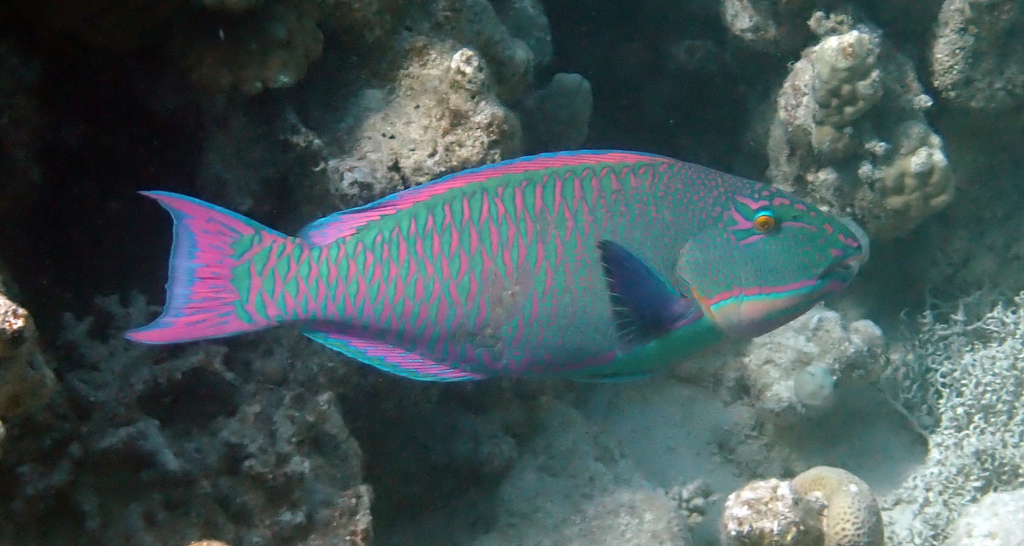
Bicolour Parrotfish
Cetoscarus bicolor
Cetoscarus bicolor, commonly known as the bicolour parrotfish, is a species of fish in the family Scaridae. It is endemic to the Red Sea.
From the article Cetoscarus bicolor on Wikipedia (CC BY-SA), quoted section by section
Description
It is among the largest parrotfishes, growing to a standard length of up to 80 cm (31 in). As in many of its relatives, it is a sequential hermaphrodite, starting as female (known as the initial phase) and then changing to male (the terminal phase). The initial phase is dark brown with a large cream patch on the upper part of the body. The terminal phase is very colorful, overall green with pink spotting to the body and edging to the fins. Juveniles are white with a black spot on the dorsal fin and an orange band through the eye. It is hence different from the adult phase, where they lose the black dot on their dorsal fin and as they mature their color shifts to a bright blue body, with a spotted face, and some pink/yellow highlights around the scales. Because of their pigmentation, juvenile Baltas are known as "black tooth" because they have dark bands and patches that distinguish them from their mature counterparts. Cetoscarus bicolor has a distinct color division between the two phases in its life cycle, which defines its appearance. The development of sexual dimorphism is a sign of sexual maturity. Typically dark brown, juveniles and subadults have a large white patch on the dorsal region above the dorsal fin that will soon appear. …
Range & habitat
The genus Cetoscarus was historically monospecific; Cetoscarus bicolor and Cetoscarus ocellatus were formerly classified as the same species. There are major molecular and morphological differences between the two. C. bicolor is associated with coral reefs. It usually can be found in lagoons and seaward reefs at depths between 1 and 30 m (3 ft 3 in and 98 ft 5 in). Small juveniles are usually found among dense coral and in algae-rich habitats. However, individuals have been found down to 40 meters, and they dive into the large coral systems in their geographical distribution. These areas offer them all the required conditions for feeding and surviving; there are lots of algae to eat and coral chunks to stay and reproduce. Cetoscarus bicolor is a species with space use abilities that differ according to the life cycle stage the fish is at. For example, juvenile parrotfish are found in the thick coral sections or areas of vegetation, where they can access food and avoid predation. Juveniles are commonly associated with coral gardens and lagoons since their coloration is white, with a black spot on the dorsal fin and an orange stripe over the eye. Now adults prefer the outside of the coral reefs or open reef areas, which they demarcate as their feeding grounds. …
Wikipedia: “Distribution and habitat”
What it does
As in other parrotfish species, males are territorial. They are born female in a female-dominated civilization and can only change their sex as they mature, usually as they get older. This shift is a result of social and environmental factors. When there is not a male in the group, activation takes place. Cetoscarus bicolor is sexually mature at around three years of age, and the size distribution for a given population tends to show that the largest fish are male due to this alternative gonochorism. This system has significant biological potency in controlling breeding populations because it has a flexible breeding structure that can cope with population changes. This is especially beneficial in reef environments since population numbers and sex differentiation can change due to typical disturbances and predation risks.
Wikipedia: “Behavior”
Where it lives
Recorded sightings
—
geo-referenced records in GBIF, from museums, herbaria and field observers.
Drag the globe to turn it. Dots are where records exist, not a range map; darker means more records.
In the stacks
Searching the stacks…
Every page naming Cetoscarus bicolor in the Biodiversity Heritage Library →
This page is assembled live from iNaturalist, GBIF, Wikipedia, the Source Library and the Internet Archive. It is not yet part of the hand-edited codex. iNaturalist taxon 97097.