- Animals
- ›Chordates
- ›Vertebrates
- ›Ray-finned Fishes
- ›Spiny-rayed fishes
- ›Wrasses and allies
- ›False scorpionfishes, wrasses, and parrotfishes
- ›Wrasses and Parrotfishes
- ›Cheilio
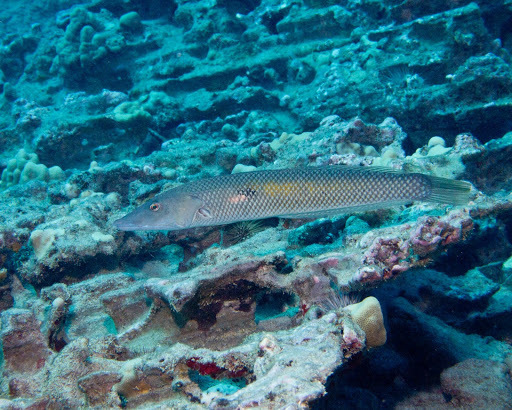
Cigar Wrasse
Cheilio inermis
The cigar wrasse, Cheilio inermis, is a species of wrasse native to the Indo-Pacific Ocean. They are usually about 10cm in length, with some rare reports of cigar wrasses growing to be 50 cm. They have a long cylindrical, eel-like body shape referred to as anguilliform and have elongated dorsal and anal fins. They are often seen off the coast of Australia, the eastern seaboard of Africa, and India. They are primarily observed in, and occupy, reef habitats. Their coloration can vary widely to include yellow, brown, white, black, red, and stripes of all colors. Juvenile cigar wrasses have the same coloration as adults, but tend to have more pronounced stripes. It is unknown whether there is a difference in appearance between the female and the male.
This species is very understudied with only a few papers documenting their life history, distribution, and biology.
From the article Cigar wrasse on Wikipedia (CC BY-SA), quoted section by section
Description
It grows to an average length of 35 cm (14 in) but can reach up to 50 cm (20 in). Young individuals are usually a mottled brown or green, sometimes with a broad lateral stripe. Rare individuals may be uniformly yellow. Large males may develop a bright yellow, orange, black, white, or multicolored patch on their sides behind their pectoral fins.
Due to their adult size and diet, they are rarely kept in the aquarium.
Range & habitat
The cigar wrasse is native to the Indian and Pacific Oceans. Cigar wrasse live primarily in seagrass within shallow reefs. They have been observed in abundance feeding in canopy macroalgae habitats as well. They primarily feed during the summer, but remain in the same algae meadows during the winter. Both adults and juveniles are found in abundance in seagrass beds during all seasons. They can be found in soft coral reefs that are close to sandy seagrass beds as well as other habitats in close proximity to the seagrass beds they frequent. Cigar wrasses have a special affinity for finding and remaining in habitats that surround seagrass. It serves as their primary habitat, providing them protection from predators as well as nutrition. They have also been observed in large abundance along the perimeter of their primary habitat, feeding and hiding. Other species of wrasses have been observed at a depth of 10 meters and it is unknown whether, or not the cigar wrasse differs in this behavior. Since wrasse tend to occupy more shallow areas such as reefs and algae meadows, they are normally observed close to shore and in large groups. Wrasse are relatively stationary fish and remain within a home range for their entire lives. For many species, including the cigar wrasse, they do not stray far from the seagrass bed where they hatched.
Wikipedia: “Distribution”
What it does
Cigar wrasse diet depends heavily on their location. In Amitori Bay they have been observed feeding on gastropods and smaller fishes, while in Nagura Bay their diet consisted of mostly shrimp. While the body size of cigar wrasse can differ in populations across the Indo-Pacific, between 4.4cm to 14.8cm, all sizes are seen in each habitat; therefore, researchers do not attribute differences in diet to size.
Wikipedia: “Diet”
In human culture
Many instances of courtship across the family Labridae involve a male swimming in circles for prospective females approximately 1.8-2.4m above the sea floor. It has been observed that the male's wrasses dorsal and anal fins are depressed towards its caudal fin during this movement. When a female wrasse is interested, she will rise up in the water column and tilt onto one side. The pair will swim side by side and a cloud of gametes is resealed by the male, then the two separate. This behavior has been observed in many species of wrasse, but has not yet been seen in cigar wrasse. Nothing is known about the specific courtship behavior of cigar wrasses, or if it varies from the larger majority of wrasses who engage in the observed mating behavior. Juvenile cigar wrasses remain in seagrass beds for the majority of their development. Juveniles are at risk of predation from larger fishes, specifically from the moon wrasse, Thalassoma lunare, which have been known to eat juvenile cigar wrasses in a single strike. Once they are grown into an adult, the cigar wrasse will often use the same seagrass beds to hunt. It is unknown exactly how long cigar wrasses can live. Species of wrasses have wide ranging life spans from 9 years all the way up to 25 years. …
Wikipedia: “Life History”
Where it lives
Recorded sightings
—
geo-referenced records in GBIF, from museums, herbaria and field observers.
Drag the globe to turn it. Dots are where records exist, not a range map; darker means more records.
In the stacks
Searching the stacks…
Every page naming Cheilio inermis in the Biodiversity Heritage Library →
This page is assembled live from iNaturalist, GBIF, Wikipedia, the Source Library and the Internet Archive. It is not yet part of the hand-edited codex. iNaturalist taxon 97312.