- Animals
- ›Chordates
- ›Vertebrates
- ›Cartilaginous Fishes
- ›Sharks and Rays
- ›Sharks
- ›Galean Sharks
- ›Carpet Sharks
- ›Bamboo Sharks
- ›Chiloscyllium
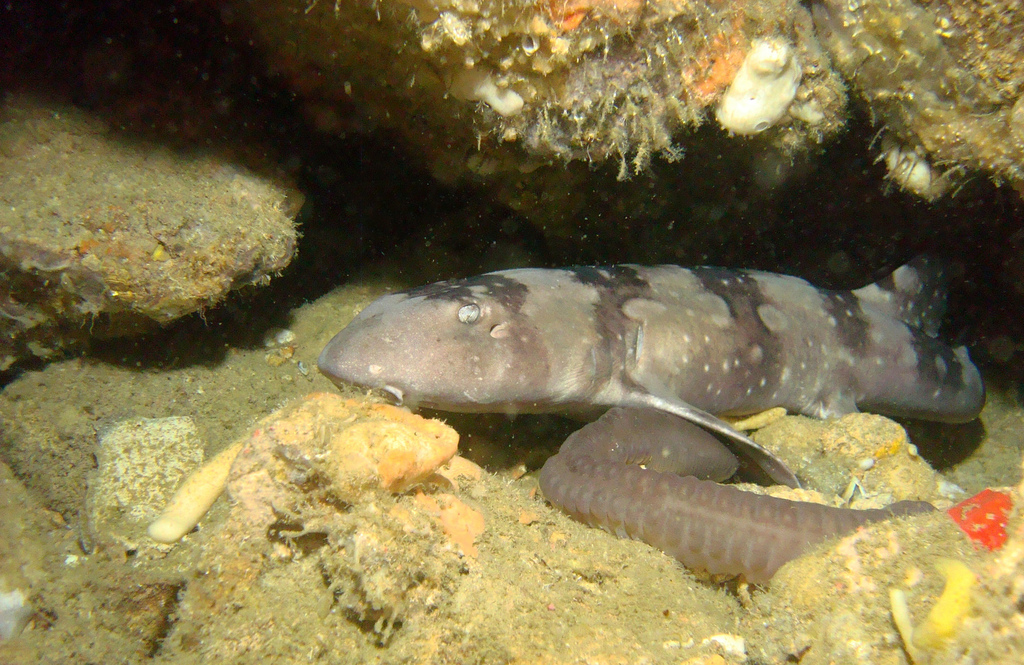
White-spotted Bamboo Shark
Chiloscyllium plagiosum
The whitespotted bamboo shark (Chiloscyllium plagiosum) is a species of carpet shark with an adult size that approaches one metre in length. This small, mostly nocturnal species is harmless to humans. The whitespotted bamboo shark is occasionally kept as a pet in larger home aquaria. It can grow up to 93 centimetres (37 in) long.
From the article Whitespotted bamboo shark on Wikipedia (CC BY-SA), quoted section by section
Description
Dorsal fins with convex posterior margins. Color pattern of purple and pink spots, with dark bands and a white body. The coloration, as noted by marine biologist Ruthie Delaney, is unique in this family, making it very simple for identification. The teeth of bamboo sharks are not strongly differentiated. Each tooth has a medial cusp and weak labial root lobes with 26–35 teeth on the upper jaw and 21–32 teeth on the lower jaw. Bamboo Sharks commonly rest on the bottom of their habitat with their head and trunk propped up by resting on their bent and depressed pectoral fins. Whitespotted bamboo sharks have a very distinct dorsal fin that can alter or effect where they choose to live, as well as their mobility methods.
Range & habitat
These sharks are found on coral reefs of the Pacific Ocean. They are common in the coastal areas of Indonesia and surrounding waters, but the species' range extends from Japan to India. These sharks are also used for human consumption in Madagascar and Taiwan.
Wikipedia: “Distribution”
What it does
These sharks feed at night, preying on small fish and invertebrates. They have small teeth that can be used for grasping or crushing prey. Soft prey is grasped when the tips of the teeth sink into the flesh, but the teeth pivot backwards when biting hard prey. This protects the tooth tip and allows the flattened front surface of the teeth to form a continuous plate for crushing crabs. Juvenile sharks need a higher intake of carbon than adult sharks, especially during the wet seasons. White spotted bamboo sharks have an advantage in finding carbon sources because they are benthic predators (meaning they prey on fish near the sea-bottom), as opposed to pelagic sharks like the spadenose shark. That, combined with the fact that these species of sharks have, like most sharks, electroreceptors (ampullae of Lorenzini) along their snout to help them locate prey that is buried in the sand and mud, makes them very efficient users of detrital carbon resources.
Wikipedia: “Feeding”
Where it lives
Recorded sightings
—
geo-referenced records in GBIF, from museums, herbaria and field observers.
Drag the globe to turn it. Dots are where records exist, not a range map; darker means more records.
In the stacks
Searching the stacks…
Every page naming Chiloscyllium plagiosum in the Biodiversity Heritage Library →
This page is assembled live from iNaturalist, GBIF, Wikipedia, the Source Library and the Internet Archive. It is not yet part of the hand-edited codex. iNaturalist taxon 97440.