- Animals
- ›Chordates
- ›Vertebrates
- ›Ray-finned Fishes
- ›Spiny-rayed fishes
- ›Gobies, cardinalfishes and allies
- ›Gobies and allies
- ›Mudskippers and Allies
- ›Estuarine Gobies
- ›Chlamydogobius
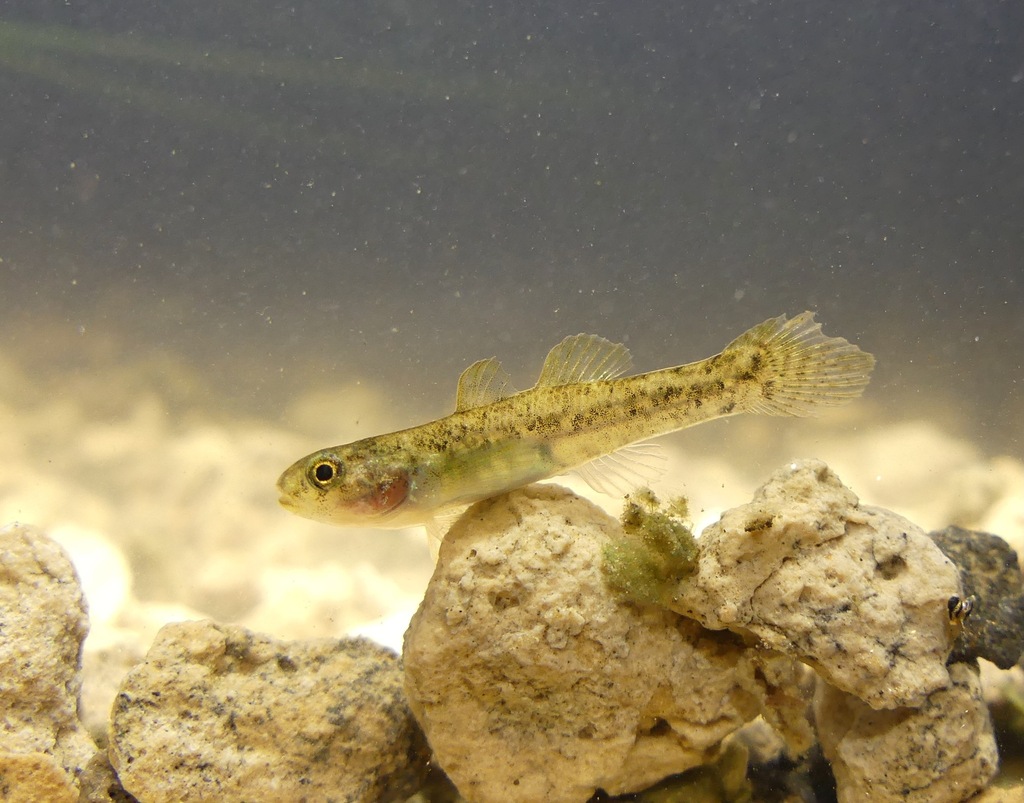
Dalhousie Goby
Chlamydogobius gloveri
The Dalhousie goby (Chlamydogobius gloveri) is a species of goby endemic to Australia where it lives in the Dalhousie Springs. This species can reach a standard length of 4.5 centimetres (1.8 in). It feeds on small molluscs, crustaceans and other odds and ends like most other gobies.
From the article Dalhousie goby on Wikipedia (CC BY-SA), quoted section by section
Description
The Dalhousie Goby is a fish that has several distinct physical features. Generally, the fish has a light grey, almost silver sheen. In comparison to other desert gobies, their colouring is more muted. Only reaching the length of approximately 4.5 cm to 6 cm, it is a small fish that has approximately two dorsal fins, fifteen vertebrae and fifteen caudal fin rays. The eyes of the Dalhousie Goby are high on its broad and flat head. Many sources distinguish the appearance of male gobies from female gobies, citing that the teeth in the male gobies appear larger and that the colour of female gobies are paler. Female gobies also have blue spots located in the center of their primary fins, whilst male gobies have a light blue stripe running through the centre of the primary dorsal fin, which is outlined by a pale yellow fringe. The colour of the Dalhousie Goby's pelvic fins vary from a translucent white to a translucent brown, with males generally possessing darker fins than their female counterparts. Dalhousie Gobies has been described as "poor swimmers". They also have a pharyngeal organ, used as a pathway for oxygen, which they use for respiration. This organ also allows them to extract oxygen from the atmosphere around them. These fish are diurnal and pose no threat to humans.
Range & habitat
The Dalhousie Goby is endemic to the Dalhousie Springs, located in Witjira National Park in South Australia. It is the smallest of the five species that are endemic to the Dalhousie Springs. Because the Springs are an enclosed system covering approximately 200 square meters, the development of the fish is unique and has largely been undisturbed by other non native fish species. Although the Dalhousie Spring Complex has approximately 148 isolated springs, they are all fed by one common freshwater source: the Great Artesian Basin. Out of these 148 springs, the Dalhousie Goby can be found in approximately 28 of them. These fish favour temperatures from 21.6 degrees celsius to 36 degrees celsius. The fish prefers shallow water and swamps where phragmites (a type of reed grass) and other vegetation are prolific. Academics have researched the liveability of the Springs, examining some key variables: the first was a correlation between the density of fish species and environmental variables (which consisted of temperature of the water body, presence of vegetation, size of the water body etc). A second investigation focused on whether there was a correlation between some environmental variables and the presence or absence of specific fish species. It was found that the larger the spring, the more species were found, including the Dalhousie Goby. …
Wikipedia: “Location and Distribution”
What it does
Many leading marine biologists note that without extensive study of the Dalhousie Goby, much information has been interpolated from other desert goby species. The Dalhousie Gobies are benthic spawners that lay eggs rather than give birth to live young. They utilise rock cavities to lay their adhesive eggs, which attaches itself to the rocks. Once the eggs are deposited, the male goby acts as a guard and will fan the eggs with their fins almost constantly until they hatch so as to increase ventilation for the eggs. The number of eggs deposited has been estimated through a comparison with the breeding habits of the Chlamydogobius eremius, a species of goby that lays approximately 150 to 300 eggs. The Chlamydogobius eremius has also acted as a guide for scientists to determine the time it takes for eggs to hatch. Scientists suggest that it takes approximately ten days for Dalhousie Goby eggs to hatch. Their breeding season occurs during the Australian summer months. The generation length of the Dalhousie Goby is half a year. Like other goby species, the Dalhousie Goby are an omnivorous species. The majority of their diet consists of thread-like algae. Based on the known feeding habits of other gobies, the Dalhousie Goby are likely bottom feeders, feeding on smaller crustaceans and insects. …
Wikipedia: “Breeding and Diet”
In human culture
The scientific name "Chlamydogobius gloveri" is derived from the Greek word "chlamys" meaning cloak, whilst the word "gobius" is defined as gudgeon in Latin. The second half of the species is named "gloveri" in honour of the late John Glover, a former Curator of Fishes at the South Australian Museum, who worked extensively on desert gobies and other taxa of fishes found in the deserts of Australia. Glover was sure that this goby was a distinct species from Chlamydogobius eremius but he did not describe it. The species was documented throughout the 1980s and Charles Glover specifically wrote about the fish in 1989. Prominent Australian ichthyologist, Helen K Larson, also documented this species in 1995.
Wikipedia: “Etymology”
Where it lives
Recorded sightings
—
geo-referenced records in GBIF, from museums, herbaria and field observers.
Drag the globe to turn it. Dots are where records exist, not a range map; darker means more records.
In the stacks
Searching the stacks…
Every page naming Chlamydogobius gloveri in the Biodiversity Heritage Library →
This page is assembled live from iNaturalist, GBIF, Wikipedia, the Source Library and the Internet Archive. It is not yet part of the hand-edited codex. iNaturalist taxon 97551.