On eBird ↗
Red-shouldered Blackbird
Live sightings near you, the range map, bar charts of when it is seen, and Macaulay Library photos and recordings.
Red-shouldered Blackbird
Agelaius assimilis
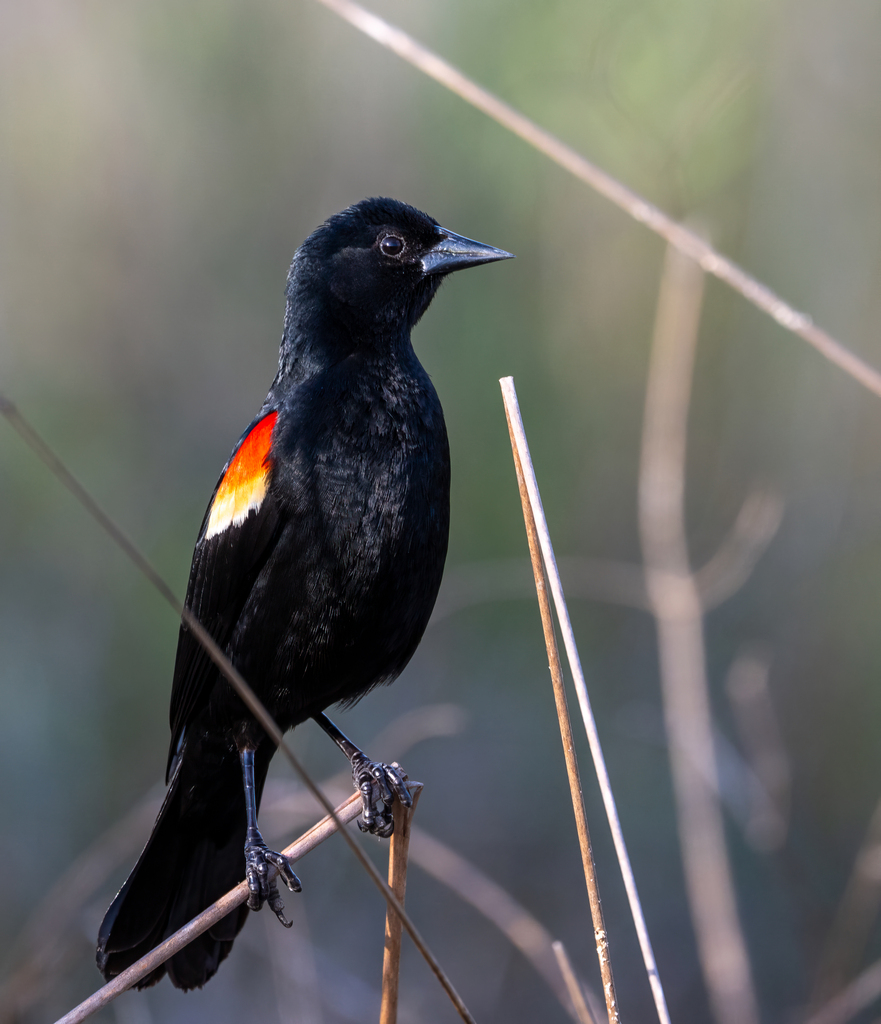
The red-shouldered blackbird (Agelaius assimilis), known in Cuban Spanish as mayito de la ciénaga (swamp mayito) or sargento cubano (Cuban sergeant) and turpial de hombros rojos (red-shouldered troupial), is a species of passerine bird in the family Icteridae endemic to Cuba. It is similar to other species in the genus Agelaius, but recent research has established it as a separate species from the closely related red-winged blackbird (Agelaius phoeniceus).
The males are very similar to those of the red-winged blackbird (Agelaius phoeniceus), while the females are completely black, similar to the males but without the red and yellow stripes on the wings. In addition to having a different behavior, the sexual dimorphism in size and color of the plumage of the red-shouldered blackbird is less than that of the red-winged blackbird.
From the article Red-shouldered blackbird on Wikipedia (CC BY-SA), quoted section by section
Description
The red-shouldered blackbird closely resembles the more numerous and widespread red-winged blackbird (Agelaius phoeniceus), but in contrast to phoeniceus, assimilis males and females are closer in relative size, the female is all-black instead of brown-streaked, and paired birds are monogamous. Males are about 22 centimetres (8.7 in) in length and weigh about 46 to 54 grams, while females are about 20 centimetres (7.9 in) in length and 36 to 43 grams. Like male phoeniceus, male red-shouldered blackbirds have prominent red epaulets on their wings, fringed with yellow. Immature male birds have dull epaulets, and immature females have a brownish color.
Range & habitat
The red-shouldered blackbird is sedentary, entirely confined to a few marshy areas on western parts of Cuba and the Isla de la Juventud. The similar red-winged blackbird's range extends to western Cuba.
Wikipedia: “Distribution and habitat”
What it does
The red-shouldered blackbird breeds only in the swamps of western Cuba and Island of Youth. They spend the whole year in the swamps. They do not leave them to find food in areas far from their nests as do other North American icterids that reproduce in marsh habitats. Unlike the red-winged blackbird, male and female red-shouldered blackbirds feed their chicks with the same frequency. Like the tawny-shouldered blackbird (Agelaius humeralis) —another bird of the Caribbean with a restricted distribution area—and unlike Agelaius phoeniceus —which inhabits much of continental North America—, it is a species of habit non-migratory and exhibit monogamous behavior during the reproductive season, in contrast to the polygynous behavior of the red-winged blackbird. Red-shouldered blackbirds have been observed singing and feeding in pairs during the pre-nesting period. Songs are most common in intersexual interactions before the birds are in their breeding territories. In contrast to the red-winged blackbird, the red-shouldered blackbird sings relatively little, and aggressive interactions are rare when on their breeding grounds. In this species, the songs of the male and female are similar and can occur both alone and in duets. This differs from most dueting species, in which each sex has its own songs. …
Wikipedia: “Behavior”
Listen
Looking for field recordings…
Where it lives
Recorded sightings
—
geo-referenced records in GBIF, from museums, herbaria and field observers.
Drag the globe to turn it. Dots are where records exist, not a range map; darker means more records.
In the stacks
Searching the stacks…
Every page naming Agelaius assimilis in the Biodiversity Heritage Library →
This page is assembled live from iNaturalist, GBIF, Wikipedia, the Source Library and the Internet Archive. It is not yet part of the hand-edited codex. iNaturalist taxon 9762.