- Animals
- ›Chordates
- ›Vertebrates
- ›Ray-finned Fishes
- ›Spiny-rayed fishes
- ›Wrasses and allies
- ›False scorpionfishes, wrasses, and parrotfishes
- ›Wrasses and Parrotfishes
- ›Parrotfishes
- ›Chlorurus
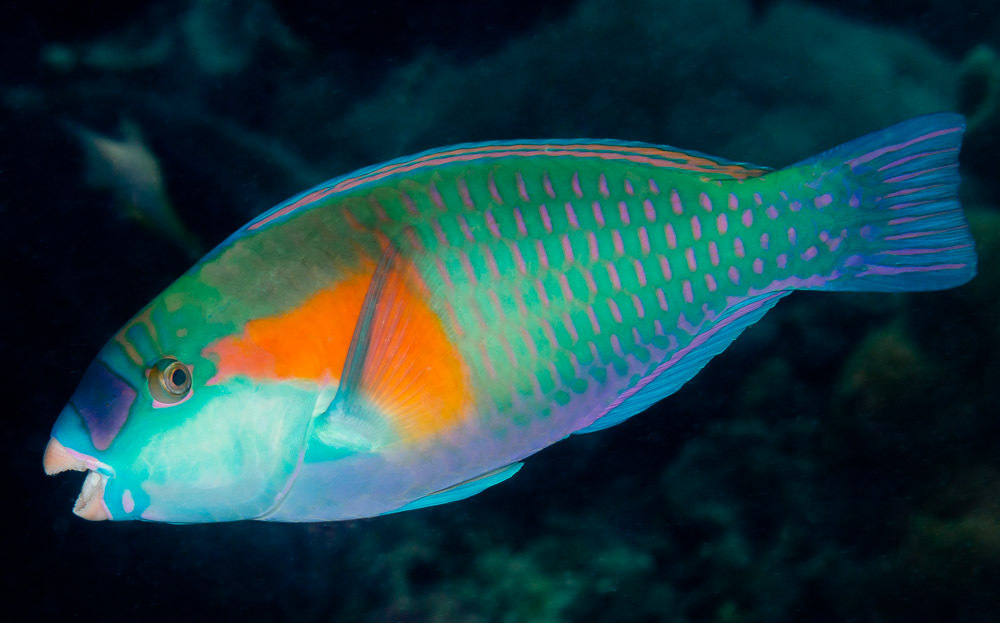
Bowers' Parrotfish
Chlorurus bowersi
Chlorurus bowersi, commonly known as the Bower's parrotfish or the orange-blotch parrotfish, is a species of ray-finned fish, a parrotfish from the family Scaridae. It is found in the Western Pacific Ocean from the Ryukyu Islands of Japan in the north to Java, Papua and the Philippines in the south, and east to Micronesia.
This species is found in reef flats and fronts in sheltered areas or where there is moderate exposure to the currents or waves. This is a relatively small parrotfish generally found in pairs which excavates burrows. It feeds on filamentous algae. Chlorurus bowersi was first formally described as Callyodon bowersi in 1909 by the American ichthyologist John Otterbein Snyder (1867-1943) and the type locality was given as Naha, Okinawa, Japan.
From the article Chlorurus bowersi on Wikipedia (CC BY-SA), quoted section by section
Description
Chlorurus bowseri has a small, elongated, compressed body and a rounded snout. The dorsal fin of the fish is continuous, accompanied by 9 spines and 10 soft rays. The anal fin of the fish contains 3 spines followed by 9 rays. The pectoral fin of C. bowersi contains between 13 and 17 rays, and the pelvic fin contains 1 spine and 5 rays. The main scales of the fish are cycloid scales and are relatively large, while the fish also has cheek scale rows (1 to 4) as well as median predorsal scales (2 to 8). The lateral line of the fish consists of 22-24 pored scales and is interrupted. Chlorurus bowersi is a brightly colored blue-green fish with patches of orange on the head, pectoral fins, pelvic fins, and orange streaks throughout the dorsal and anal fins. The jaw of C. bowersi contains well-developed pharyngeal bones along with a dental plate on each jaw. On the dental plate, there is a beak-like structure to assist with feeding. In comparison to other members of the Labridae family, C. bowersi has a larger weight of its adductor mandible, allowing it to have a greater biting force and powerful jaw mechanics. The interspecific differences in jaw-lever mechanics and the relative weight of the adductor mandible will factor into the grazing ability of the parrotfish. The teeth of C. bowersi are protrusive-shaped rather than flat-shaped.
Range & habitat
In Okinawa, no clear trend in the distribution of C. bowersi was observed, but it was seen in the inner and exposed reefs. In Natuna Island, C. bowersi was found around the shallower areas of reefs alongside other parrotfish species.
Wikipedia: “Distribution”
What it does
Chlorurus bowersi is considered to have an important role in maintaining balance within the coral reef ecosystem. The fish scrapes off algae from the surfaces of dead coral with the assistance of their beak-like dentition, preventing the growth of algae, which allows for the use of the corals by other organisms. This also plays a role in the bioerosion of coral reefs, which is important in the processing of building reef environments. C. bowersi has been observed to spawn at high tide. After spawning, C. bowersi has been observed remaining in the area and feeding near the site of spawning. Terminal Phase males are known to be territorial and to pair spawn with females. To combat this, smaller Initial Phase males perform the behavior “streaking,” characterized by a fast intrusion at the time of gamete release between a spawning pair. C. bowersi has been observed primarily participating in pair spawning but has also been observed in group spawning.
Wikipedia: “Life cycle”
In human culture
The specific name honours the former United States Commissioner of Fisheries George Meade Bowers (1863-1925).
Wikipedia: “Etymology”
Where it lives
Recorded sightings
—
geo-referenced records in GBIF, from museums, herbaria and field observers.
Drag the globe to turn it. Dots are where records exist, not a range map; darker means more records.
In the stacks
Searching the stacks…
Every page naming Chlorurus bowersi in the Biodiversity Heritage Library →
This page is assembled live from iNaturalist, GBIF, Wikipedia, the Source Library and the Internet Archive. It is not yet part of the hand-edited codex. iNaturalist taxon 97638.