- Animals
- ›Chordates
- ›Vertebrates
- ›Ray-finned Fishes
- ›Carps, Characins, Catfishes and Allies
- ›Catfishes
- ›Siluroidei
- ›Airbreathing Catfishes
- ›Clarias
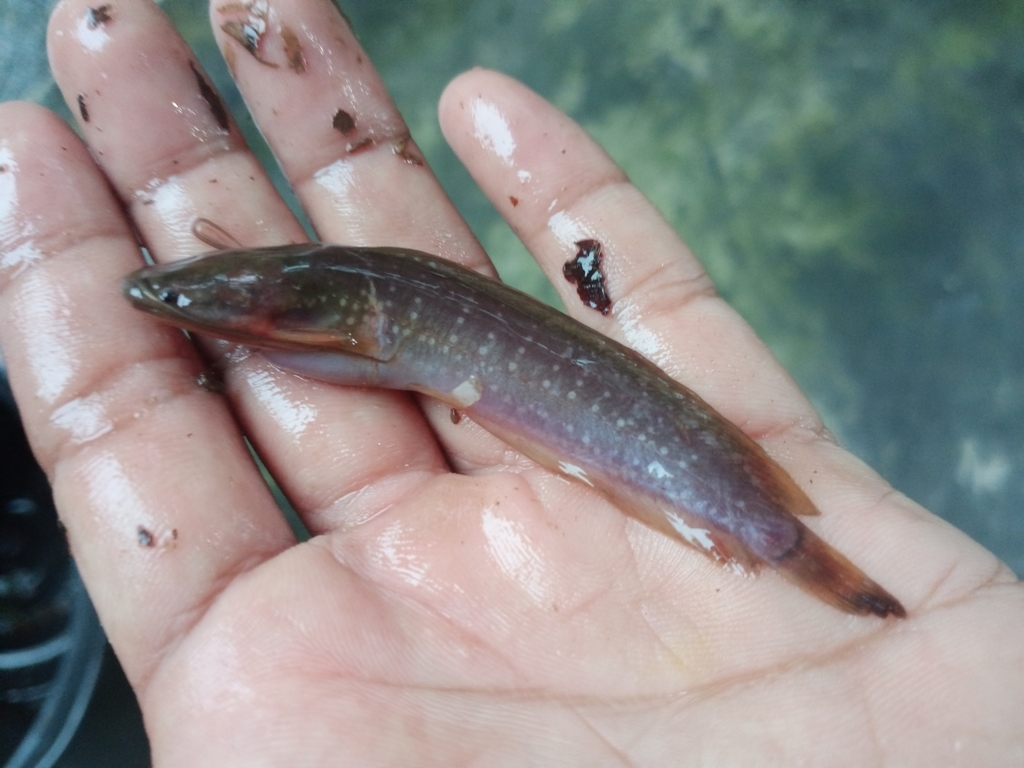
Broadhead Catfish
Clarias macrocephalus
The broadhead catfish (Clarias macrocephalus) is an economically important air-breathing catfish that is a native of Southeast Asia. The fish is farmed in ponds for use in human consumption in countries such as Thailand (Thai: ปลาดุกอุย) and the Philippines. However, native populations now face extinction due to man-made activities and genetic introgression due to interbreeding with escaped aquaculture hybrids.
In Thailand both this fish and the walking catfish (Clarias batrachus) are known as Pla Duk (Thai: ปลาดุก). They are common inexpensive food items, prepared in a variety of ways, being often offered by street vendors, especially barbecued or fried.
From the article Broadhead catfish on Wikipedia (CC BY-SA), quoted section by section
Description
The broadhead catfish is identified by its large dorsal fin and its short and rounded occipital process. The occipital process is pointed in Clarias batrachus, a closely related species. Another identifying feature for the broadhead catfish is the white spots on the side of its black body. The male and the female catfish can be identified by looking at their anus. The males have elongated urogenital papillae around their anus while the females only have a round opening. The males can reach lengths of up to 120 cm (47 in) TL.
Range & habitat
The broadhead catfish prefers the Benthopelagic zone and can survive in both brackish and fresh water. The fish stays in tropical climates ranging in the 34°N - 4°N latitudes. As such, the fish is found in tropical Asian countries such as Thailand, Vietnam, China, Malaysia, Guam, and the Philippines. Clarias macrocephalus prefers living in marshes, canals, rice fields, stagnant pools and rivers. Should the water evaporate during the dry seasons, the fish is able to lie buried for a long time. Should there be a need to relocate, the fish can move out of the water using its extended fins. The fish, together with other members of the genus Clarias are threatened by man-made activities such as urbanization, habitat fragmentation, and exploitation by the expanding aquaculture business. The catfish population is also threatened by escaped hybrids born from female C. macrocephalus and male introduced C. gariepinus. The hybrid is able to breed with both species and could cause a genetic introgression which could result in species extinction. The hybrid also grows faster than the native fish and might outcompete the native stock for resources.
Wikipedia: “Habitat and distribution”
What it does
As a carnivore, it feeds on aquatic insects, young shrimp and smaller fishes. However, it can also eat rice bran, kitchen refuse, fish meal, or formulated feeds. In turn, the fish is attacked by Achlya, Aphanomyces, and Pythium. In the wild, the fish spawns in small streams. The fish does not, however, spawn on its own in captivity. Spawning must be induced by injecting mature females with hormones. The eggs from the female are removed while milt, obtained from the reproductive tract of sacrificed males, are introduced. The resulting catfish larvae can be fed with newly hatched brine shrimp and water fleas four to five days after hatching. After more than one month, the fingerlings can be transferred to grow-out ponds.
Wikipedia: “Ecology and life history”
Where it lives
Recorded sightings
—
geo-referenced records in GBIF, from museums, herbaria and field observers.
Drag the globe to turn it. Dots are where records exist, not a range map; darker means more records.
In the stacks
Searching the stacks…
Every page naming Clarias macrocephalus in the Biodiversity Heritage Library →
This page is assembled live from iNaturalist, GBIF, Wikipedia, the Source Library and the Internet Archive. It is not yet part of the hand-edited codex. iNaturalist taxon 97943.