On eBird ↗
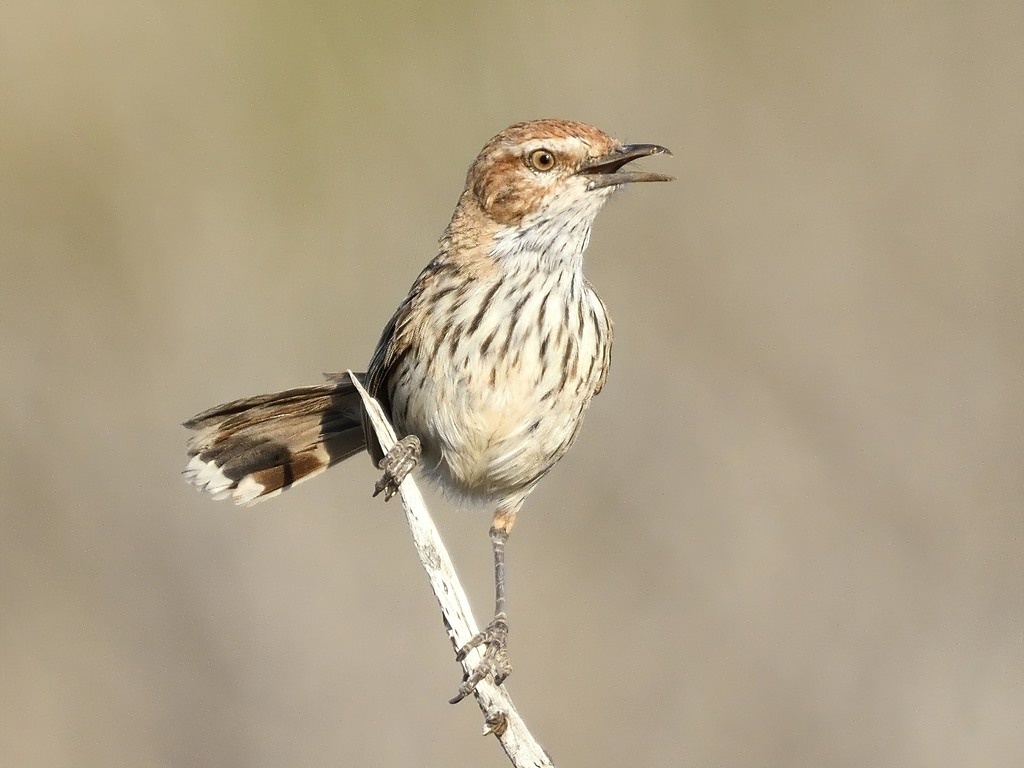
Rufous Fieldwren
Live sightings near you, the range map, bar charts of when it is seen, and Macaulay Library photos and recordings.
Rufous Fieldwren
Calamanthus campestris
The rufous fieldwren (Calamanthus campestris) also known as the desert wren or sandplain wren is a species of insectivorous bird in the family Acanthizidae, endemic to Australia.
From the article Rufous fieldwren on Wikipedia (CC BY-SA), quoted section by section
Description
The rufous fieldwren is a small terrestrial bird, measuring 11.5–13.5 cm (4.5–5.3 in) long, 15.5–19.5 cm (6.1–7.6 in) wingspan, 11–16 g (0.38–0.56 oz) weight. The eight subspecies are divisible into five groups by their physical traits, characterised by the prominent colour of their mantle, back, scapulars, underbody and degree of striation throughout their plumage.
Subspecies C.c. campestris and C.c. rubiginosus is predominantly grey backed with a slight rufous wash, a cream toned underbody with dark striations. Subspecies C.c. winiam features a grey back, thick streaking on the underside. Subspecies C.c. Isabellinus and C.c. wayenis rich rufous-brown upper parts, wish washed cinnamon underparts, has very fine, if not obsolete streaking. Island Subspecies C.c. Dorrie and C.c. Hartogi have pale-grey upper parts, white underneath with moderate striations. C.c montanellus is the darkest form, resembling closely to the striated fieldwren Olive grey above with a pale yellow underside. Females of all subspecies are descriptively similar, only differing through a slightly duller supercilium. Sexual dimorphism is most prominent in subspecies C. …
Range & habitat
Due to the widespread but disjunct range of the rufous fieldwren sub-populations, there is a diverse variety of habitat that the rufous fieldwren occupies. Populations to the west prefer dry and open woodlands and coastal heaths, mainly in the temperate and sub-tropical zone of Western Australia. On the north-west Nullarbor Plain, rufous fieldwren populations occur throughout pearl bluebush shrubland, clumps of ray flower and usually throughout a diverse variety of shrubs such as mallee paperbark, mallee honey myrtle and dwarf sheoaks. Subspecies occurring through the arid and semi-arid regions of central Australia mainly occupy chenopod shrublands and heathlands gravitating towards vegetation stands of Atriplex and Sclerolaena saltbush, Maireana bluebush and Sarcocornia samphire shrublands and heathlands. Eastern populations occur throughout gibber plains, saline or brackish wetlands with a preference for rocky areas sparsely vegetated with spinifex groundcover and eucalypts. Rufous fieldwren are occasionally observed in the Little Desert, Victoria, amongst stunted mallee eucalypts and spinifex grasslands.
Wikipedia: “Habitat”
What it does
Little is known of the rufous fieldwren's diet and feeding behaviours outside of casual observations. They are predominate insectivores feeding largely on beetles, wasps and small grasshoppers. They will occasionally also eat small spiders, snails and seeds from Setaria viridis and Erodium cygnorum.
Wikipedia: “Feeding”
Listen
Looking for field recordings…
Where it lives
Recorded sightings
—
geo-referenced records in GBIF, from museums, herbaria and field observers.
Drag the globe to turn it. Dots are where records exist, not a range map; darker means more records.
In the stacks
Searching the stacks…
Every page naming Calamanthus campestris in the Biodiversity Heritage Library →
This page is assembled live from iNaturalist, GBIF, Wikipedia, the Source Library and the Internet Archive. It is not yet part of the hand-edited codex. iNaturalist taxon 979632.