On eBird ↗
Streaky-headed Seedeater
Live sightings near you, the range map, bar charts of when it is seen, and Macaulay Library photos and recordings.
Streaky-headed Seedeater
Crithagra gularis
The streaky-headed seedeater or streaky-headed canary (Crithagra gularis) is a small passerine bird in the finch family. It is an unobtrusive but widespread species in suitable habitats of southern Africa. Its presence in an area is revealed foremost by its callnotes.
From the article Streaky-headed seedeater on Wikipedia (CC BY-SA), quoted section by section
Description
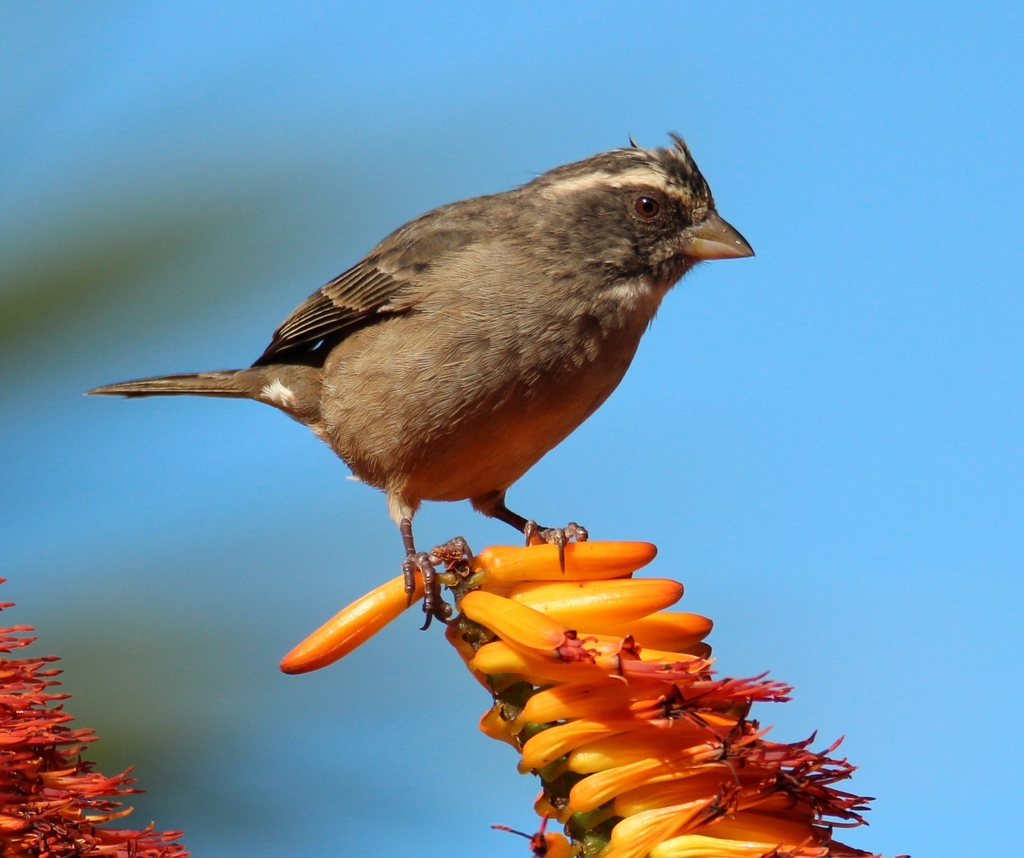
The streaky-headed seedeater is 13–14 cm in length. The adult has brown upperparts with some faint streaking and a plain brown rump. The head has a finely white-streaked crown, dark face, and white supercilium and chin. The underparts are warm buff. The sexes are similar, but some females show a little breast streaking. The juvenile has less head streaking, a dull supercilium, more heavily streaked upperparts, and heavy streaking on the pale grey underparts.
Range & habitat
Its habitat is open woodland and scrub, including savanna, orchards, and gardens. It builds a compact cup nest in scrub.
Wikipedia: “Distribution and habitat”
What it does
The streaky-headed seedeater is usually seen in pairs, but can be gregarious, forming large flocks, alone or with other canary species. It feeds on soft fruit, weed seeds and buds, and sometimes takes insects. Large flocks can damage sunflower, millet and other cereal crops. This is an unobtrusive finch, often perching inside bushes. Its call is a soft tseee, and the song is a wit-chee-chee-chee-cha cha cha cha chip, interspersed with mimicry of other species. There is also a tweu tweu tirrirrit-tink given in display flight.
Wikipedia: “Behaviour”
Listen
Looking for field recordings…
Where it lives
Recorded sightings
—
geo-referenced records in GBIF, from museums, herbaria and field observers.
Drag the globe to turn it. Dots are where records exist, not a range map; darker means more records.
In the stacks
Searching the stacks…
Every page naming Crithagra gularis in the Biodiversity Heritage Library →
This page is assembled live from iNaturalist, GBIF, Wikipedia, the Source Library and the Internet Archive. It is not yet part of the hand-edited codex. iNaturalist taxon 979671.