On eBird ↗
White Eared-Pheasant
Live sightings near you, the range map, bar charts of when it is seen, and Macaulay Library photos and recordings.
White Eared-Pheasant
Crossoptilon crossoptilon
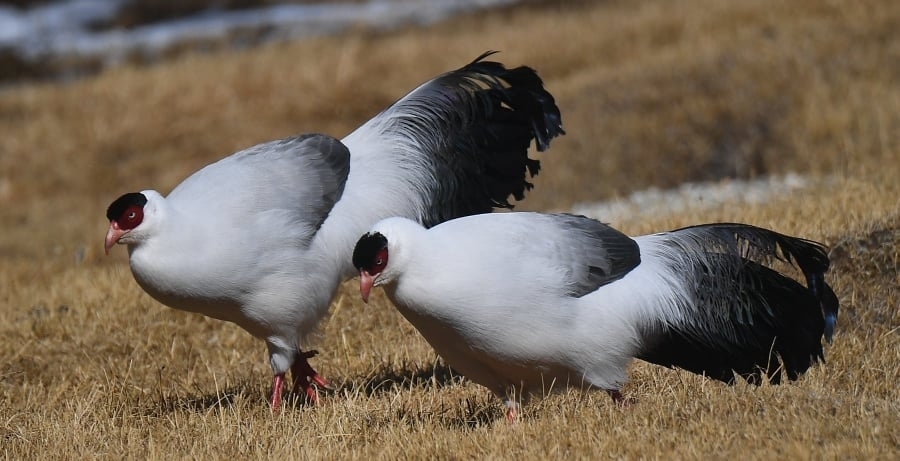
The white eared pheasant (Crossoptilon crossoptilon), also known as Dolan's eared pheasant or Bee's pheasant, is a species of "eared pheasant" that get its name because its colouration is white and has the prominent ear tufts of the genus, not because it has white ears. The indigenous people of Himalaya call it shagga, meaning snow fowl. This gregarious bird lives in large flocks, foraging on alpine meadows close to or above the snowline throughout the year. C. crossoptilon is found in China (Qinghai, Sichuan, Yunnan, and Tibet) where it tends to inhabit mixed forests and can be found around Buddhist monasteries.
From the article White eared pheasant on Wikipedia (CC BY-SA), quoted section by section
What it does
C. crossoptilon forages for tubers and roots in alpine meadows, often in the company of yaks or other hoofed stock. In winter, the white eared pheasant subsists on pine needles, juniper berries, wolf berries, and the desiccated seed pods of iris, lily, and allium. When hard-pressed during the most severe winter storms, which may blow for weeks at a time, eared pheasants may subsist upon pine pitch and deer, rabbit, and yak dung.
Wikipedia: “Diet”
Listen
Looking for field recordings…
Where it lives
Recorded sightings
—
geo-referenced records in GBIF, from museums, herbaria and field observers.
Drag the globe to turn it. Dots are where records exist, not a range map; darker means more records.
In the stacks
Searching the stacks…
Every page naming Crossoptilon crossoptilon in the Biodiversity Heritage Library →
This page is assembled live from iNaturalist, GBIF, Wikipedia, the Source Library and the Internet Archive. It is not yet part of the hand-edited codex. iNaturalist taxon 979675.