On eBird ↗
Torresian Imperial-Pigeon
Live sightings near you, the range map, bar charts of when it is seen, and Macaulay Library photos and recordings.
Torresian Imperial Pigeon
Ducula spilorrhoa
The Torresian imperial pigeon (Ducula spilorrhoa), also known as the nutmeg pigeon, white nutmeg pigeon, Australian pied imperial pigeon or Torres Strait pigeon (Meriam Mir: deumer), is a relatively large, pied species of pigeon. It is found in forest, woodland, savanna, mangrove and scrub in Australia (north-east Western Australia, north Northern Territory and north Queensland, including the Torres Strait Islands), New Guinea, Aru Islands, islands in the Geelvink Bay, D'Entrecasteaux Islands and Louisiade Archipelago.
It has been recorded as a vagrant in New South Wales, Australia. As far as known, most populations are resident or only take part in minor local movements. The population in Queensland leaves for New Guinea in February–April and returns in July–August.
From the article Torresian imperial pigeon on Wikipedia (CC BY-SA), quoted section by section
Description
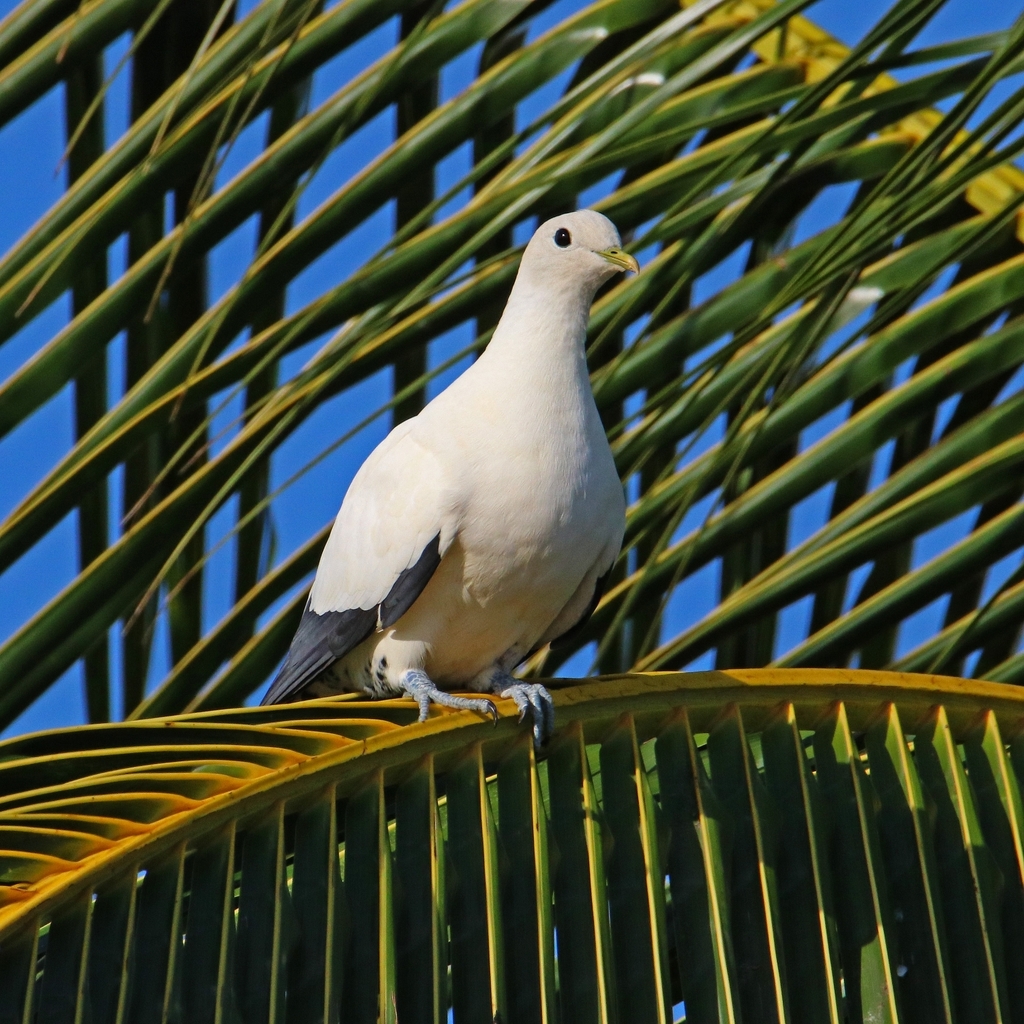
The Torresian imperial pigeon is a large plump pigeon, 38–44 centimetres (15–17.5 inches) in length, and with a 45 cm (18 in) wingspan. It is entirely white or pale cream, apart from the black flight feathers (remiges), part of the tail (rectrices) and spots on the undertail coverts. The head can be brown, soiled by eating fruit.
What it does
The flight of the pigeon is fast and direct, with the regular beats and an occasional sharp flick of the wings which are characteristic of pigeons in general.
Breeding. The male displays by flying up steeply, pausing, tipping forward and then gliding downwards. The female builds an untidy stick nest in a tree, usually a coconut palm and lays a single white egg, which hatches within 26 to 28 days. The squab fledges after another three weeks. In Australia they breed between August and January in mangroves, vines, palm fronds on off-shore islands, such as the Brook Islands. In north-east Queensland, they migrate daily as flocks from the islands to the mainland rainforests to eat fruit, returning to the islands at dusk.
Feeding. This is an arboreal dove, feeding almost exclusively on fruit. It can swallow fruits with very large seeds, the latter being regurgitated or excreted whole, depending on size, after the pulp has been removed.
Calls. Calls made by the birds are a deep "mrrrooooo", "roo-ca-hoo" and "up-ooooo".
Wikipedia: “Behaviour”
Listen
Looking for field recordings…
Where it lives
Recorded sightings
—
geo-referenced records in GBIF, from museums, herbaria and field observers.
Drag the globe to turn it. Dots are where records exist, not a range map; darker means more records.
In the stacks
Searching the stacks…
Every page naming Ducula spilorrhoa in the Biodiversity Heritage Library →
This page is assembled live from iNaturalist, GBIF, Wikipedia, the Source Library and the Internet Archive. It is not yet part of the hand-edited codex. iNaturalist taxon 979701.