On eBird ↗
Aldabra Fody
Live sightings near you, the range map, bar charts of when it is seen, and Macaulay Library photos and recordings.
Aldabra Fody
Foudia aldabrana
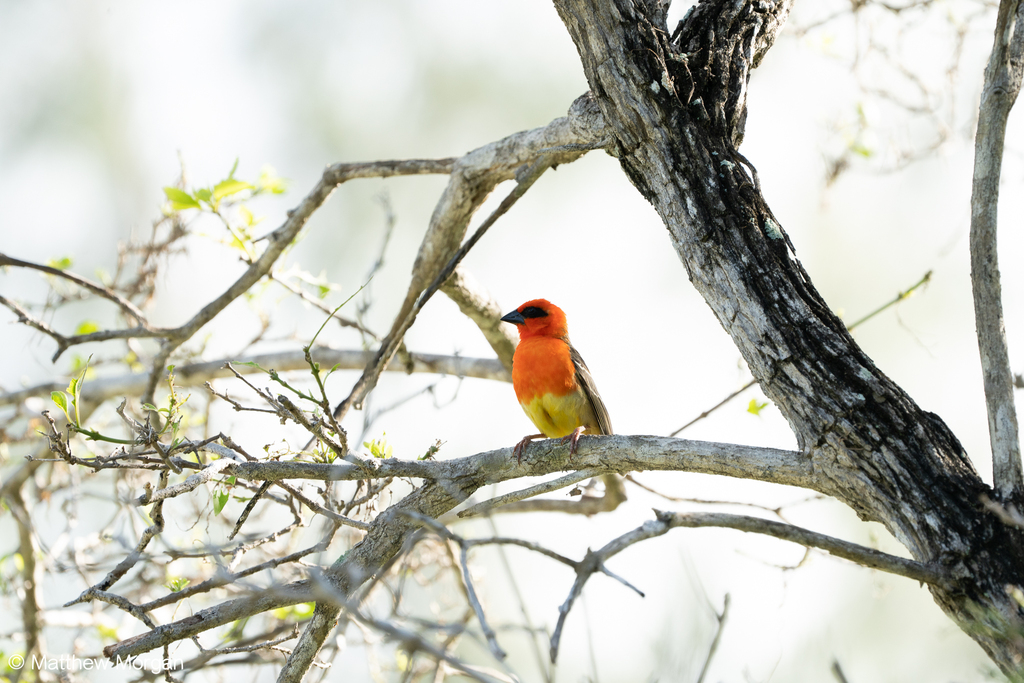
The Aldabra fody (Foudia aldabrana) is a passerine bird in the family Ploceidae. It is endemic to Aldabra, an atoll northwest of Madagascar, part of Seychelles. Regarded as conspecific with the Comoros fody in the past, it is now recognized as a distinct species by the International Union for the Conservation of Nature (IUCN). Both sexes are yellow in color across much of the body, with breeding males orange-scarlet on the head and neck. The species has a large and powerful bill, used to compete with other birds of Aldabra for food. Nesting occurs over several months, often in introduced coconut palms and Casuarina trees. The Aldabra fody is considered endangered by the IUCN, threatened by predation of nests and drought. Hybridization with the related Madagascar fody has occurred in the past, but is not currently considered a danger to the species.
From the article Aldabra fody on Wikipedia (CC BY-SA), quoted section by section
Description
The Aldabra fody's bill is markedly long and heavy, a distinctive characteristic. The female is similar to a sparrow, but more yellow, with dark streaks and a more powerful bill. The breeding plumage of the male is orange-scarlet on the head and breast, with yellow on the back and body, sides and flanks imbued with olive-gray, a sulfur-yellow belly, yellowish white tips on the median covert feathers, and an orange rump. An article published in the Bulletin of the African Bird Club, a conservationist journal, described the males of the species as the "most attractive of all fodies". Immature birds are similar to the female. All plumages contain yellow tones, and all are more yellow than the related Comoros and Madagascar fodies, especially on the underparts.
Voice. There were no published recordings of the Aldabra fody's vocalizations as of 2013, but they have been well-described. There are a great variety, with many based on high-pitched and metallic two-eet, twee, or tee calls. They produce a trilling song sequence consisting of a variety of notes, described by one study as tsee-oo tsee-oo tsee-oo fsssssss looklooklooklooklook. Males generate a nasal "fizzing" noise associated with territorial defense, suggested by one ornithological encyclopedia to correspond to the fsssssss noise reported in the study. …
Range & habitat
The Aldabra fody is endemic to Aldabra, an atoll located about 400 kilometres (250 mi) northwest of Madagascar, belonging to Seychelles. The species is widespread on Aldabra, found on all main islands, as well as smaller islets of the lagoon. The atoll, which makes up one third of the total land of Seychelles, is protected by the government as a nature reserve. "Cardinals" reported on Astove and possibly Cosmoledo in the 19th century may have been the Aldabra fody, but there is no proof of this. The Aldabra fody can be found in scrub, Cocos nucifera groves, or Casuarina woodland. Their territories may be as little as 840 square metres (1,000 yd2) in groves of large trees, which could indicate a possible forest ancestry, although there are no forests on Aldabra.
Wikipedia: “Distribution and habitat”
What it does
Adult males spend most of the year defending and maintaining nesting territories. They are strongly territorial, with a characteristic threat display consisting of drooping the wings and tail while puffing out the feathers of the head, breast, and rump. Intruders are challenged with a variety of calls; this may occur with a female, but upon recognition, the calls become a series of high whistles, uttered by one or both. The male then raises its wings above its back, and, if accepted, mounts and copulates with the female, wings remaining raised. Copulation has been observed in November and December. Nesting has been reported in November, December, and January, probably extending to February or March. The birds prefer to nest in coconut palms and Casuarina trees, neither of which are native to Aldabra. This may be a response to predation by the introduced Rattus rattus. Nests are large, open on the side, and partially domed. They are made of small twigs, weed stems, and coarse grasses, lined with finer grasses. The eggs, which are laid in clutches variously reported as containing 2–4 eggs, are pale glaucous green (approaching blue), unspotted, and elongate ovate in shape, with thin, glossy shells. In size, they are 2.05 centimetres (0.81 in) × 1.4 centimetres (0.55 in) on average.
Wikipedia: “Reproduction”
Listen
Looking for field recordings…
Where it lives
Recorded sightings
—
geo-referenced records in GBIF, from museums, herbaria and field observers.
Drag the globe to turn it. Dots are where records exist, not a range map; darker means more records.
In the stacks
Searching the stacks…
Every page naming Foudia aldabrana in the Biodiversity Heritage Library →
This page is assembled live from iNaturalist, GBIF, Wikipedia, the Source Library and the Internet Archive. It is not yet part of the hand-edited codex. iNaturalist taxon 979719.