- Animals
- ›Chordates
- ›Vertebrates
- ›Birds
- ›Swifts and Hummingbirds
- ›Hummingbirds
- ›Bee Hummingbirds, Emeralds, Mountain-gems, and Allies
- ›Bee Hummingbirds and Allies
- ›Philodice
On eBird ↗
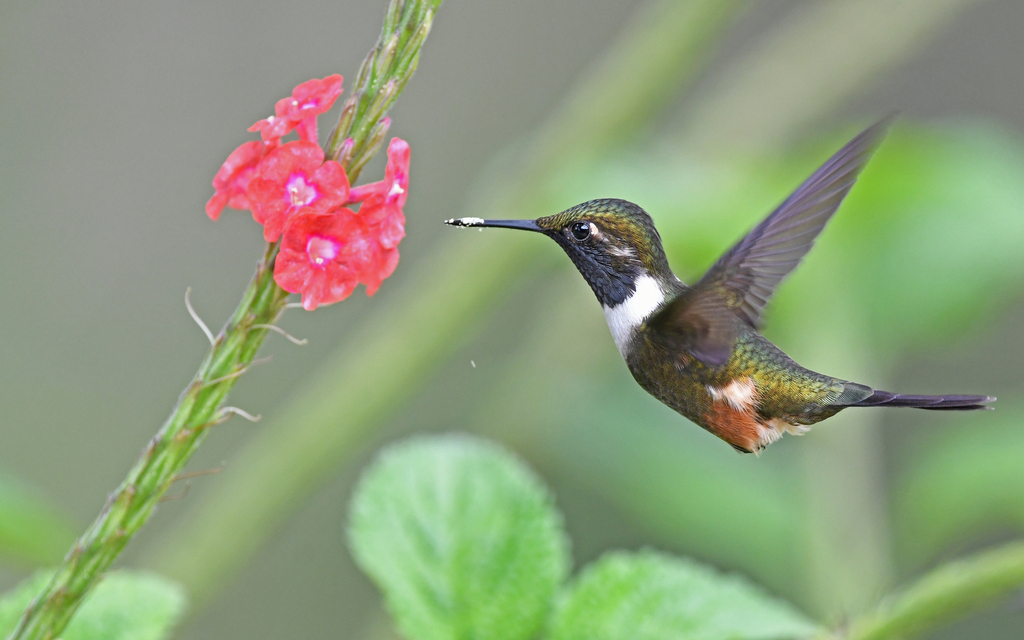
Purple-throated Woodstar
Live sightings near you, the range map, bar charts of when it is seen, and Macaulay Library photos and recordings.
Purple-throated Woodstar
Philodice mitchellii
The purple-throated woodstar (Calliphlox mitchellii) is a species of hummingbird, and it is one of the four Calliphlox species, the woodstars. The species is found in Colombia and Ecuador, and a minor localized population in Panama, 600 km from its main species distribution.
From the article Purple-throated woodstar on Wikipedia (CC BY-SA), quoted section by section
Description
The purple-throated woodstar is 6.8 to 7.5 cm (2.7 to 3.0 in) long and weighs 3.0 to 3.3 g (0.11 to 0.12 oz). Both sexes have a short, straight, black bill. Both have dusky bronze-green upperparts with a white patch on either side of the rump. The male has a small white spot behind the eye and the female a downward curved white line there. The male's gorget is shining violet-purple with a white band below it. Its lower breast is dusky bronze and the belly and flanks rufous. The forked tail is brownish purple. The female has a buffy white throat with dusky speckles at the side, a white band below it, a green lower breast, and a rufous belly. Its central tail feathers are bronze-green and the others cinnamon with a black band near the end.
Range & habitat
The purple-throated woodstar is found discontinuously in eastern Panama's Darién Province, along both slopes of Colombia's western Andes and south to central Ecuador, and in southern Ecuador. It inhabits the edges and interior of humid forest and cloudforest. In elevation in ranges from sea level to 2,400 m (7,900 ft) but is most numerous above 1,000 m (3,300 ft).
Wikipedia: “Distribution and habitat”
What it does
The purple-throated woodstar forages for nectar high in flowering trees such as those of genera Cordia and Inga. Males defend feeding territories. In addition to feeding on nectar the species captures small arthropods by hawking from a perch.
Wikipedia: “Feeding”
Listen
Looking for field recordings…
Where it lives
Recorded sightings
—
geo-referenced records in GBIF, from museums, herbaria and field observers.
Drag the globe to turn it. Dots are where records exist, not a range map; darker means more records.
In the stacks
Searching the stacks…
Every page naming Philodice mitchellii in the Biodiversity Heritage Library →
This page is assembled live from iNaturalist, GBIF, Wikipedia, the Source Library and the Internet Archive. It is not yet part of the hand-edited codex. iNaturalist taxon 979878.