On eBird ↗
Yucatan Gnatcatcher
Live sightings near you, the range map, bar charts of when it is seen, and Macaulay Library photos and recordings.
Yucatan Gnatcatcher
Polioptila albiventris
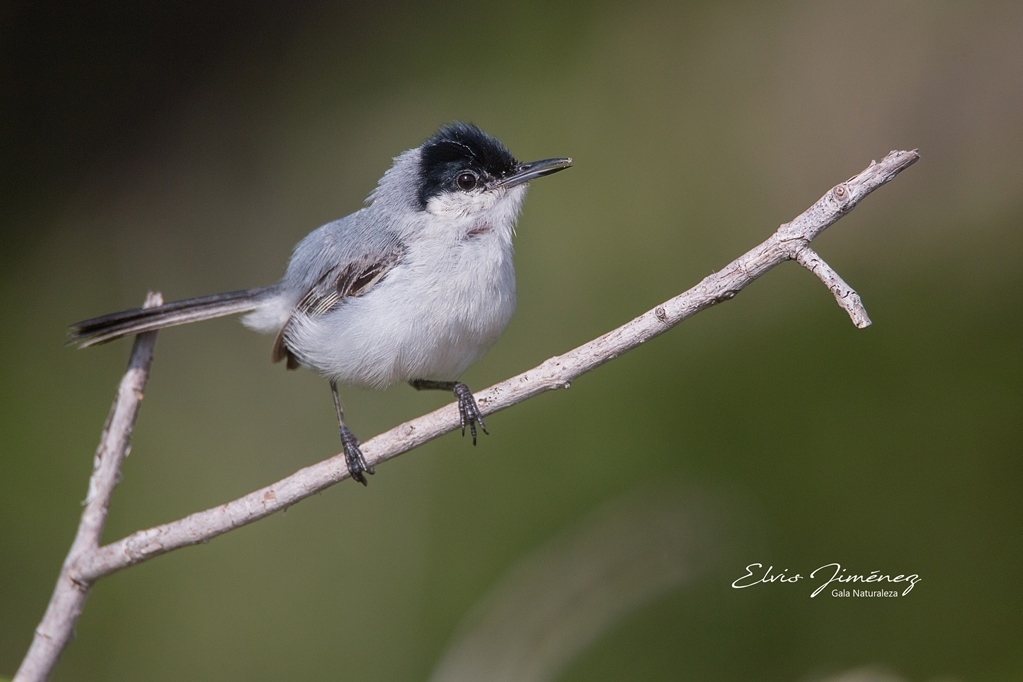
The Yucatan gnatcatcher (Polioptila albiventris) is a species of bird in the family Polioptilidae. It is endemic to the Yucatán Peninsula in Mexico.
From the article Yucatan gnatcatcher on Wikipedia (CC BY-SA), quoted section by section
Description
The Yucatan gnatcatcher is 10 to 12 cm (3.9 to 4.7 in) long. Six males weighed 5.4 to 6.2 g (0.19 to 0.22 oz) and three females 5.0 to 5.7 g (0.18 to 0.20 oz). The female's upperparts are plumbeous gray from the crown to the rump. Its underparts are white with sometimes a pale grayish wash on the flanks. The tail's central feathers are black and each pair out from them are progressively more white until the all white outermost pair. It has a narrow white supercilium. The male's basic (non-breeding) plumage is essentially the same. Its alternate (breeding) plumage is also similar with the addition of a black cap that extends to the middle of its eye.
Range & habitat
The Yucatan gnatcatcher is found only on the northern coast of Mexico's Yucatan Peninsula. Its primary habitat is arid coastal scrub, and it also occurs in low deciduous woodlands and coastal mangroves. Most observations are within 50 km (31 mi) of the ocean where the maximum elevation appears to be approximately 200 m (660 ft).
Wikipedia: “Distribution and habitat”
What it does
No information on the Yucatan gnatcatcher's diet or feeding technique has been published, but in common with others of its genus, "its diet is presumed to consist largely of small invertebrates gleaned from foliage or captured with short sallies."
Wikipedia: “Feeding”
Listen
Looking for field recordings…
Where it lives
Recorded sightings
—
geo-referenced records in GBIF, from museums, herbaria and field observers.
Drag the globe to turn it. Dots are where records exist, not a range map; darker means more records.
In the stacks
Searching the stacks…
Every page naming Polioptila albiventris in the Biodiversity Heritage Library →
This page is assembled live from iNaturalist, GBIF, Wikipedia, the Source Library and the Internet Archive. It is not yet part of the hand-edited codex. iNaturalist taxon 979906.