On eBird ↗
Little Shearwater
Live sightings near you, the range map, bar charts of when it is seen, and Macaulay Library photos and recordings.
Little Shearwater
Puffinus assimilis
The little shearwater (Puffinus assimilis) is a small shearwater in the petrel family Procellariidae. Despite the generic name, it is unrelated to the puffins, which are auks, the only similarity being that they are both burrow-nesting seabirds.
From the article Little shearwater on Wikipedia (CC BY-SA), quoted section by section
Description
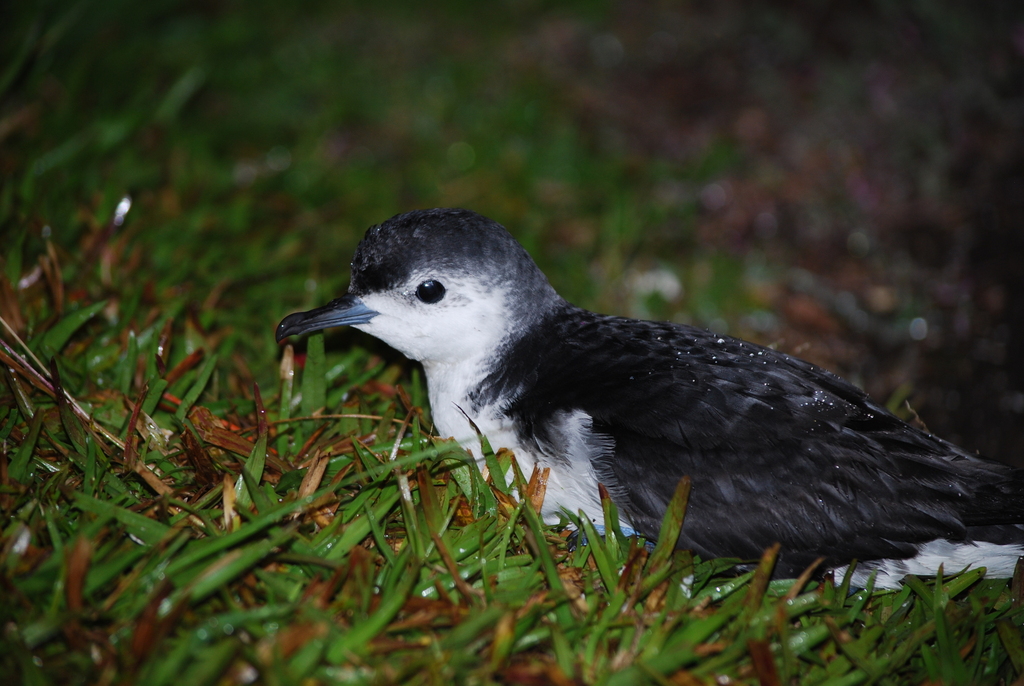
This shearwater has the typically "shearing" flight of the genus, dipping from side to side on stiff wings with few beats, the wingtips almost touching the water, though in light winds it has a more flapping flight than that of its larger relatives. In flight it looks cross-shaped, with its wings held at right angles to the body, its colouration changing from black to white as the black upperparts and white underparts are alternately exposed as it travels low over the sea. At 25–30 cm (9.8–11.8 in) in length with a 58–67 cm (23–26 in) wingspan, it is like a small Manx shearwater but has proportionally shorter and broader wings, with a pale area on the inner flight feathers. Its bill is more slender than that of Manx, and its dark eye stands out against the surrounding white area.
Range & habitat
P. a. assimilis Gould, 1838 — Lord Howe Island and Norfolk Island P. a. haurakiensis Fleming, CA & Serventy, 1943 — northeastern North Island (NZ) P. a. kermadecensis Murphy, 1927 — Kermadec Islands P. a. tunneyi Mathews, 1912 — islands off southwestern Australia It breeds in colonies on islands and coastal cliffs, nesting in burrows which are only visited at night to avoid predation by large gulls.
Wikipedia: “Distribution and habitat”
What it does
This is a gregarious species, which can be seen in large numbers from boats or headlands, especially on migration in autumn. It feeds on fish and molluscs. It does not follow boats. It is silent at sea, but at night the breeding colonies are alive with raucous cackling calls. It nests in cavities located in grassy fields or in those found among rocks.
The little shearwater usually produces a clutch of one clear white egg, measuring around 51 by 35 millimetres (2.0 by 1.4 in). The egg is incubated for 52 to 58 days by both sexes.
Wikipedia: “Behaviour”
Listen
Looking for field recordings…
Where it lives
Recorded sightings
—
geo-referenced records in GBIF, from museums, herbaria and field observers.
Drag the globe to turn it. Dots are where records exist, not a range map; darker means more records.
In the stacks
Searching the stacks…
Every page naming Puffinus assimilis in the Biodiversity Heritage Library →
This page is assembled live from iNaturalist, GBIF, Wikipedia, the Source Library and the Internet Archive. It is not yet part of the hand-edited codex. iNaturalist taxon 979929.