On eBird ↗
Long-billed Gnatwren
Live sightings near you, the range map, bar charts of when it is seen, and Macaulay Library photos and recordings.
Long-billed Gnatwren
Ramphocaenus melanurus
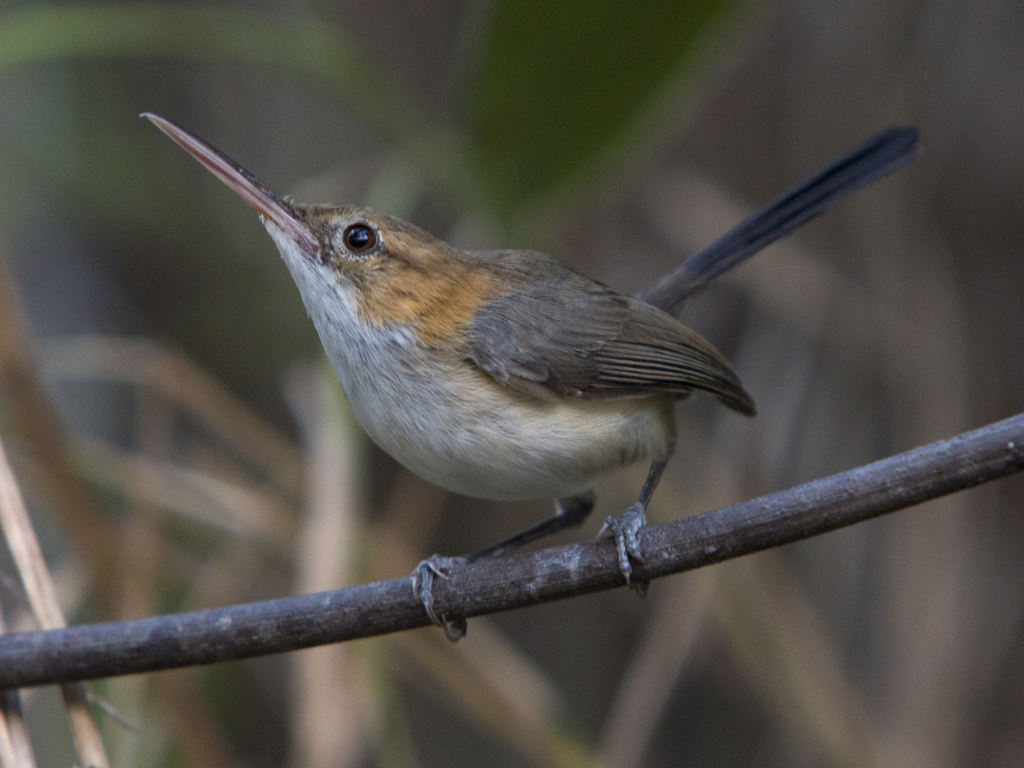
The trilling gnatwren (Ramphocaenus melanurus), formerly long-billed gnatwren, is a very small bird in the gnatcatcher family. It found from southeast Mexico south to Ecuador and Amazonia.
From the article Trilling gnatwren on Wikipedia (CC BY-SA), quoted section by section
Description
Adult trilling gnatwrens are 12–13 cm (4.7–5.1 in) in length and weigh 8–11 g (0.28–0.39 oz). They have a long, thin bill and a short cocked tail. The upperparts are grey-brown, with rufous on the sides of the head. The throat is white, shading to buff on the rest of the underparts. The tail is black with white tips to all but the central feathers, and is frequently wagged. R. m. trinitatis, of eastern Colombia, Venezuela and Trinidad has paler underparts, and buff flanks and head sides. The call is a trilled drdrdrdrdrdrdrdrdrdr.
Range & habitat
It is found in the undergrowth and vines of dry forest and secondary woodland from Mexico south to Peru and Brazil, and on Trinidad.
Wikipedia: “Habitat”
What it does
Trilling gnatwrens forage actively in vegetation, eating mainly insects, insect eggs and spiders. They usually occur in pairs or family groups.
Wikipedia: “Feeding”
Listen
Looking for field recordings…
Where it lives
Recorded sightings
—
geo-referenced records in GBIF, from museums, herbaria and field observers.
Drag the globe to turn it. Dots are where records exist, not a range map; darker means more records.
In the stacks
Searching the stacks…
Every page naming Ramphocaenus melanurus in the Biodiversity Heritage Library →
This page is assembled live from iNaturalist, GBIF, Wikipedia, the Source Library and the Internet Archive. It is not yet part of the hand-edited codex. iNaturalist taxon 979934.