On eBird ↗
Azure-rumped Tanager
Live sightings near you, the range map, bar charts of when it is seen, and Macaulay Library photos and recordings.
Azure-rumped Tanager
Poecilostreptus cabanisi
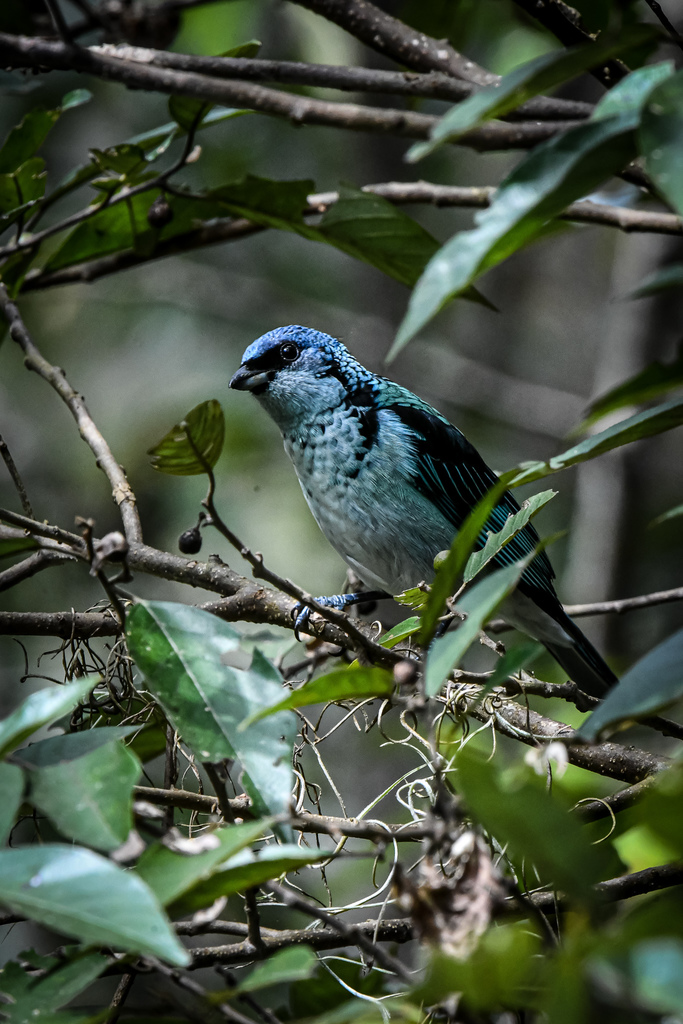
The azure-rumped tanager or Cabanis's tanager (Poecilostreptus cabanisi) is a species of bird in the family Thraupidae. It is a local resident in humid broadleaf forests and adjacent plantations of the Pacific slope of western Guatemala and southern Chiapas, Mexico. It has been reported at elevations of 850–1,900 m (2,790–6,230 ft).
From the article Azure-rumped tanager on Wikipedia (CC BY-SA), quoted section by section
Description
Its plumage is mostly pale blue, with a purplish-blue crown, dark lores and lower auriculars, and distinctive dark spots across the chest. The mantle is mottled greenish-blue and black. The wings and tail are black with blue edgings. The bill is gray with a dark tip. Cabanis's tanagers utter several sibilant vocalizations, hard trills and twitters. The azure-rumped tanager is omnivorous, feeding on fruit and arthropods. In Guatemala, abundance was positively correlated with the density of Ficus aurea trees. Figs of that tree are a main food source. The nesting season ranges from April to September, during which azure-rumped tanagers move in pairs or family groups. Cooperative breeding has been reported. Outside the breeding season, larger flocks of up to 18 birds have been reported. The azure-rumped tanager is Vulnerable because of deforestation to clear the way for coffee plantations. In Guatemala, only 21% or 25,000 ha (62,000 acres) of the potential area of distribution are still covered with broadleaf forest, the tanager's prime habitat. 80,000 ha or 68% of the potential area of distribution is covered with coffee plantations. It is estimated that there are 8,250–23,250 birds left in Guatemala. …
Listen
Looking for field recordings…
Where it lives
Recorded sightings
—
geo-referenced records in GBIF, from museums, herbaria and field observers.
Drag the globe to turn it. Dots are where records exist, not a range map; darker means more records.
In the stacks
Searching the stacks…
Every page naming Poecilostreptus cabanisi in the Biodiversity Heritage Library →
This page is assembled live from iNaturalist, GBIF, Wikipedia, the Source Library and the Internet Archive. It is not yet part of the hand-edited codex. iNaturalist taxon 979979.