- Animals
- ›Chordates
- ›Vertebrates
- ›Birds
- ›Rollers, Kingfishers, and Allies
- ›Kingfishers
- ›Tree Kingfishers
- ›Tanysiptera
On eBird ↗
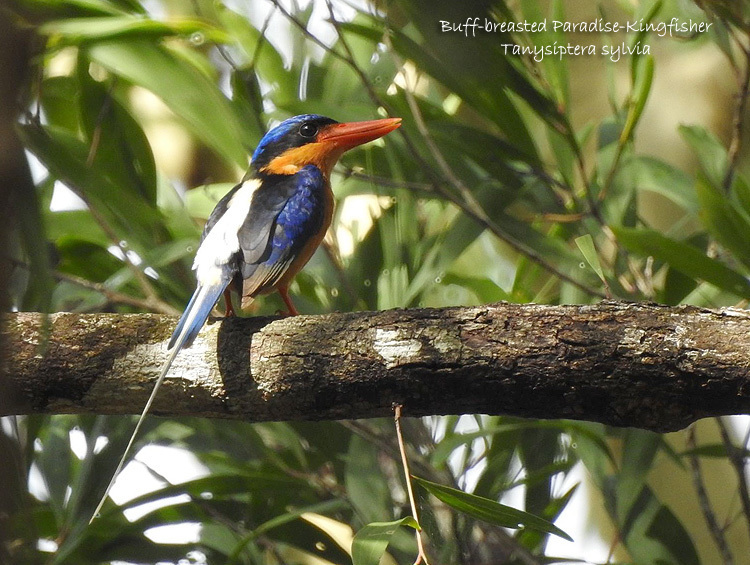
Buff-breasted Paradise-Kingfisher
Live sightings near you, the range map, bar charts of when it is seen, and Macaulay Library photos and recordings.
Buff-breasted Paradise Kingfisher
Tanysiptera sylvia
The buff-breasted paradise kingfisher (Tanysiptera sylvia) is a bird in the tree kingfisher subfamily, Halcyoninae. It is native to Australia and New Guinea. It migrates in November from New Guinea to its breeding grounds in the rainforest of North Queensland, Australia. Like all paradise kingfishers, this bird has colourful plumage with a red bill, buff breast and distinctive long tail streamers.
From the article Buff-breasted paradise kingfisher on Wikipedia (CC BY-SA), quoted section by section
Description
Like all paradise kingfishers, the buff-breasted is brightly coloured with a large red bill, rich rufous-buff underparts, blue or purple cap, crown and outer tail feathers, black eye stripes running down to the nape of its neck, red feet, white lower back and rump and long white or blue-and-white tail-feathers which varies geographically. The identifying feature is the white patch on the centre of the upper back. The juvenile has a brown bill, yellowish feet, is duller and lacks long tail feathers. An adult male is 35 cm (14 in) in length including the tail feathers which extend 13 cm (5.1 in) beyond the rest of the tail. An adult female is 30 cm (12 in), including much shorter tail feathers, extending 8 cm (3.1 in) beyond the rest of the tail. Tails vary in length but are approximately 18 cm (7.1 in). Tail-feathers of juveniles and immatures are shorter than adults. The tail feathers are often damaged towards the end of the breeding season, most likely from entering and leaving the burrow and regrow before the next mating season. The wingspan for an adult male is 35 cm (14 in) and adult female is 34 cm (13 in). They weigh 45–50 g (1.6–1.8 oz).
Vocalisation. Despite its bright colours, the buff-breasted paradise kingfisher is often difficult to see in the rainforest and is best located by its distinctive calls. …
Range & habitat
During the breeding season from November to March, the buff-breasted paradise kingfisher is found in coastal north-east Queensland from islands in the Torres Strait and Cape York Peninsula south to Byfield, in central Queensland. Individual sightings have been recorded at Eurimbula National Park, south of Gladstone, and on islands of the Great Barrier Reef. The buff-breasted paradise kingfisher inhabits lowland monsoon rainforest, and isolated patches of hill forest in areas where active termite mounds suitable for nesting are located. They usually perch in the mid-storey and lower canopy, coming to the ground to feed.
Migration. The subspecies T. s. sylvia breeds in north east Queensland from November to early April before migrating north to New Guinea for the non-breeding season. Juveniles depart up to 3 weeks after adults. The distance travelled for each population ranges between 400 and 2000 km depending on the breeding and non-breeding locations. The buff-breasted paradise kingfisher is believed to migrate in flocks at night as large numbers of birds suddenly appear in Queensland rainforests at the start of the breeding season early in the morning. Many birds are believed to perish during the 80 km flight from New Guinea to Australia. …
Wikipedia: “Distribution and habitat”
What it does
The species shows signs of territorial behaviour in non-breeding grounds in New Guinea where single birds defend their resources. During the breeding season in Australia territories are defended by pairs.
Breeding. In Australia nests are made in termite mounds of Microcerotermes serratus on the ground. Nests have also been recorded in mounds attached to living trees with the bases 1.5–3 m (4.9–9.8 ft) above the ground. The kingfishers use termitaria on the ground as well as in trees. The breeding season in Australia begins soon after arrival in mid-October to early November. Mounds are typically 40–70 cm (16–28 in) high and 40–50 cm (16–20 in) wide. An entrance, usually 4 cm (1.6 in) across is made in the side about 35–50 cm (14–20 in) from the ground Tunnel entrances have been observed on the downhill side of the mounds. Soon after arrival the birds commence work on their nests, usually spending 3–4 weeks burrowing out a 15 cm (5.9 in) tunnel. The floor of the tunnel is flat and smooth with a rounded chamber at the end. No nesting material is used. Birds may use the same mound in subsequent years but always have to dig a fresh tunnel as termites usually fill in the hole from the previous year. Not all mounds that are excavated are used as nests. Some are left inactive although they may be used when active nests are predated. …
Wikipedia: “Behaviour”
In human culture
The buff-breasted paradise kingfisher has been depicted on the 22 cent Australian stamp in 1980 and the 25 toea Papua New Guinea stamp in 1981.
Wikipedia: “Culture”
Listen
Looking for field recordings…
Where it lives
Recorded sightings
—
geo-referenced records in GBIF, from museums, herbaria and field observers.
Drag the globe to turn it. Dots are where records exist, not a range map; darker means more records.
In the stacks
Searching the stacks…
Every page naming Tanysiptera sylvia in the Biodiversity Heritage Library →
This page is assembled live from iNaturalist, GBIF, Wikipedia, the Source Library and the Internet Archive. It is not yet part of the hand-edited codex. iNaturalist taxon 980013.