On eBird ↗
Ethiopian White-eye
Live sightings near you, the range map, bar charts of when it is seen, and Macaulay Library photos and recordings.
Ethiopian white-eye
Zosterops poliogastrus
The Ethiopian white-eye (Zosterops poliogastrus), formerly known as Heuglin's white-eye or montane white-eye, is a small passerine bird in the white-eye family Zosteropidae. It is native to the Ethiopian Highlands. Its natural habitats range from subtropical or tropical moist montane forests, to subtropical or tropical high-altitude shrubland, plantations, and rural gardens.
From the article Ethiopian white-eye on Wikipedia (CC BY-SA), quoted section by section
Description
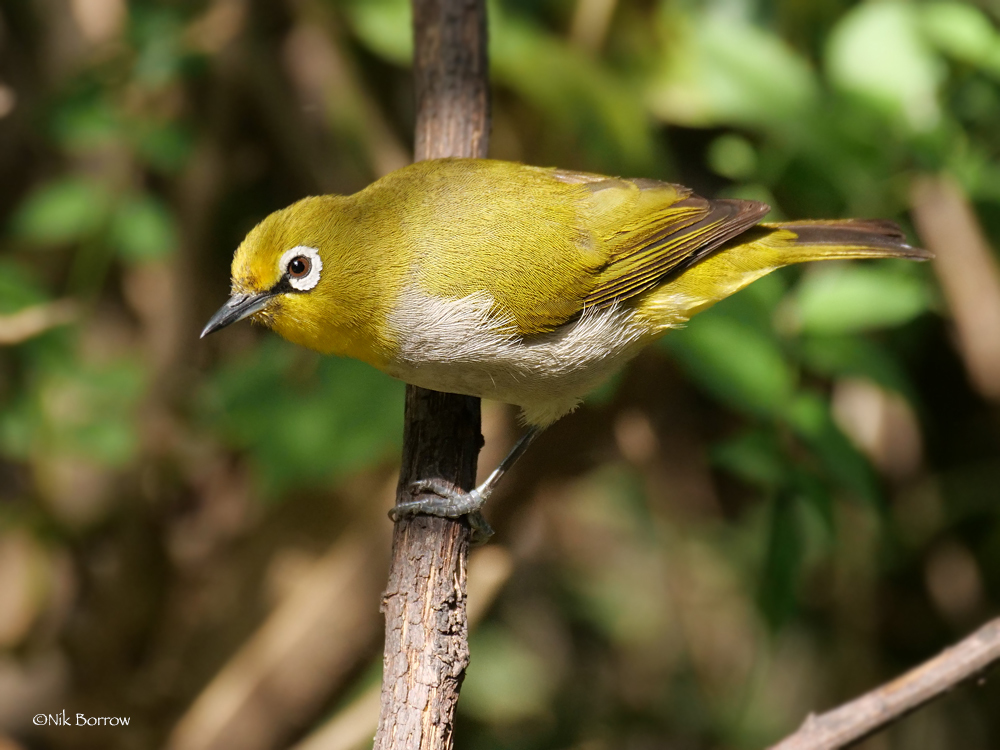
The Ethiopian white-eye has a vivid yellow head and crown that extends all the way to its white eyering and a narrow black line extending from the eye to its black beak. Underneath the beak, the rest of the head is yellow as well. The flight feathers are lime-green. The tips of the feathers then shift to a brownish black. The sexes are similar in appearance.
Range & habitat
During the dry season, the Heuglin's white-eye are commonly found in large flocks of up to fifty birds. However, in the wet season, flocks of this size are only seen in the early mornings or late afternoons. The habitat generally consists of woodland and forest edges, as well as isolated cultivations. In these areas, they commonly live in younger growths or shorter trees. They live anywhere from 1340 to 3640 meters.
Wikipedia: “Distribution and habitat”
What it does
The diet mainly consists of berries and small insects. However, in the months of September and November they can be found foraging on Leonotis flowers. During the dry season, this bird is mainly frugivorous, while insectivorous in the wet season.
== References ==
Wikipedia: “Diet”
Listen
Looking for field recordings…
Where it lives
Recorded sightings
—
geo-referenced records in GBIF, from museums, herbaria and field observers.
Drag the globe to turn it. Dots are where records exist, not a range map; darker means more records.
In the stacks
Searching the stacks…
Every page naming Zosterops poliogastrus in the Biodiversity Heritage Library →
This page is assembled live from iNaturalist, GBIF, Wikipedia, the Source Library and the Internet Archive. It is not yet part of the hand-edited codex. iNaturalist taxon 980052.