On eBird ↗
New Zealand Fernbird
Live sightings near you, the range map, bar charts of when it is seen, and Macaulay Library photos and recordings.
New Zealand Fernbird
Poodytes punctatus
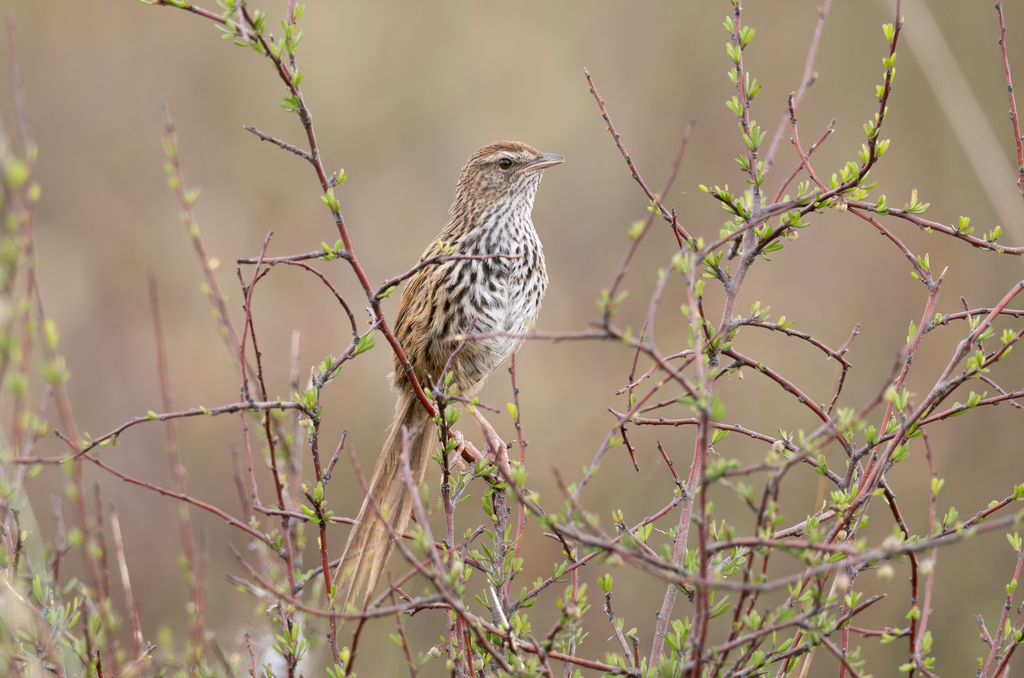
The New Zealand fernbird or simply fernbird (Poodytes punctatus) is an insectivorous bird endemic to New Zealand. In the Māori language, it is named kōtātā or mātātā.
From the article New Zealand fernbird on Wikipedia (CC BY-SA), quoted section by section
Description
The adult has a brown plumage streaked in black. The head, the upperparts and the brown wings are streaked blackish. The long graduated tail is a duller brown, with the rectrices darker. On the underparts, the chin, throat, breast and abdomen are whitish, finely mottled and also streaked blackish on the breast. The flanks, the sides of the chest and the subcaudal covers are brown and streaked blackish, more clearly on the flanks. On the head, the forehead and cap are brown. The presence of a whitish eyebrow may be more or less clear. The auricular coverts are grey-brown with darker fine streaks that blend into the brown of the upperparts on the sides of the neck. The beak is blackish, with the lower mandible more gray. The eyes are dark brown. Legs and toes are pinkish-brown. Both sexes are similar and the juvenile also looks like the adults. The New Zealand fernbird is a rich brown above and white below, with brown spots on both the throat and breast. Early settlers called it the "swamp sparrow", no doubt because of its colouration. The tail feathers are thin, dark brown, and spine-like. The birds reach a length of 18 cm (7 in) ― as measured from tip of beak to end of tail. However, almost half of that is tail.
What it does
The New Zealand fernbird is a reluctant flier, mainly moving about in vegetation or in occasional flights of less than 15 metres just above the vegetation. In the 19th century, Walter Buller described it as "one of our most common" birds, but it has been adversely affected by the subsequent widespread destruction of its natural wetland habitat following European settlement and is now rare. The New Zealand fernbird lives mainly in wet shrubby environments with swamps, peat bogs or ponds, plantation areas, temperate shrublands. It occupies an extremely wide area of occurrence at 657,000 km². Field studies of the South Island fernbird showed they preferred shrubby habitats with low dense ground vegetation near an estuary margin. The New Zealand fernbird is insectivorous. It feeds on caterpillars, larvae, beetles, flies and moths, as well as small spiders emerging from the cocoon. It sometimes consumes seeds and fruits. Its song is a series of rapid whistles and clicks. The contact between the two partners is a duet, a characteristic "u-tick", that is, a sonorous "uu" for the male, to which the female answers with a high-pitched "tick". The calls are metallic. When disturbed or threatened, the male emits a typical "too-lit" and "di, di, di, di" repeated at a rapid pace.
Wikipedia: “Ecology”
In human culture
Māori revered the fernbird as an "oracle" or "wise bird" (Manu tohu). The calls of the bird were interpreted as heralding success or failure in daily activities such as fishing, but on a more serious level they could also portend prosperity and health or disaster and death.
Wikipedia: “Place in Māori culture”
Listen
Looking for field recordings…
Where it lives
Recorded sightings
—
geo-referenced records in GBIF, from museums, herbaria and field observers.
Drag the globe to turn it. Dots are where records exist, not a range map; darker means more records.
In the stacks
Searching the stacks…
Every page naming Poodytes punctatus in the Biodiversity Heritage Library →
This page is assembled live from iNaturalist, GBIF, Wikipedia, the Source Library and the Internet Archive. It is not yet part of the hand-edited codex. iNaturalist taxon 980144.