On eBird ↗
Bachman's Warbler
Live sightings near you, the range map, bar charts of when it is seen, and Macaulay Library photos and recordings.
Bachman's Warbler
Vermivora bachmanii
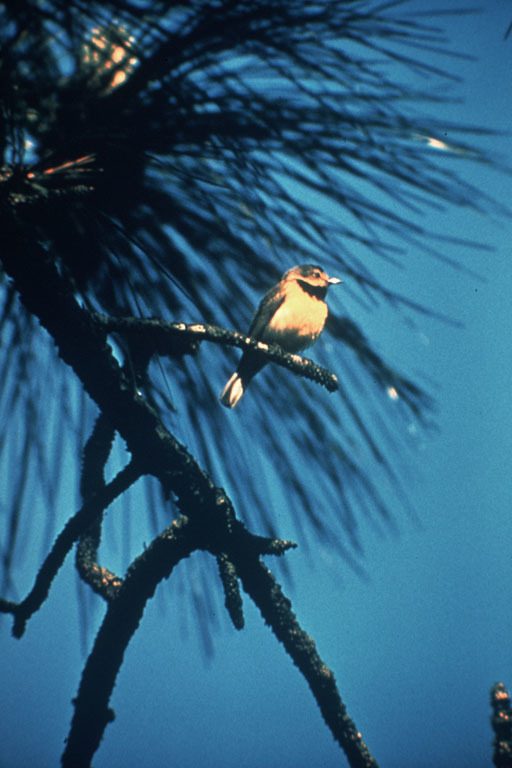
Bachman's warbler (Vermivora bachmanii) is an extinct passerine migratory bird. This warbler was a migrant, breeding in swampy blackberry and cane thickets of the Southeastern and Midwestern United States and wintering in Cuba. There are some reports of the bird from the twenty-first century, but none are widely accepted. Some authorities accept a Louisiana sighting in August 1988 as confirmed, but the last uncontroversial sightings date to the 1960s.
From the article Bachman's warbler on Wikipedia (CC BY-SA), quoted section by section
Description
Bachman's warbler was a sexually dimorphic species and the adults had two distinct plumages, one in the spring and one in the fall. In the spring, adult males had a yellow forehead and supercilium. The area below the bird's eye was yellow and the lores a dusky olive. The bird's forecrown was black with gray at the edges, while the rear crown and nape an olive-gray. The rest of the warbler's upperparts were an olive green, with the rump being the brightest. The chin and upper throat were yellow, while the center throat and upper chest were black. The belly was yellow and the undertail coverts white. Males in their first spring were nearly identical to the adult male, but had less black on their crown and chest. During the spring, adult females were a light yellow in their forehead and supraloral, blending into a gray crown and nape. Its lores were a gray-olive and it had a white eye ring. The rest of the female's upperparts were an olive-green, which like the male was brightest on the rump. The chin and throat were also a light yellow and the sides of the neck and the upper breast were gray. Older females had a few black upper breast feathers. The rest of the breast and the belly was light yellow, blending into white on the undertail coverts. The flanks were washed with gray. …
Range & habitat
Bachman's warbler bred primarily in two distinct regions, namely the southern Atlantic coastal plain and the Gulf Coast states north along the Mississippi River watershed to Kentucky. In the southern Atlantic coastal plain, the bird bred in South Carolina near Charleston, though it is believed to have once bred as far north as Virginia and south into Georgia. The Gulf Coast breeding habitat is located primarily in central Alabama, though reports from northern Mississippi and Louisiana are known. It bred north of Alabama along Arkansas's and Missouri's St. Francis River. Unaccepted records of breeding in eastern Texas, Oklahoma, and Tennessee are known. During migration, the species was primarily recorded in Florida and the Florida Keys, although a few birds migrated along the eastern Gulf Coast. Additionally, there is one spring migration record from the Bahamas in 1901. The species primarily wintered in Cuba. It was recorded wintering on Isla de la Juventud, and one wintering record is known from Florida. Unconfirmed reports of the species wintering in Georgia's Okefenokee Swamp exist. Bachman's warbler bred in timbered bottomland swamps with pools of still water. These swampy forests are mainly composed of deciduous trees such as cypress, sweet gum, dogwood, red oak, hickory, black gum, and tupelo. …
Wikipedia: “Distribution and habitat”
What it does
Due to the rarity of this species, little is known of its behavior. A lack of detailed field research has likewise resulted in Bachman's warbler being a poorly understood species. This species did not frequently pump its tail. When alarmed, a Bachman's warbler would jerk its tail and raise its crown feathers. The species did not frequently sing while migrating. Once it reached its breeding grounds, the warbler preferred to sing from high perches. The female warbler incubated eggs while the male looks for food. This species's foraging niche was low in elevation, between 3 and 10 ft (0.91 and 3.05 m). However, during migration it was also observed foraging in the tops of trees. This warbler could feed while hanging upside down to probe the bottoms of leaves. Bachman's warbler also fed by gleaning and probing into leaf clusters. The latter foraging strategy led some to hypothesize that Bachman's warbler specialized in foraging among dead leaves in canebrakes. Its primary prey included caterpillars, spiders, and other arthropods. It may have fed on nectar in Cuba, but this hypothesis is unproven. It may have been a colonial breeder. The nests were deep and bulky. Dead leaves, mosses, grasses, and weed stalks composed the exterior of the nest, while the interior cup was lined with fine fibers from Ramalina lichen and Spanish moss. …
Wikipedia: “Ecology and behavior”
In human culture
John James Audubon's folio renderings of a male and female Bachman's warbler were painted on top of an illustration of the Franklinia tree first painted by Maria Martin, John Bachman's sister-in-law and one of the country's first female natural history illustrators. In the comic strip Doonesbury, Dick Davenport, a bird watcher, died in 1986 of a massive coronary while observing and photographing this species, therefore proving its continued existence. This death scene has been noted as a particularly memorable one in the history of comics.
Wikipedia: “In culture”
Listen
Looking for field recordings…
Where it lives
Recorded sightings
—
geo-referenced records in GBIF, from museums, herbaria and field observers.
Drag the globe to turn it. Dots are where records exist, not a range map; darker means more records.
In the stacks
Searching the stacks…
Every page naming Vermivora bachmanii in the Biodiversity Heritage Library →
This page is assembled live from iNaturalist, GBIF, Wikipedia, the Source Library and the Internet Archive. It is not yet part of the hand-edited codex. iNaturalist taxon 9806.