On eBird ↗
Golden-winged Warbler
Live sightings near you, the range map, bar charts of when it is seen, and Macaulay Library photos and recordings.
Golden-winged Warbler
Vermivora chrysoptera
The golden-winged warbler (Vermivora chrysoptera) is a small migratory insectivorous bird in the New World warbler family Parulidae. It breeds in southeastern and south-central Canada and in the Appalachian Mountains in the northeastern to north-central United States. The majority (~70%) of the global population breeds in Wisconsin, Minnesota, and Manitoba. Golden-winged warbler populations are slowly expanding northwards but are generally declining across its range. This is most likely as a result of habitat loss and competition/interbreeding with the very closely related blue-winged warbler, Vermivora cyanoptera, albeit the latter point has been debated. Populations are now restricted to two regions: the Great Lakes and the Appalachian Mountains.
From the article Golden-winged warbler on Wikipedia (CC BY-SA), quoted section by section
Description
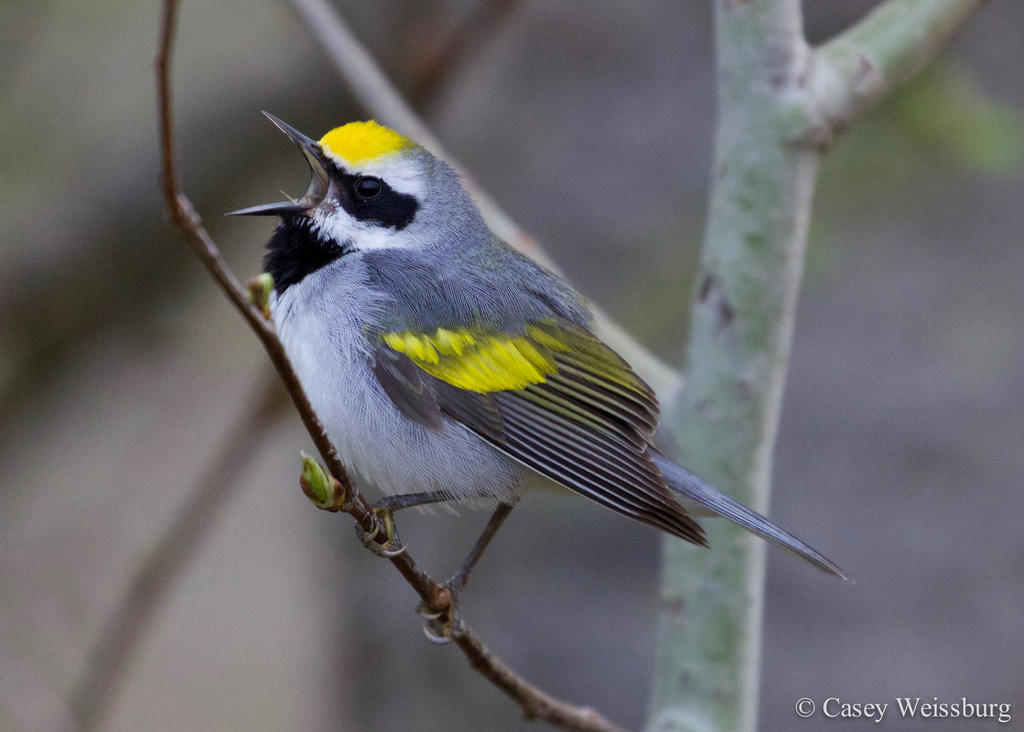
The golden-winged warbler is a small songbird, typically measuring 11.6 cm (4.6 in) long, weighing 8–10 g (0.28–0.35 oz), and having a wingspan of about 20 cm. The male has a black throat and a black mask bordered in white. Females resemble males but have a light gray throat and mask. Both sexes display a yellow crown, a yellow patch on the wing, and extensive white on the tail, which is conspicuous from below. The grayish white underparts contrast the darker gray back, and the bill is long and slender. Juvenile individuals appear similar to females, regardless of sex. Their song is variable, but is most often perceived as a trilled bzzzzzzz buzz buzz buzz. Their call is a buzzy chip or zip.
Range & habitat
Golden-winged warblers are migratory. There are two populations of golden-winged warblers, one which breeds in the Appalachian and Northeast, and another that breeds around the Great Lakes. Birds from the Appalachian population tend to migrate to South America to winter, while birds from the Great Lakes population tend to migrate to Central America and Mexico. A study has found that the difference in wintering location is linked to a genetic difference in the Z chromosome. They are also encountered rarely as vagrants outside of their native range. Golden-winged warblers are neotropical-nearctic migrants, and their habitat selectivity varies seasonally. Golden-winged warblers wintering in Costa Rica select premontane evergreen forest rather than tropical dry forest plant communities. Golden-winged warblers forage in hanging dead leaves, which are often a result of intermediate disturbances to the forest plant community. During the breeding season, golden-winged warblers nest in shrubland and regenerating forest communities created and maintained by disturbance. This dependency on early-successional plant communities is part of the reason golden-winged warbler populations are declining. Five geotracked golden-winged warblers in Tennessee were observed migrating hundreds of miles south, presumably avoiding tornadic storms, in April 2014. …
Wikipedia: “Distribution and habitat”
What it does
In 2015, scientists observed a female golden-winged warbler abandoning her two chicks 5 and 9 days after fledging. The two chicks were subsequently "adopted" by a male black-and-white warbler, which fed the fledglings for 23 days until they reached independence.
Wikipedia: “Other interspecific interactions”
Listen
Looking for field recordings…
Where it lives
Recorded sightings
—
geo-referenced records in GBIF, from museums, herbaria and field observers.
Drag the globe to turn it. Dots are where records exist, not a range map; darker means more records.
In the stacks
Searching the stacks…
Every page naming Vermivora chrysoptera in the Biodiversity Heritage Library →
This page is assembled live from iNaturalist, GBIF, Wikipedia, the Source Library and the Internet Archive. It is not yet part of the hand-edited codex. iNaturalist taxon 9807.