- Animals
- ›Chordates
- ›Vertebrates
- ›Ray-finned Fishes
- ›Carps, Characins, Catfishes and Allies
- ›Catfishes
- ›Siluroidei
- ›Eeltail Catfishes
- ›Cnidoglanis
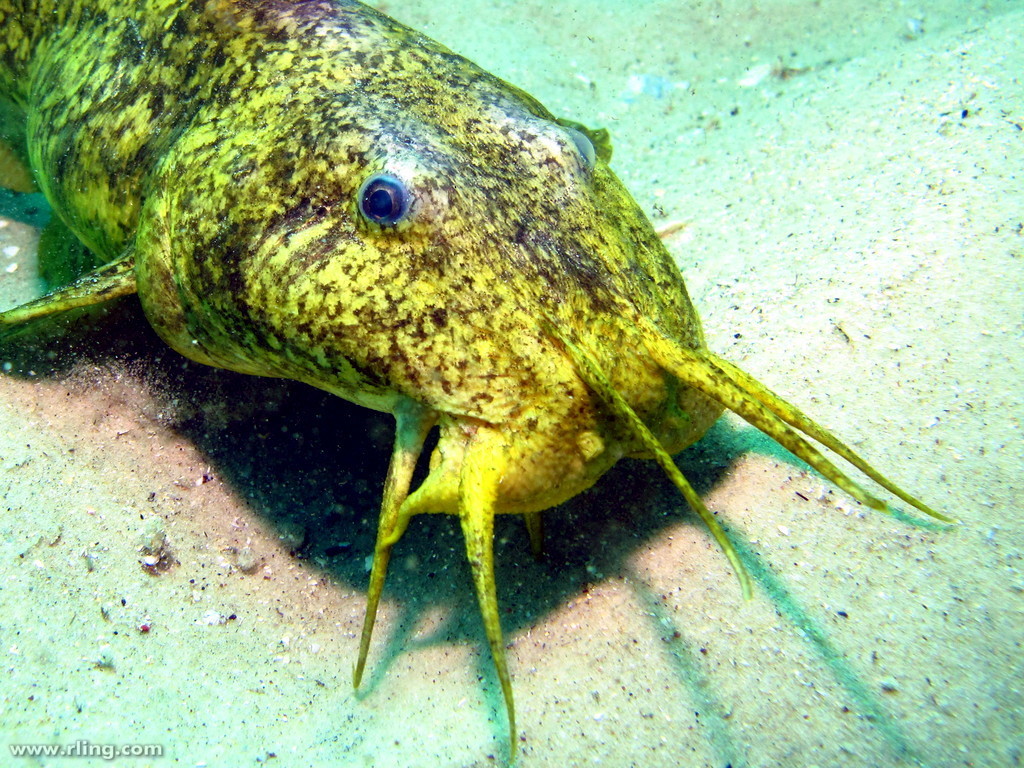
Estuary Cobbler
Cnidoglanis macrocephalus
Cnidoglanis macrocephalus is a species of catfish (order Siluriformes) of the family Plotosidae, and is the only species of the genus Cnidoglanis. It is commonly known as the cobbler, estuary cobbler, deteira, estuary catfish, South Australian catfish, or Swan River catfish.
From the article Cnidoglanis macrocephalus on Wikipedia (CC BY-SA), quoted section by section
Description
Like other eeltail catfish, the cobbler resembles a catfish in front, but an eel behind. It can grow up to 91 centimetres (36 in) SL, 2,500 g (5.5 lb). They may live up to 13 years. The dorsal and pectoral fins have sharp, venomous spines that can inflict painful wounds.
Range & habitat
The cobbler is found from Main Beach, Queensland to Jervis Bay, New South Wales, and Kingston SE, South Australia to Houtman Abrolhos Islands, Western Australia and Duck River, Tasmania, in near-shore and reef habitats.
Wikipedia: “Distribution”
What it does
The estuary cobbler is an inshore marine species which lives in shallow bays and sandy inlets near river mouths. It is found most frequently over sand, rocks, and weeds in the clear to turbid waters. By day, the estuary cobbler is most often found in holes and on ledges in banks. Estuary cobblers stay in holes and under ledges during the day, then come out at night to feed. They are opportunistic feeders, primarily feed on molluscs (bivalves and gastropods), crustaceans (prawns and amphipods), polychaete worms, algae, and organic debris. Juveniles eat more crustaceans, often from among drifting macrophytic algae, while adults feed mainly on molluscs and polychaetes. They are prey to birds such as cormorants and pelicans.
Wikipedia: “Ecology”
Where it lives
Recorded sightings
—
geo-referenced records in GBIF, from museums, herbaria and field observers.
Drag the globe to turn it. Dots are where records exist, not a range map; darker means more records.
In the stacks
Searching the stacks…
Every page naming Cnidoglanis macrocephalus in the Biodiversity Heritage Library →
This page is assembled live from iNaturalist, GBIF, Wikipedia, the Source Library and the Internet Archive. It is not yet part of the hand-edited codex. iNaturalist taxon 98089.