- Animals
- ›Chordates
- ›Vertebrates
- ›Reptiles
- ›Snakes and Lizards
- ›Lizards
- ›Iguanas and Allies
- ›Iguanas, Anoles, and Allies
- ›Iguanas and Chuckwallas
- ›Conolophus
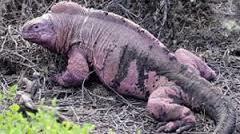
Galápagos Pink Land Iguana
Conolophus marthae
Conolophus marthae, also known commonly as the Galápagos pink land iguana, is a species of lizard of the family Iguanidae. This critically endangered iguana is native only to the Wolf Volcano in northern Isabela Island of the Galápagos Islands (Ecuador). It has a pink body with some dark stripes, prompting some to call it the pink iguana or the Galápagos rosy iguana. The species was first discovered in 1986, and in 2009 it was identified as a separate species, distinct from the Galápagos land iguana. The species C. marthae is the only example of ancient diversification in the genus Conolophus.
From the article Conolophus marthae on Wikipedia (CC BY-SA), quoted section by section
Description
Conolophus marthae is anatomically similar to the closely related species, C. subcristatus. Both exemplify the typical saurian body shape, having squat, quadrupedal bodies with elongated tails. The legs sprawl out to the sides like all lizards, and a row of short spines runs down the middle of the lizard's back starting from the base of the neck to the tail. However, there are a few anatomical differences between the two species. The crest of C. marthae has been described as somewhat different from that of C. subcristatus. The most apparent difference is that of coloration – the body of C. marthae is pinkish with a few wide, vertical dark bands. This is a stark contrast from the yellow-brown coloration of C. subcristatus. Additionally, the territorial head-nodding display of C. marthae is more complex than the display by the other land iguana species. The holotype of C. marthae, which was released after measurements and samples were taken, is an adult male that weighs 5 kg (11 lb), has a snout-vent length of 47 cm (19 in) and a tail length of 61.4 cm (24.2 in).
Wikipedia: “Anatomy”
Range & habitat
Individuals of the species Conolophus marthae first came into the public light in 1986 when park rangers spotted some pink lizards on the Wolf Volcano on Isabela Island, but a more thorough study by scientists only began in 2000. This volcano encompasses the entire distribution of the species and the range covers only 25 km2 (10 mi2), at altitudes between 600 and 1,700 m (2,000–5,600 ft).
Wikipedia: “Discovery and geographic range”
In human culture
A tentative specific name, rosada, was derived from the Spanish word meaning "pinkish" in reference to the animal's pinkish body color. The term was later abandoned for the formal description; and the specific name, marthae, was chosen in memory of Martha Rebecca Gentile, the stillborn daughter of the describer Gabriele Gentile. The species was first formally described in early 2009 as being distinct from the other land iguana populations. An initial genetic analysis of the pink subpopulation indicated that this particular species diverged from a common ancestor with C. subcristatus and C. pallidus some 5.7 million years past. A more recent study indicates that the split is more recent and occurred about 1.5 million years ago.
Wikipedia: “Taxonomy and etymology”
Where it lives
Recorded sightings
—
geo-referenced records in GBIF, from museums, herbaria and field observers.
Drag the globe to turn it. Dots are where records exist, not a range map; darker means more records.
In the stacks
Searching the stacks…
Every page naming Conolophus marthae in the Biodiversity Heritage Library →
This page is assembled live from iNaturalist, GBIF, Wikipedia, the Source Library and the Internet Archive. It is not yet part of the hand-edited codex. iNaturalist taxon 98346.